Why is Rainbow Mountain in Peru Colorful? Geology Behind the Colors
Ultima actualización en 7 September, 2026 por Jhon Quispe
Last Updated on 7 September, 2026 by Jhon Quispe
What Makes Rainbow Mountain in Peru Colorful?
Rainbow Mountain, or Vinicunca, is colorful because its exposed sedimentary layers contain different mixtures of clay-rich material, sandstone, carbonate-rich rock, iron-bearing minerals, and other geological components. Andean uplift and erosion exposed those layers, while weathering and oxidation modified some of their surface tones. The colors are natural, but each stripe is not simply one separate mineral, and light or moisture can change how intense the mountain appears.
- Why is Rainbow Mountain Peru Colorful?
- Rainbow Mountain’s geological formation
- Minerals and rock materials behind Vinicunca’s colors
- Why it is called the Mountain of Seven Colors
- How weather and light change Vinicunca’s appearance
- Where Rainbow Mountain is located
- Other colored geological landscapes near Cusco
- Frequently asked questions about Why is Rainbow Mountain Peru Colorful
Vinicunca is essentially a geological cross-section exposed across a high-Andean slope. Sediments with different compositions accumulated over a very long period, later became rock, were lifted during Andean mountain-building and eventually reached the surface through erosion and weathering.
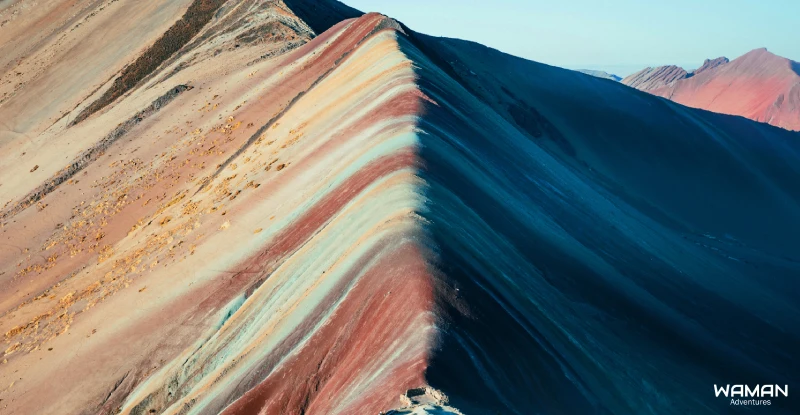
Exposed sedimentary layers create Vinicunca’s naturally striped appearance.
Why is Rainbow Mountain Peru Colorful?
Vinicunca’s colors come from differences between the sedimentary layers that form the mountain. Those layers contain varying proportions of clay-rich material, mudstones, sandstones, carbonate-rich rocks, iron-bearing minerals and other geological components.
When these materials are exposed at the surface, weathering and oxidation can modify their appearance. Layers with more iron-bearing material can develop red or reddish-brown tones, while sandstone or carbonate-rich layers can appear lighter. Greenish, lavender and yellow-brown bands reflect other combinations of sediments, minerals and surface alteration.
It is therefore more accurate to think of Rainbow Mountain as a sequence of differently composed rock layers than as a mountain where every color corresponds to one isolated mineral.
Peru’s official tourism inventory describes Vinicunca as a landscape whose multicolored stratification is associated with sediments deposited in marine, lacustrine and fluvial environments and later affected by tectonic and surface processes. Travelers who want to review the official attraction record can consult the Peruvian tourism inventory for Winikunka.
Rainbow Mountain’s geological formation
Rainbow Mountain did not become colorful through one sudden geological event. Its present appearance is the result of several processes acting in sequence over a very long period.
| Stage | What happened | Why it matters today |
| 1. Sediment deposition | Marine, lake and river environments deposited sediments with different compositions. | Those differences created the raw material for contrasting rock layers. |
| 2. Sedimentary rock formation | Accumulated sediments were compacted and preserved as layered sedimentary rock. | Changes in composition remained visible as distinct geological bands. |
| 3. Andean uplift and deformation | Tectonic compression associated with formation of the Andes raised, tilted and deformed the rock sequence. | Previously buried layers were brought to high elevation and exposed at new angles. |
| 4. Erosion | Water, wind, ice and other surface processes gradually removed overlying material. | Different internal layers became visible next to one another on the slopes. |
| 5. Weathering and oxidation | Exposed minerals reacted with water, oxygen and changing surface conditions. | These reactions helped modify and intensify some colors visible today. |
The mountain’s stripes are visible because tectonic deformation and erosion exposed layers that would otherwise remain buried. Their contrast depends on both the composition of the original sediments and the geological processes that brought them to the surface.

Uplift and erosion exposed Rainbow Mountain’s contrasting sedimentary layers.
Minerals and rock materials behind Vinicunca’s colors
The color-by-color explanation should be treated as a set of geological associations rather than a strict formula. A visible band can contain several minerals and sedimentary components, while weathering can alter the final color seen at the surface.
Iron-bearing minerals are especially relevant to many red, reddish-brown and yellow-brown tones because oxidation can produce iron oxides and hydroxides. The important point is that the bands are mixed geological materials rather than six perfectly separated mineral deposits.
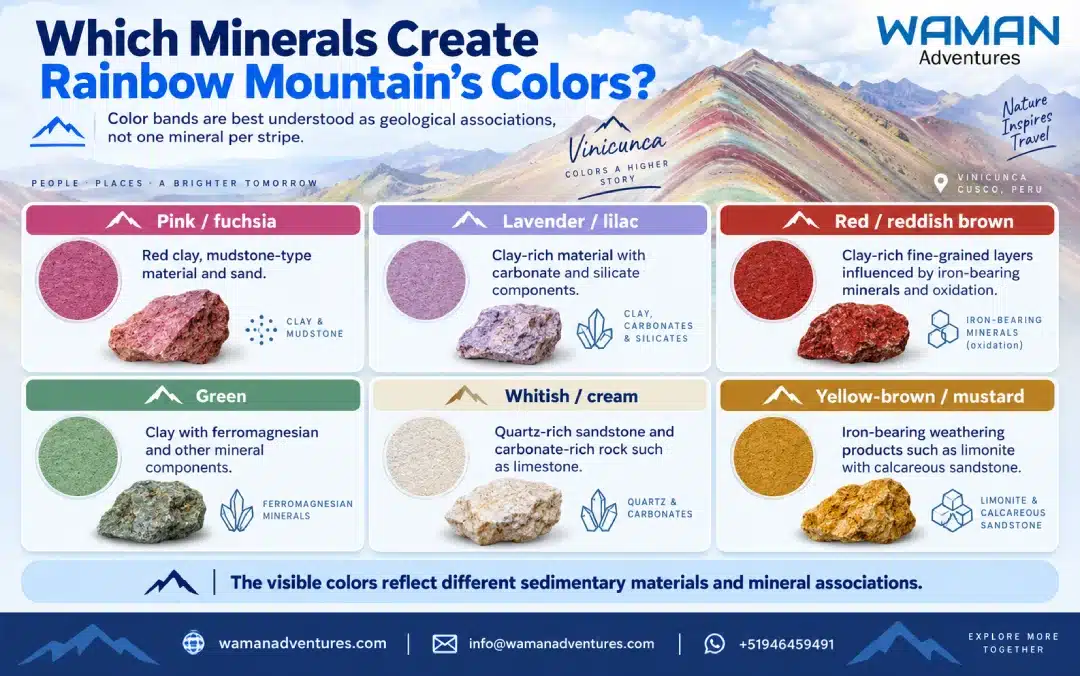
Different rock materials help explain Vinicunca’s visible color bands.
Why it is called the Mountain of Seven Colors
“Mountain of Seven Colors” is a popular descriptive name for Vinicunca’s multicolored slopes. It should not be interpreted as a scientific classification showing that the mountain contains exactly seven separate mineral layers.
The number depends partly on how observers group similar shades. Pink, red, cream, green, lavender and yellow-brown tones can look more or less distinct depending on viewing conditions.
The geological explanation is therefore based on layered sedimentary materials and differences in composition rather than a fixed scientific count of seven minerals or seven perfectly separate bands.
How weather and light change Vinicunca’s appearance
The underlying geology does not change from one day to the next, but the way the colors appear can change noticeably.
Sunlight, cloud, moisture and snow
- Bright sunlight: can strengthen contrast between exposed bands, although harsh light can reduce photographic detail.
- Cloud cover: creates softer lighting and can make some colors appear less intense.
- Rain and wet ground: can darken exposed rock and soil, changing the contrast between layers.
- Fog: can partially hide ridges and reduce visibility.
- Snow or frost: can temporarily cover the colored surface without changing the rock beneath it.
Two visitors can therefore photograph Vinicunca under different conditions and see noticeably different color intensity even though they are looking at the same geological layers.
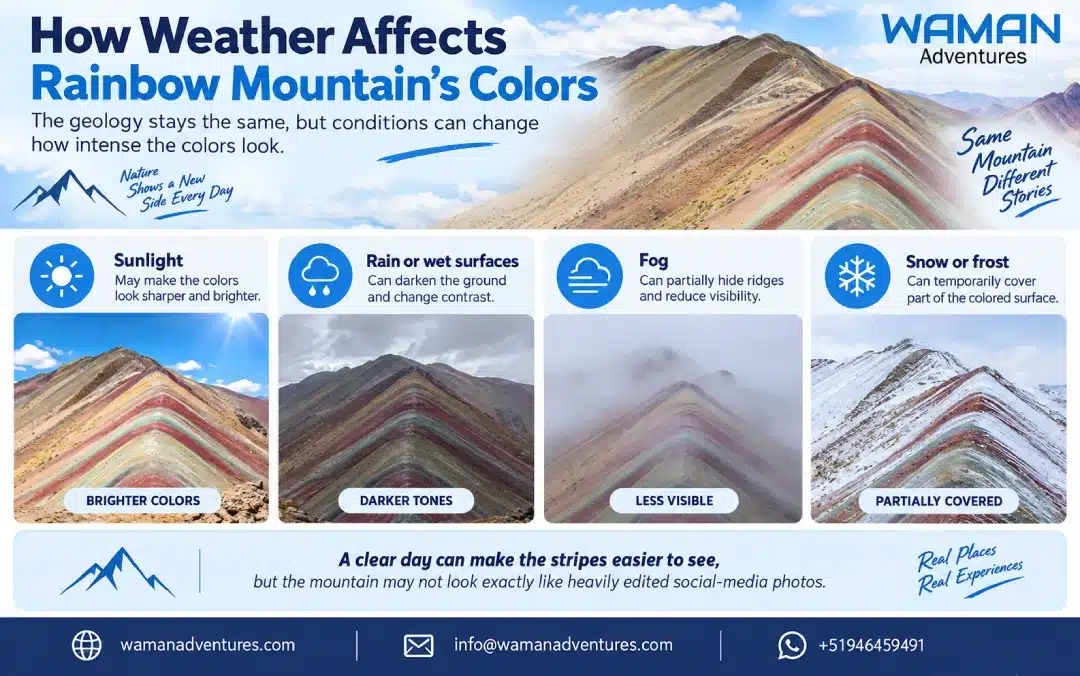
Weather and light change how Vinicunca’s colors appear.
Are Rainbow Mountain’s colors natural?
Yes. Vinicunca’s colors occur naturally in its exposed geological layers. The mountain does not need artificial paint or coloring to create the striped appearance seen from the viewpoint.
Photography can still change perception. Camera settings, filters, editing, saturation and lighting can make online images look more intense than the mountain appears under cloud, fog or flat light.
Keep this in mind:
The geological colors are real, but their apparent intensity changes with natural light, moisture and visibility. Do not expect every visit to look identical to heavily edited social-media photographs.
Where Rainbow Mountain is located
Rainbow Mountain is in the Cusco region of southern Peru, within the Vilcanota mountain range near the Ausangate massif. The tourist area is associated with the high-Andean districts of Cusipata and Pitumarca.
Vinicunca sits above approximately 16,400 ft (5,000 m), so altitude is a major part of the actual visitor experience even though this article focuses on geology.
For hiking distance, acclimatization, difficulty, route conditions, horses and what to bring, use the Rainbow Mountain hike guide.
Other colored geological landscapes near Cusco
Unsure if the Mountain of 7 Colors is the right choice for you? Don’t worry. You have two other options in the Cusco region:
Palcoyo
Palcoyo Mountain, also known as the Mountain of 7 Colors in Palcoyo, is one of the best alternatives if you want to see a rainbow mountain at a lower altitude.
This mountain is another geological formation located 110 km from the city of Cusco. Similar to the famous Vinicunca Mountain, Palcoyo Mountain is situated at an altitude of 16,076 ft/4,900 m. It offers a spectacular landscape with layers of natural colors on its slopes.
Palcoyo Mountain has gained popularity among visitors seeking to experience the beauty of the Andes Mountains without the intensity of higher altitudes found in other nearby mountains, such as Vinicunca. The elevation at Palcoyo is lower, which may make the hike more accessible for some visitors compared to other rainbow mountains in the region.

Tourists enjoying the fascinating view of Palcoyo
Pallay Punchu
Discover the fascinating Pallay Punchu Mountain, one of the new and exciting tourist destinations in the Cusco region. This fascinating mountain is also known as “Pallya Puncho,” “Cerro de los colores con puntos afilados” or “Sharp-edged colored mountain,” and is part of the imposing “Apu Taqllo Apacheta.”
What makes Pallay Punchu unique is its spectacular rock formation adorned with sharp peaks displaying an impressive combination of colors, similar to Andean ponchos. On its slopes, fascinating colors can be seen, from the red of clay to the white of sand and the yellow of limonites.
The experience of visiting this beautiful mountain involves admiring its chromatic beauty and facing a stimulating hike surrounded by majestic mountains, stunning snow-capped peaks, and the serene Langui lagoon.

Pallay Punchu Mountain, sharp and imposing, resembles an Andean poncho
Frequently asked questions about Why is Rainbow Mountain Peru Colorful
Why is Rainbow Mountain Peru colorful?
How was Rainbow Mountain formed?
What minerals are found in Rainbow Mountain?
Is Rainbow Mountain naturally colorful?
Why is it called the Mountain of Seven Colors?
Does rain change Rainbow Mountain’s colors?
Can snow cover Rainbow Mountain’s colors?
Share:



Related tours you might be interested in
Enjoy unique experiences in Cusco and Machu Picchu with the peace of mind that comes from working with a local travel agency

Tour to Chinchero, Maras & Moray – Private Service
Discover with us this beautiful, charming and historic places, where we will visit the enigmatic...

2-Day Trip to Machu Picchu from Cusco with Machu Picchu Mountain
LIVE A UNIQUE EXPERIENCE EXPLORING THE BREATHTAKING LANDSCAPES ON A 2-DAY JOURNEY TO MACHU PICCHU...
6-Day Tour Cusco, Sacred Valley, Machu Picchu and Rainbow Mountain
EXPERIENCE THE MAJESTY OF THE INCAS: SACRED VALLEY, MACHU PICCHU & RAINBOW MOUNTAIN IN ONE TRIP If...

6 Day Andean Adventures Tour│With Flights from Chile
ENJOY THE BEST OF CUSCO CITY – MUST VISIT DESTINATIONS ARE WAITING FOR YOU! Want to explore Cusco...
If you liked this article and the information you found, give us 5 stars!
Table of Contents
Related blogs