5 Day Salkantay Trek to Machu Picchu Itinerary
Ultima actualización en 16 November, 2026 por Jhon Quispe
Last Updated on 16 November, 2026 by Jhon Quispe
5 Day Salkantay Trek to Machu Picchu
The classic 5 Day Salkantay Trek covers about 42.9 mi (69 km) of hiking over four trekking days before visiting Machu Picchu on Day 5. It reaches 15,190 ft (4,630 m) at Salkantay Pass, includes Humantay Lake and Llactapata, and is challenging for most recreational hikers, with Day 2 usually the hardest stage.
- 5 Day Salkantay Trek at a glance
- 5 Day Salkantay Trek itinerary
- 5 Day Salkantay Trek daily distance and altitude
- Difficulty on the 5 Day Salkantay Trek
- 5 Day vs 4 Day Salkantay Trek
- Best time for the 5 Day Salkantay Trek
- What to prepare for the 5 Day Salkantay Trek
- Salkantay Trek permits and Machu Picchu tickets
- Common mistakes when planning the 5 Day Salkantay Trek
- Choose the 5 Day Salkantay Trek if this pace fits you
-
Frequently asked questions about the 5 Day Salkantay Trek
- Does the 5 Day Salkantay Trek include Humantay Lake?
- Where do you sleep during the 5 Day Salkantay Trek?
- Do you need a special permit for the Salkantay Trek?
- Can you hike the 5 Day Salkantay Trek without a guide?
- Do I need to carry all my camping gear?
- Is Machu Picchu included on Day 5?
- Is Huayna Picchu included in the 5 Day Salkantay Trek?
The five-day version spreads the route across more time than the four-day alternative, but the extra day does not make it an easy trek. Long hiking stages, a pass above 15,000 ft (4,572 m) and major changes in elevation still require acclimatization, suitable hiking gear and realistic preparation.

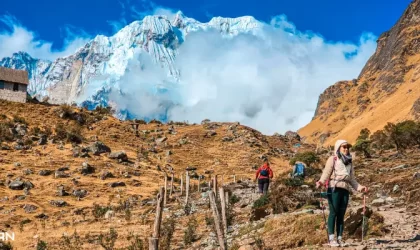
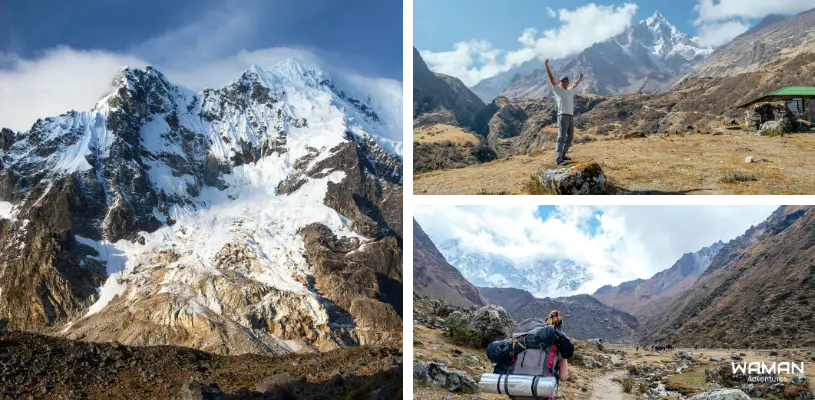
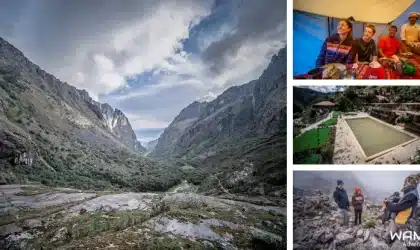
Salkantay Mountain dominates the high-Andean section of the five-day route.
5 Day Salkantay Trek at a glance
| Detail | Planning reference |
| Duration | 5 days / 4 nights |
| Approximate trekking distance | 42.9 mi (69 km) |
| Starting trail area | Challacancha |
| Highest point | Salkantay Pass |
| Maximum altitude | 15,190 ft (4,630 m) |
| Day 1 highlight | Humantay Lake |
| Hardest day | Day 2 |
| Day 4 highlight | Llactapata and the descent toward Hidroeléctrica |
| Final destination | Machu Picchu |
| Overall physical demand | Challenging for most recreational hikers |
The route moves from high mountains and glacial scenery into warmer cloud-forest environments before reaching Machu Picchu Pueblo. For a broader explanation of Salkantay and its alternative itinerary formats, use the complete Salkantay Trek guide.

The route climbs into high mountain terrain before descending toward cloud forest.
5 Day Salkantay Trek itinerary
Day 1 Challacancha to Soraypampa and Humantay Lake
The journey begins with road transportation from Cusco through the Mollepata area toward Challacancha, where the trekking section of the classic five-day route begins.
The trail gradually climbs toward Soraypampa at approximately 12,795 ft (3,900 m). After reaching camp, hikers continue with the side trip to Humantay Lake at approximately 13,779 ft (4,200 m) before returning to Soraypampa for the first overnight.
Day 1 covers about 7.5 mi (12 km) and approximately six hours of hiking. Although it is shorter than Day 2, the Humantay Lake ascent takes place at considerable altitude, so travelers arriving recently from low elevation may find the first day harder than its distance suggests.

Weather, altitude and visitor levels should all influence your travel date.
Day 2 Soraypampa to Salkantay Pass and Chaullay
Day 2 is normally the most demanding stage of the trek. The trail climbs from Soraypampa toward Salkantaypampa before reaching Salkantay Pass at 15,190 ft (4,630 m), the highest point of the five-day route.
The pass should not be confused with the summit of Salkantay Mountain. Trekkers cross below the mountain itself, then begin a long descent through changing ecological zones toward Huayracmachay and Chaullay.
This stage covers approximately 13.7 mi (22 km) and can require around nine hours of hiking, depending on pace and conditions.
Keep this in mind:
Day 2 is normally the hardest stage because it combines the climb to 15,190 ft (4,630 m), about 13.7 mi (22 km) of hiking and a long descent toward Chaullay.

The route descends rapidly toward warmer valleys after crossing Salkantay Pass.
Day 3 Chaullay to La Playa Sahuayaco and Lucmabamba
Day 3 changes the character of the trek. Instead of high alpine terrain, hikers continue through warmer valleys and cloud-forest environments toward La Playa Sahuayaco and Lucmabamba.
Vegetation becomes denser, temperatures are generally warmer and agricultural activity becomes more visible. Depending on the exact trail and local conditions, travelers may pass coffee and fruit-growing areas.
The stage covers approximately 11.2 mi (18 km) and about six hours of hiking before the overnight around Lucmabamba.
Bird and wildlife sightings are possible in the forested environments, but they should be treated as an additional experience rather than a guaranteed feature of the itinerary.
Day 4 Lucmabamba to Llactapata and Aguas Calientes
Day 4 combines trekking with archaeology. From Lucmabamba, the route climbs toward Llactapata, an Inca archaeological site overlooking the broader Machu Picchu landscape.
After Llactapata, hikers descend toward the Hidroeléctrica sector and then continue along the valley toward Machu Picchu Pueblo, also known as Aguas Calientes. This stage covers about 10.6 mi (17 km) and approximately seven hours of hiking.
The highest area around Llactapata is approximately 8,865 ft (2,702 m). The night is normally spent in Aguas Calientes rather than at a trekking camp.
Important note:
The archaeological stop on Day 4 is Llactapata. Sayacmarka belongs to the Classic Inca Trail and should not be presented as a stop on the standard five-day Salkantay itinerary.
Day 5 Machu Picchu and return to Cusco
Day 5 is dedicated to the Machu Picchu visit and the return journey toward Cusco.
The exact archaeological experience depends on the circuit and route associated with the confirmed Machu Picchu entrance ticket. Travelers follow the route included with that reservation rather than one universal itinerary through the Llaqta.
After the visit, travelers return to Machu Picchu Pueblo and continue by scheduled train toward the Sacred Valley, followed by the corresponding road transfer toward Cusco.
Optional mountain routes such as Huayna Picchu or Machu Picchu Mountain require the appropriate separate ticket and current availability and should not be assumed to be included in every five-day itinerary.

5 Day Salkantay Trek daily distance and altitude
| Day | Route | Distance | Hiking time | Key altitude | Overnight |
| Day 1 | Challacancha – Soraypampa – Humantay Lake – Soraypampa | 7.5 mi (12 km) | About 6 h | Humantay Lake – 13,779 ft (4,200 m) | Soraypampa |
| Day 2 | Soraypampa – Salkantay Pass – Huayracmachay – Chaullay | 13.7 mi (22 km) | About 9 h | Salkantay Pass – 15,190 ft (4,630 m) | Chaullay |
| Day 3 | Chaullay – La Playa Sahuayaco – Lucmabamba | 11.2 mi (18 km) | About 6 h | Lower cloud-forest terrain | Lucmabamba area |
| Day 4 | Lucmabamba – Llactapata – Hidroeléctrica – Aguas Calientes | 10.6 mi (17 km) | About 7 h | Llactapata area – about 8,865 ft (2,702 m) | Aguas Calientes |
| Day 5 | Machu Picchu visit and return | Depends on ticketed archaeological route | Guided visit plus return travel | Depends on confirmed Machu Picchu route | Return toward Cusco |
The four main trekking stages total approximately 42.9 mi (69 km). Exact measurements can vary slightly according to campsite location, trail access and whether side hikes are measured separately.
Difficulty on the 5 Day Salkantay Trek
The five-day route is challenging for most recreational hikers because it combines long walking days, repeated elevation changes and a maximum altitude above 15,000 ft.
Day 2 is the principal physical test, while Day 1 can also feel difficult because the Humantay Lake hike reaches 13,779 ft (4,200 m). Days 3 and 4 take place at lower elevations but still require several hours of hiking.
The extra day distributes the route better than a compressed itinerary, but it should not be interpreted as making Salkantay an easy trek. For training, terrain and a deeper physical assessment, use the Salkantay Trek difficulty guide.

A good trip is also enjoyed with good travel gear.
5 Day vs 4 Day Salkantay Trek
| Factor | 5 Day Salkantay | 4 Day Salkantay |
| Duration | 5 days / 4 nights | 4 days / 3 nights |
| Approximate distance | 42.9 mi (69 km) | About 32.3 mi (52 km), depending on itinerary |
| Highest point | Salkantay Pass – 15,190 ft (4,630 m) | Salkantay Pass – similar high-altitude crossing |
| Pace | More distributed across the itinerary | More compressed |
| Humantay Lake | Included in the classic five-day itinerary | Depends on the specific four-day itinerary |
| Best fit | Travelers wanting the classic longer experience | Travelers with less time who are comfortable with a faster schedule |
If duration is your main decision factor, use the Salkantay Trek duration comparison for a deeper breakdown of route lengths and itinerary formats.
Best time for the 5 Day Salkantay Trek
May through September forms the core drier trekking period in the Cusco Andes, generally bringing firmer trails and a better chance of clear mountain views. April and October are transition months that can also work, although conditions are more variable.
Wetter months bring a greater chance of rain, mud, cloud and trail disruption. Weather can still change quickly in any season, especially around Salkantay Pass, so seasonal patterns should guide planning rather than be treated as a guarantee.
What to prepare for the 5 Day Salkantay Trek
Preparation matters because the itinerary combines high altitude with several consecutive days of walking. A last-minute fitness effort cannot replace acclimatization and previous hiking conditioning.
- Spend time acclimatizing in Cusco or another high-altitude location before Day 1.
- Train for repeated uphill and downhill walking before the trip.
- Use broken-in hiking footwear with reliable grip.
- Carry breathable layers, insulation and rain protection.
- Bring the original valid passport or identification required for Machu Picchu.
- Use sun protection at high elevation.
- Carry any personal medication you normally require.
- Keep your personal daypack light and confirm the luggage allowance provided by your trekking service.
Commercial trekking services may provide camping equipment, meals, luggage support and other logistics, but inclusions differ by operator. Check the exact package rather than assuming every five-day Salkantay service includes the same equipment.
Salkantay Trek permits and Machu Picchu tickets
The standard Salkantay route does not require the same limited government trekking permit used for the Classic Inca Trail. However, local access charges or route-specific tickets can still apply depending on the itinerary and current operating arrangements.
A confirmed Machu Picchu entrance ticket remains essential because the five-day itinerary reaches the archaeological site on Day 5. The date and route on that ticket affect the final part of the journey.
For detailed Machu Picchu route and ticket differences, use the Machu Picchu entrance ticket guide.
Independent vs organized trekking
The Salkantay route can be hiked independently, but doing so transfers considerably more logistical responsibility to the traveler.
| Independent trek | Organized service |
| You manage navigation and current trail conditions | Guide and operator coordinate the trekking route |
| You arrange camps or accommodation | Camping and accommodation logistics are coordinated according to the package |
| You organize food and personal luggage | Meals and luggage support may be included |
| You arrange trailhead and return transportation | Transport is coordinated according to the service |
| You manage your Machu Picchu reservation | Ticket coordination may form part of the package |
The better option depends on your trekking experience, route knowledge and how much logistics you want to manage yourself.
Common mistakes when planning the 5 Day Salkantay Trek
- Thinking the trek climbs the summit of Salkantay Mountain rather than crossing Salkantay Pass.
- Confusing the classic five-day itinerary with a compressed four-day route.
- Underestimating Day 2 because the overall trek is spread across five days.
- Using Sayacmarka instead of Llactapata as the Day 4 archaeological stop.
- Assuming every Machu Picchu ticket includes the same circuit or viewpoint.
- Waiting until the last minute to check Machu Picchu entrance availability.
- Trying to solve fitness only a few days before departure.
- Overpacking the personal daypack.
- Assuming all operators use identical camps, hotels and included services.
- Choosing the five-day route only because it sounds easier than four days without considering the total distance.
Choose the 5 Day Salkantay Trek if this pace fits you
The five-day itinerary is a strong fit if you want the classic route through Humantay Lake, Salkantay Pass, cloud forest, Llactapata and Machu Picchu without compressing the journey into four days. It still requires substantial hiking and acclimatization, especially on Day 2. Compare Waman’s 5 Day Salkantay group service or 5 Day Salkantay private service, or talk to a travel specialist if you want help deciding which format fits your group.

Frequently asked questions about the 5 Day Salkantay Trek
Does the 5 Day Salkantay Trek include Humantay Lake?
Where do you sleep during the 5 Day Salkantay Trek?
Do you need a special permit for the Salkantay Trek?
Can you hike the 5 Day Salkantay Trek without a guide?
Do I need to carry all my camping gear?
Is Machu Picchu included on Day 5?
Is Huayna Picchu included in the 5 Day Salkantay Trek?
Share:



If you liked this article and the information you found, give us 5 stars!
Table of Contents
Related blogs
The Definitive Guide to the Lares Trek to Machu Picchu
23 min of reading