Best Time to Visit Uyuni Salt Flats and See the Mirror
Ultima actualización en 29 October, 2026 por Jhon Quispe
Last Updated on 29 October, 2026 by Jhon Quispe
What is the best time to visit Uyuni Salt Flats?
The best time to visit Uyuni Salt Flats depends on the landscape you want. January and February usually offer the strongest chance of the famous mirror effect, while May through October provide the most reliable dry white salt surface and wider vehicle access. March and early April can combine lingering reflections with improving access, while June through August are especially useful for dry-season stargazing but bring very cold nights.
- Best time to visit Uyuni Salt Flats at a glance
- When is the Uyuni mirror season?
- Best time for the dry white Uyuni Salt Flats
- Uyuni Salt Flats weather by season
- Uyuni Salt Flats month by month
- Best season for photography at Uyuni
- What to pack for Uyuni by season
- Common mistakes when choosing when to visit Uyuni
-
Frequently asked questions about the best time to visit Uyuni
- Can I see the Uyuni mirror effect in December?
- Is March a good month for the Uyuni Salt Flats?
- Can I visit Incahuasi Island during mirror season?
- Is November wet or dry at Uyuni?
- What are the coldest months at Uyuni?
- Is June a good month for Uyuni?
- Can I see both reflections and dry salt on the same trip?
- Does the mirror effect happen every day during rainy season?
There is no single perfect month because the same water that creates Uyuni’s mirror can also restrict access across the Salar. Choosing the right season means deciding whether reflections, dry salt patterns, Incahuasi access or night photography matters most to you.

Best time to visit Uyuni Salt Flats at a glance
| What you want to see | Best planning window | What to expect |
| Strongest chance of mirror effect | January–February | Widespread shallow water and reflections when rainfall and wind conditions align |
| Mirror effect with improving access | March–early April | Reflections may remain while some parts of the Salar begin drying |
| Dry white salt and hexagonal patterns | May–October | Firm salt crust and generally wider vehicle access across the Salar |
| Stargazing and clear dry-season nights | June–August | Dry conditions, clear skies and very cold nights |
| Transition between wet and dry conditions | April and November | Variable conditions with possible partial reflections and dry sections |
When is the Uyuni mirror season?
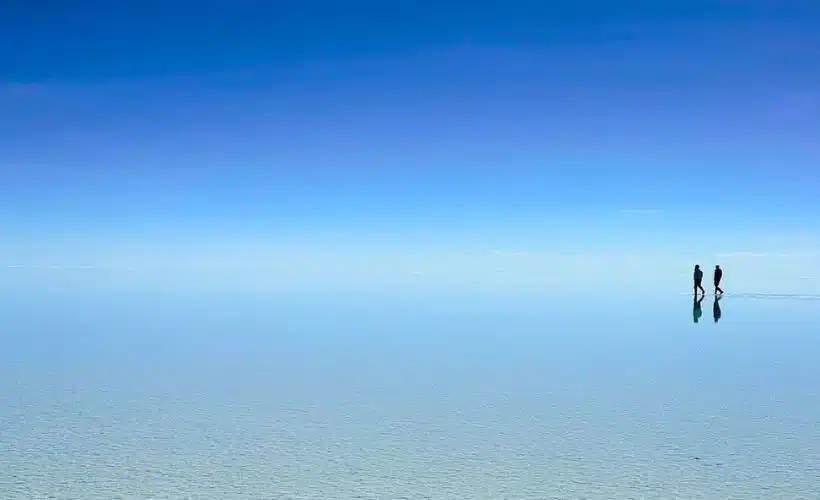
The Uyuni mirror effect is associated with the rainy season, but rainy season and mirror season are not exactly the same thing. A strong reflection needs a thin layer of standing water and relatively calm wind. Heavy rain, deeper flooding or strong wind can reduce the quality of the reflection or restrict vehicle access.
January and February for the strongest mirror chance
January and February usually provide the most consistent chance of widespread mirror conditions. Rainwater can cover large sections of the flat surface, allowing clouds and sky to reflect across Salar de Uyuni.
These months are the strongest choice if the mirror effect is the main reason for your trip. The trade-off is that deeper water can make some areas harder or impossible for vehicles to reach.
March and early April for reflections with improving access
March can provide a useful compromise between the wettest conditions and the beginning of the drier period. Water often remains on sections of the Salar while rainfall begins to ease, so travelers may still find reflections as access gradually improves.
Early April can also retain reflective areas, although conditions become less predictable as the surface continues drying.
Important note:
The mirror effect cannot be guaranteed for a particular day, even during peak rainy-season months. Recent rainfall, water depth and wind conditions all affect how reflective the Salar appears.
Mirror season and Incahuasi access
The same water that creates the mirror effect can make deeper sections of the Salar difficult or impossible for vehicles to cross. During significant flooding, operators may be unable to reach Incahuasi Island and can modify the itinerary according to water depth and safety conditions.
This is the main seasonal trade-off at Uyuni: the wettest months usually provide the strongest chance of reflections, while the drier months normally provide more reliable access across the salt flat.
Best time for the dry white Uyuni Salt Flats
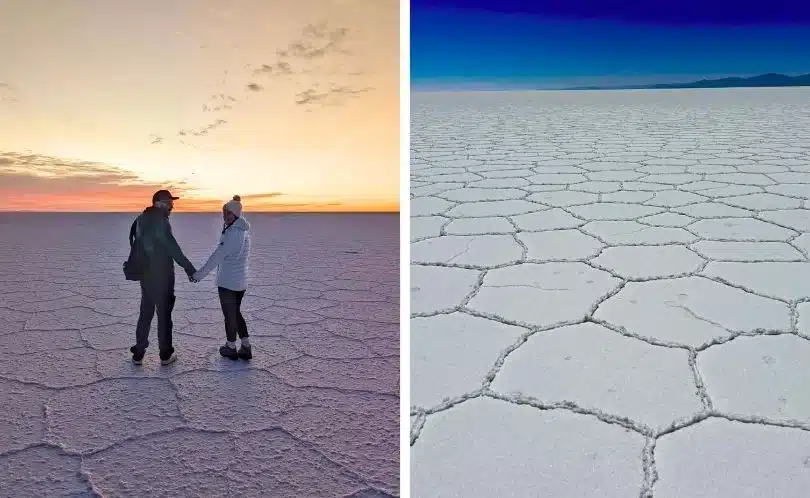
May through October generally provide the most reliable dry conditions. During this period, the water has usually evaporated and the salt crust develops the geometric patterns associated with Uyuni’s classic white-desert landscape.
Dry conditions normally allow vehicles to travel farther across the Salar and make access to places such as Incahuasi Island more reliable than during peak flooding. The trade-off is that you are unlikely to see the large-scale mirror effect. June, July and August can also bring particularly cold nights on the Bolivian Altiplano.
Uyuni Salt Flats weather by season
| Season | Typical conditions | Main advantage | Main trade-off |
| Wet season | More rain, cloud and standing water | Mirror effect | Flooded sections can restrict access |
| Dry season | Dry salt crust, clearer skies and colder nights | White landscape and broader access | Little or no mirror effect |
| Transition months | Mixed wet and dry conditions | Potential to see both surfaces | Less predictable conditions |
Salar de Uyuni sits at approximately 12,000 ft (3,656 m), so conditions can change sharply between daytime and nighttime. The coldest nights are generally associated with the middle of the dry season, particularly June through August.
Uyuni Salt Flats month by month
| Month | Typical surface | Mirror chance | Planning note |
| January | Wet / flooded | High | One of the strongest months for reflections |
| February | Wet / flooded | High | Peak mirror conditions are common when weather cooperates |
| March | Wet to mixed | Medium to high | Useful compromise between reflections and improving access |
| April | Transition | Variable | Reflective areas may remain while other sections begin drying |
| May | Mostly dry | Low | Dry-season access becomes more reliable |
| June | Dry | Very low | Cold nights and clear dry-season landscapes |
| July | Dry | Very low | White salt patterns and some of the coldest nights |
| August | Dry | Very low | Good access and clear night skies |
| September | Dry | Very low | Stable dry-surface experience |
| October | Mostly dry | Low | Dry conditions usually continue as the wetter period approaches |
| November | Transition | Variable | Early rains can create isolated reflective sections |
| December | Wet transition | Increasing | Mirror conditions may begin as rainfall becomes more established |
April and November as transition months
April and November sit between Uyuni’s wetter and drier periods. These months can produce mixed landscapes where some sections remain dry while shallow water appears elsewhere.
This can suit travelers who want the possibility of seeing both salt patterns and partial reflections, but the result is less predictable than choosing January–February specifically for the mirror or the core dry months for a firm salt surface.

Keep this in mind:
April and November can show mixed wet and dry surfaces, but transition conditions vary from year to year. Choose these months only if you are comfortable with less predictable reflections.
Best season for photography at Uyuni
Mirror photography
January and February are generally the strongest months if your priority is photographing reflections. Sunrise and sunset can be especially effective when the water is shallow and the wind is light.
White salt and perspective photography
May through October reveal the dry salt crust and geometric patterns. The flat white horizon also works well for forced-perspective photography.
Night photography
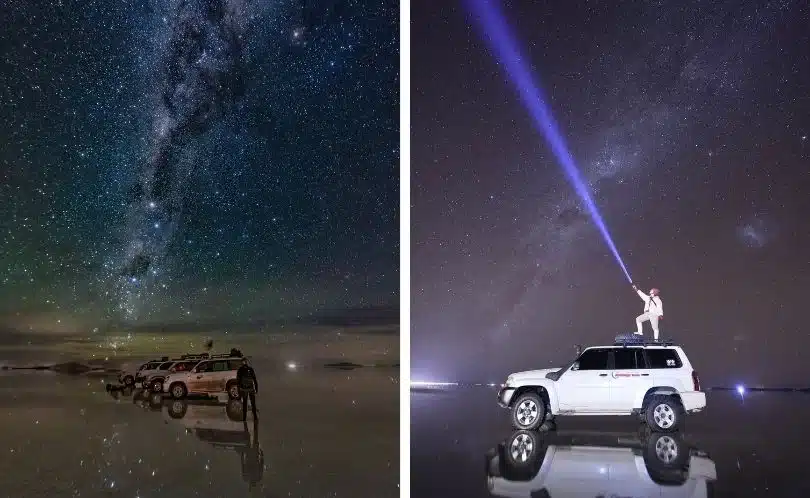
June through August often provide clear, dry skies and very low light pollution, making them useful months for stars and Milky Way photography. Nights can be extremely cold, so warm clothing is important.
What to pack for Uyuni by season
Uyuni is a high-altitude environment, so layered clothing and sun protection are useful throughout the year. The main difference is whether your visit requires greater protection from water or from extreme nighttime cold.
| Wet or mirror season | Dry season |
| Waterproof footwear or boots | Warm insulated layers |
| Waterproof outer layer | Gloves and warm hat for cold nights |
| Dry bag for electronics | Wind protection |
| Sun protection | Sun protection |
| Sunglasses | Sunglasses |

Remember the altitude
Salar de Uyuni sits at approximately 12,000 ft (3,656 m) above sea level. Travelers arriving directly from much lower elevations can experience headache, fatigue, nausea or shortness of breath.
Allowing time to adjust before a demanding itinerary can help your body adapt. Physical fitness does not guarantee protection from altitude illness, so pay attention to symptoms rather than assuming discomfort is a normal part of the trip. Travelers with medical concerns about high-altitude travel should discuss their plans with an appropriate healthcare professional.
For flights, buses and routes from La Paz, Sucre, Potosí and other starting points, use the dedicated guide to getting to the Uyuni Salt Flats.
Common mistakes when choosing when to visit Uyuni
- Assuming the mirror effect is guaranteed throughout the entire rainy season.
- Choosing January or February without considering that flooding can restrict access to Incahuasi.
- Expecting the large-scale mirror effect during the dry season.
- Assuming April or November will definitely provide both wet and dry landscapes.
- Underestimating cold nighttime temperatures during June, July and August.
- Choosing a month based only on photographs without considering access and itinerary priorities.

Frequently asked questions about the best time to visit Uyuni
Can I see the Uyuni mirror effect in December?
Is March a good month for the Uyuni Salt Flats?
Can I visit Incahuasi Island during mirror season?
Is November wet or dry at Uyuni?
What are the coldest months at Uyuni?
Is June a good month for Uyuni?
Can I see both reflections and dry salt on the same trip?
Does the mirror effect happen every day during rainy season?

Share:



If you liked this article and the information you found, give us 5 stars!
Table of Contents
Related blogs
Before You Visit: How Uyuni Tickets Work and Where to Get Them
7 min of reading