How to get to Choquequirao: A step-by-step guide for adventurous travelers.
Ultima actualización en 29 October, 2026 por Jhon Quispe
Last Updated on 29 October, 2026 by Jhon Quispe
How do you get to Choquequirao from Cusco?
To reach Choquequirao from Cusco, first travel by road toward Cachora and the Capuliyoc trail area, then continue on foot through the Apurímac Canyon toward Marampata and the archaeological complex. There is no public road or operating cable car directly to Choquequirao in 2026. Most standard round trips take 4 or 5 days.
- Choquequirao access in 2026 at a glance
- Current Choquequirao access status in 2026
- How to get from Cusco to Choquequirao
- Can you drive directly to Choquequirao?
- Choquequirao cable car and tram status in 2026
- How long does it take to reach Choquequirao?
- Independent vs guided access to Choquequirao
- What to check before leaving Cusco
- Common mistakes when getting to Choquequirao
- Plan your Choquequirao access before leaving Cusco
-
Frequently asked questions about how to get to Choquequirao
- How far is Cachora from Capuliyoc?
- Can I get public transportation directly from Cusco to Capuliyoc?
- Is the Capuliyoc route open year-round?
- Can I start the Choquequirao Trek from Huanipaca?
- Can I hire a mule locally for Choquequirao?
- Do I need an Inca Trail-style permit for Choquequirao?
- Can I combine Choquequirao with Machu Picchu?
- Should I choose 4 or 5 days for Choquequirao?
Access information matters especially in 2026 because the Capuliyoc–Cachora route temporarily closed during the rainy period before reopening on April 15. The proposed cable-car system also remains a future infrastructure project rather than a visitor service, so current trail conditions should be checked before departure.

Choquequirao access in 2026 at a glance
| Access question | Current answer |
| Main tourist approach | Cachora–Capuliyoc |
| Current route status | Reopened on April 15, 2026 |
| Can you drive directly to Choquequirao? | No |
| Can you drive to Capuliyoc? | Yes |
| Cachora to Capuliyoc | About 7.5 mi (12 km), roughly 30 minutes by local vehicle |
| Final access to Choquequirao | Multi-day trek through the Apurímac Canyon |
| Tourist cable car operating? | No |
| Standard round trip | Usually 4 or 5 days |
| Independent travel possible? | Yes, with self-managed transport and trekking logistics |
Current Choquequirao access status in 2026
The main tourist approach through the Cachora and Capuliyoc sector is open again. Peru’s Ministry of Culture officially reopened the Capuliyoc–Cachora route on April 15, 2026 after temporary access restrictions and maintenance during the rainy period.
Trail conditions can still change because of heavy rain, landslides, maintenance or other safety concerns. Check the current status shortly before departure rather than assuming the trail will remain open without interruption throughout the year.
You can review updates through the official Ministry of Culture reopening notice.
How to get from Cusco to Choquequirao
The journey has two distinct parts. First, you travel by road from Cusco toward Cachora and Capuliyoc. From the trailhead, you continue on foot through the Apurímac Canyon toward Marampata and Choquequirao.
| Stage | Planning reference |
| Cusco to Cachora / Capuliyoc area | Road transportation, usually several hours depending on vehicle, route and stops |
| Capuliyoc | Main current trail-access area and viewpoint |
| Capuliyoc to canyon floor | Long descent toward Chiquisca and Playa Rosalinas |
| Apurímac River to Marampata | Major sustained uphill section |
| Marampata to Choquequirao | Final walking approach to the archaeological complex |

Step 1 travel from Cusco toward Cachora and Capuliyoc
Organized and private treks normally travel directly from Cusco toward the Cachora and Capuliyoc area before beginning the hike.
Independent travelers can use transportation along the Cusco–Abancay corridor and connect toward Cachora. The junction is commonly known locally as the Ramal de Cachora, where travelers can arrange onward local transportation.
Departure points, transport frequency and local fares can change, so verify them shortly before leaving Cusco instead of relying on an old fixed schedule or price.
Step 2 reach the Capuliyoc trailhead
Capuliyoc is the principal access point for the standard Choquequirao route. From Cachora, it is approximately 7.5 mi (12 km) by road.
Current official tourism information lists approximately 30 minutes by local vehicle between Cachora and Capuliyoc, or roughly 2 hours on foot depending on pace and conditions.
Capuliyoc also provides the first major views into the Apurímac Canyon before the trekking route begins its long descent.
Step 3 descend into the Apurímac Canyon
From Capuliyoc, the trail descends steeply through the canyon toward areas such as Chiquisca and Playa Rosalinas near the Apurímac River.
The descent is substantial and is followed later by a demanding climb. This is why reaching Choquequirao should not be treated as a simple archaeological day trip.
Step 4 climb toward Marampata
After crossing the lower canyon section, the route climbs steeply toward Santa Rosa and Marampata.
The combination of a major descent followed by a sustained ascent is one of the defining physical characteristics of the standard access route.
Step 5 continue from Marampata to Choquequirao
Marampata is one of the final inhabited areas before the archaeological complex. From here, travelers continue on foot toward Choquequirao.
The monumental archaeological complex is located at approximately 9,951 ft (3,033 m) above sea level.
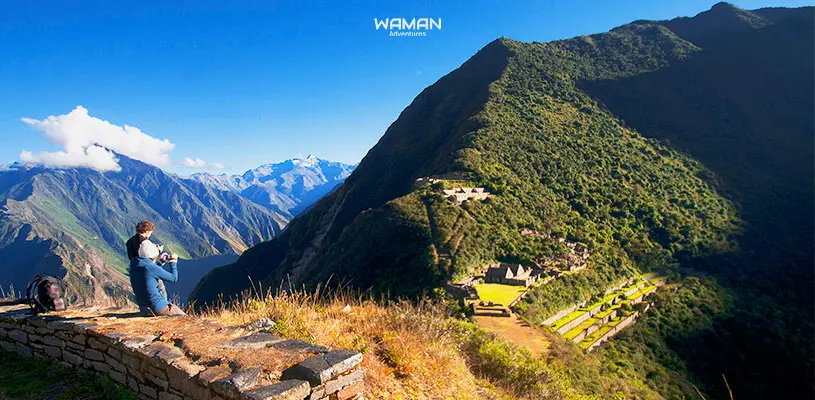
Can you drive directly to Choquequirao?
No. There is currently no public road that takes visitors directly to the Choquequirao archaeological complex.
Road transportation can reach the Cachora and Capuliyoc access area, but visitors must continue on foot from the trailhead under the current access system.
This is one of the main differences between Choquequirao and Machu Picchu. Choquequirao remains a remote trekking destination rather than an archaeological site reached directly by train, bus or road.
Choquequirao cable car and tram status in 2026
No tourist cable car or tram is operating at Choquequirao in 2026. Current visitors still need to trek to the archaeological complex.
Peru has an active infrastructure project intended to improve access to Choquequirao through cable transportation and associated tourism infrastructure. However, the system remains a future project rather than an operating visitor service.
PROINVERSIÓN continues to list Choquequirao as an infrastructure and concession project. For current project information, review the official PROINVERSIÓN Choquequirao project profile.
Important note:
If you find an article claiming that the Choquequirao cable car is already operating, check its publication date and the official project status. Current visitors still need to plan for trekking access.
How long does it take to reach Choquequirao?
Most standard Choquequirao trips from Cusco are organized as 4- or 5-day round-trip treks, including transportation, hiking, the archaeological visit and the return.
| Itinerary | Best for | Planning trade-off |
| 4 days | Experienced trekkers with limited time | Faster pace and more demanding trekking days |
| 5 days | Travelers who prefer more recovery time | Slower pace and more time around Choquequirao |
| Extended route toward Machu Picchu | Travelers wanting a longer Vilcabamba trekking experience | Much larger time and trekking commitment |
For detailed daily routes, camps and longer itinerary comparisons, use the complete Choquequirao Trek guide.

Independent vs guided access to Choquequirao
You can reach Choquequirao without joining an organized tour. Unlike the Classic Inca Trail, the standard Choquequirao route does not currently operate under the same limited trekking-permit system.
Independent trekking, however, means taking responsibility for transportation, navigation, food, water, camps, trail updates and any pack-animal arrangements.
| Independent trek | Guided trek |
| More control over pace and schedule | Transport and route logistics are coordinated |
| You organize food and camps | Meals and camping are normally organized |
| You manage navigation and trail updates | Local route support is available |
| You arrange mules locally if needed | Pack-animal support may be coordinated in advance |
| Best suited to experienced self-supported trekkers | Useful for travelers who prefer logistical support |
If your main concern is the physical challenge rather than access logistics, use the dedicated Choquequirao Trek difficulty guide.
Mules and camps for independent trekkers
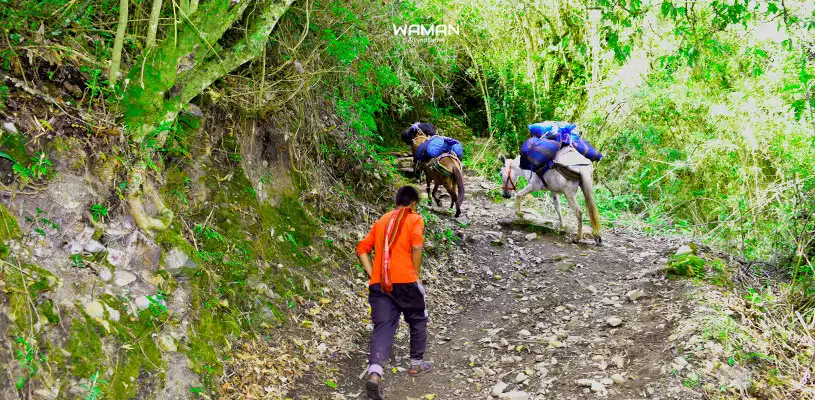
Mules and muleteers are commonly used on Choquequirao trekking routes to carry camping equipment, food and part of the group load.
Independent travelers may be able to arrange pack-animal support locally, but availability, rates and weight limits can change. Confirm those conditions before depending on mule support.
Multi-day itineraries use camps and small communities along the route, including areas around Chiquisca and Marampata. Facilities are basic and availability can vary, so independent travelers should not assume that every store, campsite or service will always be open or fully stocked.
Permit and admission requirements
Choquequirao does not currently use an Inca Trail-style limited trekking permit that normally has to be secured months in advance.
Visitors still need to comply with archaeological-site admission requirements and any local access controls in force at the time of travel.
Admission fees, payment procedures and operational arrangements can change, so verify the current conditions shortly before departure.
Carry your original passport or valid identification during the trek, particularly when purchasing or validating archaeological admission.
What to check before leaving Cusco
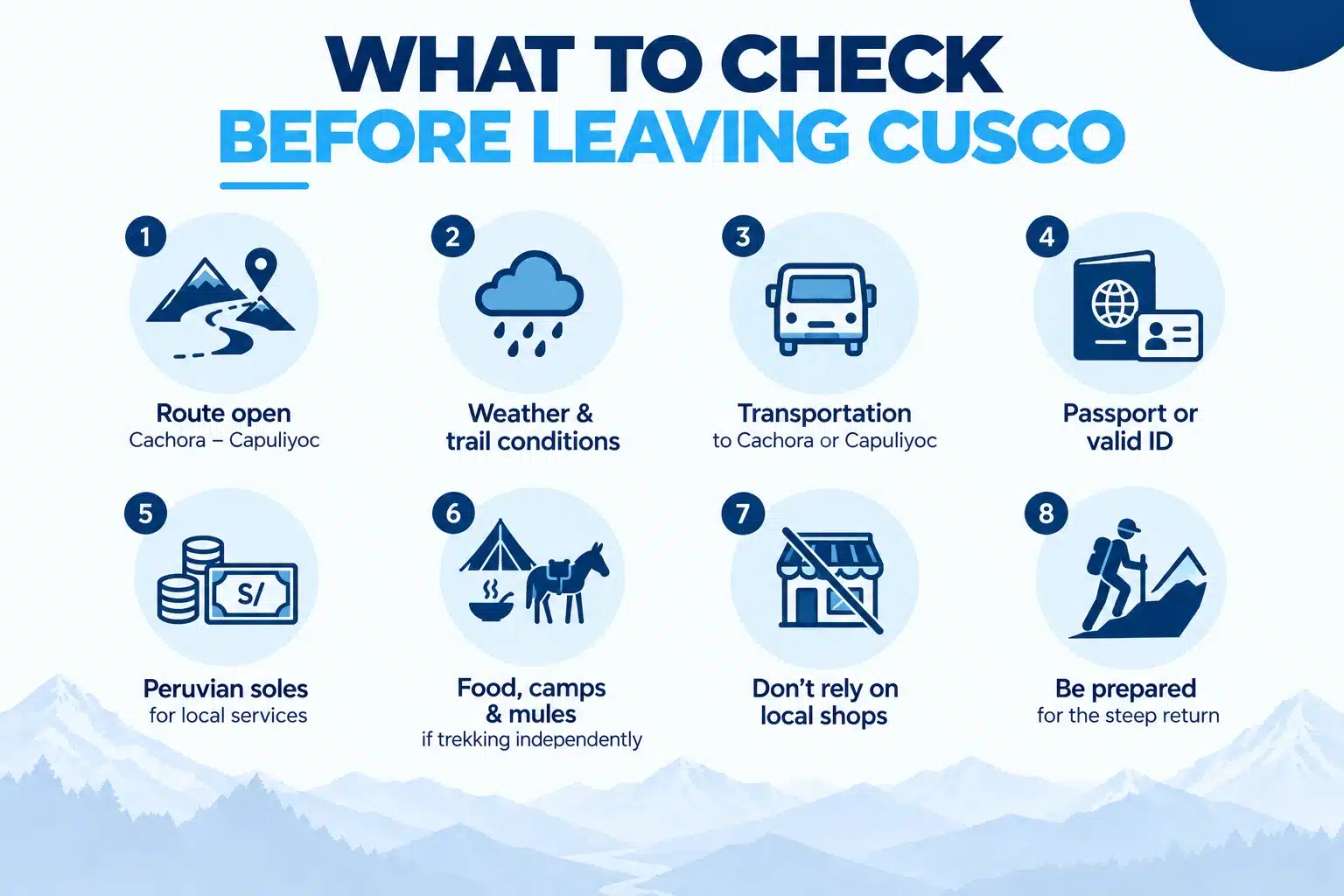
Infographic with a pre-departure checklist from Cusco to Choquequirao, covering route access, weather, transport, ID, cash, camps and physical preparation.
For physical preparation, acclimatization and a more complete gear checklist, use the Choquequirao preparation guide.
Common mistakes when getting to Choquequirao
- Assuming you can drive directly to the archaeological complex.
- Planning around a cable car that is not operating yet.
- Using old transport or mule prices as guaranteed current rates.
- Underestimating the descent and climb through the Apurímac Canyon.
- Choosing a 4-day itinerary only because it is shorter without considering the faster pace.
- Assuming local shops, muleteers or other services will always be immediately available.
- Using information about the temporary 2026 closure without checking that the route later reopened.
Plan your Choquequirao access before leaving Cusco
Choquequirao still requires road transportation to the Cachora–Capuliyoc area followed by a demanding multi-day trek. Review the complete Choquequirao Trek guide if you are comparing 4-, 5- or extended routes, or talk to a travel specialist if you want help coordinating transportation and trekking logistics.

Frequently asked questions about how to get to Choquequirao
How far is Cachora from Capuliyoc?
Can I get public transportation directly from Cusco to Capuliyoc?
Is the Capuliyoc route open year-round?
Can I start the Choquequirao Trek from Huanipaca?
Can I hire a mule locally for Choquequirao?
Do I need an Inca Trail-style permit for Choquequirao?
Can I combine Choquequirao with Machu Picchu?
Should I choose 4 or 5 days for Choquequirao?
Share:



Related tours you might be interested in
Enjoy unique experiences in Cusco and Machu Picchu with the peace of mind that comes from working with a local travel agency
Rural and Agritourism Experience in Chichubamba
TRADITIONAL LIFE IN THE HEART OF THE SACRED VALLEY Let yourself be immersed in the mystique and...

Birdwatching Experience at Chacán Dam & Ensifera Camp
BIRD WATCHING IN CUSCO: CHACÁN & ENSIFERA CAMP Cusco is far more than history and dramatic...

Cusco Soccer Game Experience
EXPERIENCE CUSCO SOCCER LIKE A LOCAL Immerse yourself in one of Cusco’s most intense cultural...
Huacarpay Birdwatching Experience
HUACARPAY: ANDEAN BIRD SANCTUARY Discover the natural richness of Huacarpay, a high-Andean wetland...
If you liked this article and the information you found, give us 5 stars!
Table of Contents
Related blogs
Unforgettable Ausangate Trek: The Best Adventure Awaits!
17 min of reading
How hard is Humantay Lake trek? Here’s everything you need to know!
12 min of reading
Water in Peru: Stories, Risks, and the Art of Staying Healthy
8 min of reading