


How Difficult is Rainbow Mountain Hike Really? Myths and Realities Explained
Ultima actualización en 6 November, 2024 por Waman Adventures
Last Updated on 6 November, 2024 by Waman Adventures
The persistent question for those considering facing this adventure is: How Difficult Is Rainbow Mountain Hike? Although the ascent presents challenges, from steep terrain to high altitudes, the reward of spectacular panoramic views makes many adventurers believe it is worth it.
The Rainbow mountain stands out as a geological wonder in the Cusco region. Its distinctive color palette, ranging from red, green, lavender, whitish, and yellow tones, creates a visually striking and fascinating landscape. In recent years, this natural gem has gained worldwide fame, attracting travelers from all over the world seeking unique experiences. Join us in exploring the reality behind this trek and debunking the myths surrounding the hike to the rainbow mountain.
What is the rainbow mountain?
The 7-color mountain, also called Vinicunca or Rainbow Mountain, is an extraordinary geological formation. It stands out for the layers of colors on its slopes, ranging from red, pink, green, blue, yellow, and brown tones. This entire color palette creates a visually striking and fascinating landscape.
In recent years, this natural wonder has gained popularity among tourists for its unique beauty and vibrant colors, attracting travelers from all over the world seeking exceptional experiences.

Vinicunca is an extraordinary geological wonder that captivates all tourists.
How Difficult Is Rainbow Mountain Hike?
The difficulty of Rainbow Mountain varies from moderate to challenging. Although the beginning of the ascent is not particularly difficult, about the remaining 20% of the trail becomes steep, being the most challenging part of the hike. This section requires physical and mental endurance, testing both qualities.
The high altitude also adds to the difficulty, so visitors must acclimatize properly before embarking on this journey.
The hike to the 7-color mountain presents different challenges that hikers may face. Some of these challenges are:
HIGH ALTITUDE
What altitude is the rainbow mountain at?
The impressive Vinicunca mountain, also known as the 7-color mountain, is located at an approximate altitude of 16,470 ft / 5,200 m. The high altitude and terrain conditions visit this mountain require proper acclimatization to avoid altitude sickness symptoms.
Maximum altitude reached in Vinicunca
The maximum altitude reached in Vinicunca is 16,522 feet (5,036 meters), located at the second viewpoint. From this point, you will enjoy an impressive panoramic view of the majestic mountain.
Minimum altitude in Vinicunca
The minimum altitude upon arriving at Vinicunca is 16,469 feet (5,020 meters), located at the first viewpoint. From here, you’ll have the opportunity to capture closer photos of the imposing mountain.
Comparison Points
- Everest Base Camp – 5380 meters
- Mount Rainier, Washington, USA – 4392 meters
- Puno, Peru – 3827 meters
- La Paz, Bolivia – 3640 meters
- Cusco, Peru – 3399 meters
- Ollantaytambo, Peru – 2792 meters
- Machu Picchu, Peru – 2430 meters
- Calgary, Canada – 1045 meters
- Vancouver, Canada 0 – 152 meters

Infographic of the Rainbow Mountain hike showing location, altitude, climate, and best visiting hours
DURATION OF THE HIKE
How long is the hike to the 7-color mountain?
The total hiking time to the 7-color mountain, including the ascent to the Winikunka viewpoint (16,522 feet/5,036 meters) from the starting point and the subsequent descent, generally ranges between 5 and 6 hours.
The ascent takes approximately 2 hours and 30 minutes to 3 hours, starting at an altitude of 15,091 feet/4,600 meters. The descent has a similar duration, approximately 2 to 3 hours. It’s important to note that these times can vary depending on the group’s speed and individual conditions.
CLIMATIC VARIABILITY
The Rainbow Mountain, located in the Andean region of Peru, experiences notable climatic variability due to its high altitude and the region’s geography. Here are key aspects of the climatic variability in Vinicunca:
-
Changing climates
The weather in the Cusco region can change rapidly, especially during the rainy season (November to March), even within the same day. You may experience sunny moments followed by sudden rain or strong winds. Generally, the climate in the 7-color mountain is chilly.
-
Temperature in Vinicunca
Most tourists opt to visit between 11 am and 2 pm. During these hours, temperatures range from 44.6ºF (7ºC) to 53.6ºF (12ºC). At night, the cold can drop to 0 degrees Celsius (32ºF). As is typical in the Andean region, rain can occur at any time of the day.
-
Dry and rainy seasons
The Rainbow Mountain, being located in the Cusco region, shares its characteristic climate and thus experiences two distinct seasons throughout the year. The dry season, which runs from April to October, is characterized by sunny days and clear skies; while the rainy season, which extends from November to March, brings rainy days and occasional snowfall.
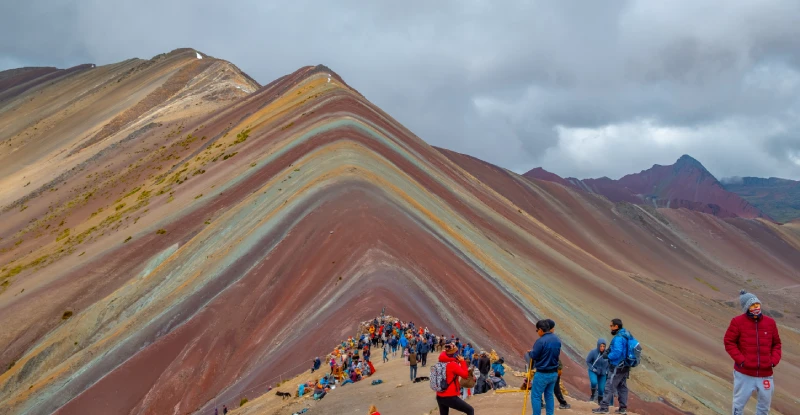
Rainbow Mountain during the rainy season, showing a cloudier sky with no sun
-
Hiking Difficulty Depending on the Season in Cusco
-
Dry Season
During the dry season in Cusco, which typically runs from April to October, the hike to Rainbow Mountain presents more stable and predictable conditions, with a moderate level of difficulty. The clear skies offer optimal visibility, and the temperatures tend to be more pleasant.
However, keep in mind that the altitude and sun exposure can still be challenging, so it’s crucial to take measures for acclimatization and sun protection. Trails are generally in better condition, making the hike easier compared to the rainy season.
-
Rainy Season
From November to March, the rainy season in Cusco can make the hike to Rainbow Mountain more challenging. Rain can affect the accessibility of the trails, making them slippery and potentially dangerous. Visibility may also be reduced due to clouds and rain, impacting the appreciation of the vibrant colors.
Caution is key during this period, and it is essential to check weather conditions before embarking on the hike. Despite the challenges, some travelers choose to visit the Rainbow Mountain during the rainy season to experience a different, less crowded landscape.

During the rainy season, you can often see rainbow mountains covered in snow or on any rainy day throughout the year.
IRREGULAR TERRAIN
The terrain of Rainbow Mountain, also known as Vinicunca, is notably irregular and presents specific challenges for hikers. Here’s information on the terrain of this famous mountain:
1.- Gradual and Steep Ascent:
- The hike generally begins with a gradual ascent, allowing hikers to acclimatize gradually to the altitude.
- As you progress, the terrain becomes steeper, especially towards the final part of the hike. This is where many find the most challenging portion of the trek.

Hikers walking towards Rainbow Mountain, panoramic view of the trek
2.- High-Altitude Hike:
- The high altitude (approximately 5,020 meters) adds a level of difficulty. The lack of oxygen can make the hike more exhausting, even on seemingly easy stretches.
3.- Altitude Changes:
- The terrain is not only steep but there are also notable changes in altitude throughout the hike.
- These changes can affect breathing and physical capacity, highlighting the importance of acclimatization.
4.- Strong Winds:
- Due to the high altitude and geographical location, strong winds are common on Rainbow Mountain.
- Hikers should prepare for windy conditions, especially at the summit.
ALTITUDE ACCLIMATIZATION
Acclimatization to the altitude is a crucial aspect if you plan to visit Rainbow Mountain, which is situated at a considerable altitude of about 5,200 meters.
What is Altitude Sickness?
Altitude sickness is the difficulty the body experiences in adapting to the reduced oxygen levels at high altitudes. Symptoms usually appear when people are above 2,000 meters (6,561 feet). It’s crucial to note that each individual’s reaction to altitude, temperature, weather, and atmospheric pressure changes can vary considerably.
Since Cusco is located at an altitude of 3,400 meters above sea level, it’s important to consider that the likelihood of experiencing altitude sickness increases significantly, especially for those coming from sea-level areas.
Altitude Sickness Symptoms in Rainbow Mountain
Symptoms of altitude sickness can vary from person to person and may be stronger or milder depending on the height and how quickly you’ve adapted. Some symptoms you may experience include:
- Headache
- Dizziness
- Fatigue
- Nausea
- Loss of appetite
- Shortness of breath
For this reason, it is important to take preventive measures for altitude sickness, such as gradually acclimatizing in the city of Cusco for 2 to 3 days, staying hydrated, resting enough, and avoiding excessive physical exertion.

Headache, fatigue, and vomiting are some symptoms of altitude sickness
How to Prevent Altitude Sickness?
To prevent altitude sickness on the Inca Trail, it is recommended to follow these tips:
- Gradual acclimatization: Spend 1 to 3 days adjusting to the altitude before engaging in intense activities or ascents.
- Adequate hydration: Drink at least 2-3 liters of water a day and avoid alcohol and caffeine.
- Healthy diet: Opt for a balanced diet rich in carbohydrates, avoiding heavy and spicy foods.
- Enough rest: Respect your sleeping hours and avoid physical exhaustion.
- Coca tea: Coca tea can help alleviate symptoms, but its effectiveness may vary from person to person.
- Medical consultation: If necessary, consult a doctor before taking altitude sickness medications, as each case is particular and requires professional evaluation.

Mate de coca is a traditional infusion that helps combat altitude sickness
Is the Rainbow Mountain dangerous?
Hiking to the Rainbow Mountain in Peru is not considered dangerous as long as proper precautions are taken and safety guidelines are followed. Aspects to consider include the altitude (approximately 5,200 meters), which can cause symptoms of altitude sickness; the physical condition required due to challenging terrain; the changing weather conditions in the Andean region; and choosing a reliable tour operator. Acclimatizing, physically preparing, dressing appropriately, and selecting a trustworthy agency are key to ensuring a safe and enjoyable experience at Rainbow Mountain.
Routes that will take you to Vinicunca
Route via Pitumarca
If you choose to visit the rainbow mountain on your own, you should head to Av. Huayruropata (near the Coliseo Cerrado), where you’ll find buses going along the Cusco-Sicuani route. The bus fare is approximately S/ 10. Remember to get off at the town of Checacupe, and from there, take another shared ride to Pitumarca.
From Pitumarca, the best option to reach the mountain is by quad bike. This tour costs around $100.00 USD, depending on the company you choose. This option offers greater comfort and speed during your trip to the 7 Color Mountain.
You also have the option to take the Rainbow Mountain and Red Valley 2D/1N tour, and the best choice for this adventure is by booking through a travel agency.

Map of the Rainbow Mountain and Red Valley 2D/1N Tour – Pitumarca Route
Route via Cusipata
In recent years, the route via Cusipata has become the most popular for those wanting to hike to the mountain. If you want to go alone, you must take a bus from Av. Huayruropata (near the Coliseo Cerrado). But this time, you’ll need to get off at the district of Cusipata. This route is shorter and more traveled than the Pitumarca route.

Map of the hike to the 7 Color Mountain / Cusipata Route
The route via Ausangate trek
This option is ideal for adventure lovers, offering a challenging route characterized by beautiful landscapes and interaction with local villagers. The safest way to reach the 7 Color Mountain through the Ausangate route is by booking with an authorized travel agency like Waman Adventures. The hike can last anywhere from 2, to 4 to 7 days.
Note: For an unforgettable experience at Vinicunca Mountain, it is recommended to choose a travel agency that offers a variety of tours tailored to the traveler’s budget. In addition to providing safety and comfort, a specialized agency can enrich the experience with valuable information about the region, ensuring memorable moments when planning the visit with adjustments to expectations and budget.
How to dress for the hike to Vinicunca?
Dressing appropriately for Rainbow Mountain is essential to ensure comfort and protection, given the high-altitude environment. Here are some recommendations on how to dress:
- Layers: The temperature can vary significantly, especially during early morning hikes. Dressing in layers allows you to adjust clothing as conditions change.
- Thermal clothing: Wearing lightweight thermal clothing underneath outerwear helps retain body heat without adding bulk.
- Waterproof and windproof jacket: Since the weather can be unpredictable, carrying a waterproof and windproof jacket is essential to protect against rain and wind.
- Durable pants: Choose durable but comfortable pants for the hike. Some trails can be rocky or steep.
- Proper footwear: Use trekking boots or hiking shoes with good ankle support. Make sure they are comfortable and have been worn before to avoid blisters.
- Gloves and hats: Even on warm days, the altitude can cause temperatures to drop. Wearing gloves and a hat will help you stay warm.
- Balaclava or bandana: Essential for covering your face and avoiding dust that might be encountered along the way.
- Sun protection: The altitude increases sun exposure. Use a broad-spectrum sunscreen and wear sunglasses to protect yourself from the intense UV rays.
- Small backpack: Carry a small backpack with water, snacks, sunscreen, and extra layers.

Everything you need to bring and how to dress for the hike to Rainbow Mountain
The hike to Rainbow Mountain is an experience that ranges from moderate to challenging but enriching, where nature dazzles with its chromatic splendor. Although the altitude and uneven terrain present challenges, proper preparation and respect for the mountain ensure a safe journey.
Now that you’ve uncovered the truth behind the difficulty, will you dare to conquer Rainbow Mountain? Get ready for a unique adventure filled with vibrant colors with Waman Adventures. Dive into this journey and let the 7 Color Mountain reveal its magic before your eyes!

Share:



Related tours you might be interested in
Enjoy unique experiences in Cusco and Machu Picchu with the peace of mind that comes from working with a local travel agency
If you liked this article and the information you found, give us 5 stars!
Table of Contents
Related blogs
When the Sun Kisses the Salt: The Uyuni Sunset Experience
10 min of reading

