Rainbow mountain Peru: Experience the magic of the Andes and its wonderful landscapes with this complete guide!
Ultima actualización en 6 November, 2024 por Waman Adventures
Last Updated on 6 November, 2024 by Waman Adventures
- What is the Rainbow Mountain Peru?
- LOCATION AND ALTITUDE
- HISTORY AND DISCOVERY
- ROUTES, DISTANCES, AND DURATION
- CURIOSITIES
- IS RAINBOW MOUNTAIN WORTH IT?
- CHALLENGES AND RISKS
-
WEATHER IN VINICUNCA
- Dry Season
- Rainy Season
- How Cold is Rainbow Mountain?
- Is Rainbow Mountain Open All Year Round?
-
Rainbow Mountain Month-by-Month
- Rainbow Mountain in January
- Rainbow Mountain in February
- Rainbow Mountain in March
- Rainbow Mountain in April
- Rainbow Mountain in May
- Rainbow Mountain in June
- Rainbow Mountain in July
- Rainbow Mountain in August
- Rainbow Mountain in September
- Rainbow Mountain in October
- Rainbow Mountain in November
- Rainbow Mountain in December
- PLANNING AND ALTERNATIVES
- ATTRACTIONS NEAR RAINBOW MOUNTAIN
- RECOMMENDATIONS
- Wildlife at Rainbow Mountain
- TOURS TO THE 7 COLORED MOUNTAIN
Discover the magic of Rainbow Mountain in Peru with our complete guide to exploring this natural wonder. Also known as Vinicunca or Rainbow Mountain, this geological formation dazzles with its layers of colors ranging from red and pink to green, lavender, yellow, and whitish tones, creating a visually stunning and fascinating landscape. Attracted by its unique beauty, travelers from around the world converge in this corner of the Andes, exploring its heights and absorbing the rich history and geology that surrounds this natural wonder.
What is the Rainbow Mountain Peru?
The Rainbow Mountain Peru, also known as Vinicunca or Rainbow Mountain, is an impressive geological formation. Its main attraction is the layers of colors on its slopes, ranging from red, pink, green, lavender, yellow, and whitish tones. This entire palette of colors creates a visually stunning and fascinating landscape.
This natural wonder has become popular among tourists in recent years due to its unique beauty and vibrant colors, attracting travelers from around the world in search of exceptional experiences.
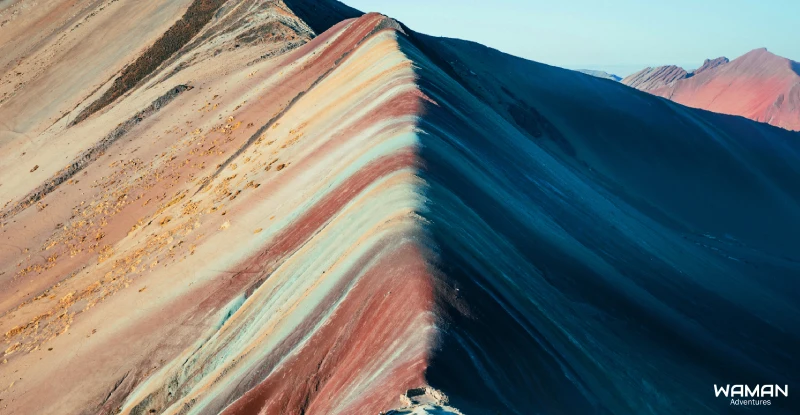
The Rainbow Mountain in all its splendor
LOCATION AND ALTITUDE
Where is the Rainbow Mountain located?
The Rainbow Mountain is located 100 kilometers southeast of Cusco, Peru. Specifically, it is situated on the way to the Ausangate snow-capped mountain, in the Andes mountain range, between the districts of Cusipata and Pitumarca.
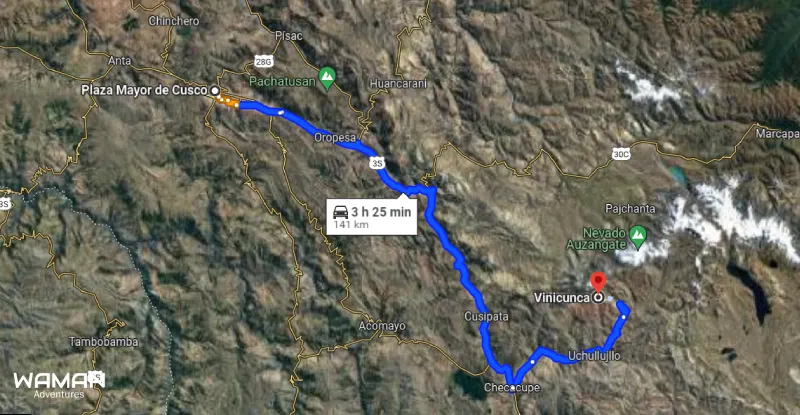
Map of the location of the Rainbow Mountain
What is the altitude of the Rainbow Mountain?
The Vinicunca Mountain, also known as the Rainbow Mountain is located at an approximate altitude of 16,470 feet/5,200 m. The high altitude and terrain conditions require proper acclimatization to avoid altitude sickness symptoms.
Maximum altitude of the hike: It is 16,522 feet (5,036 meters), located at the second viewpoint. You will have a panoramic view of the majestic mountain.
Minimum altitude of the hike: It is 16,469 feet (5,020 meters), located at the first viewpoint. You can capture closer photographs of the mountain.
HISTORY AND DISCOVERY
When was the Rainbow Mountain discovered?
Years ago, the Rainbow Mountain Peru, known as Vinicunca, was only accessible to those who ventured along the Ausangate route. Being the first ones tour operators in collaboration with the communities of Chillca and Osefina, starting in 2006, opened the way for hiking enthusiasts.
The mountain’s popularity surged in early 2016 when the 7 Colors Mountain began to gain notoriety through social media, and tourism agencies intensified their promotion.
With the opening of roads facilitating access from the municipalities of Pitumarca and Cusipata, the 7 Colors Mountain became a tourist phenomenon. Despite weather conditions and altitude, the mountain began to receive up to 1,500 tourists daily.
How was the Rainbow Mountain formed?
- The Rainbow Mountain Peru displays a diversity of colors due to the presence of various minerals in its geological composition.
- The formation of the Rainbow Mountain’s colors dates back millions of years, linked to marine, lacustrine, and fluvial sediments transported by water that once covered the area.
- The sediments, approximately 65 million years old, stratified over time, giving rise to the different colored layers that characterize the mountain.
- Tectonic plates in the region caused the uplifting of these colorful sediments, transforming them into imposing mountains.
- The oxidation and erosion of soil minerals, according to César Muñoz of the Geological Society of Peru, contributed to the mountains acquiring their vibrant colors.

The Rainbow Mountain in Peru shows a varied chromatic palette due to the existence of different minerals in its geological structure.
ROUTES, DISTANCES, AND DURATION
How far is the Rainbow Mountain from Cusco?
The Rainbow Mountain Peru is located approximately 100 km (62 miles) southeast of the city of Cusco.
How far is the Rainbow Mountain from Lima?
The rainbow mountain is located a considerable distance from Lima. The distance between Lima and Vinicunca is approximately 664 kilometers (412 miles) in a straight line. The road distance is 1218.5 kilometers (757.14 miles).
How far is Machu Picchu from the rainbow mountain?
The distance between Machu Picchu and Rainbow Mountain Peru is approximately 154 km (95 miles). The road distance is 353.9 km (219.9 miles).
How to get to the rainbow mountain from Cusco?
To get to the rainbow mountain, you can choose from 3 different routes, each with its own charm and natural beauty. The journey starts from the city of Cusco:
-
Route through Pitumarca
If you choose to visit the rainbow mountain on your own, you should head to Av. Huayruropata (near the Closed Coliseum), where you will find buses going on the Cusco-Sicuani route. The fare is approximately S/ 10. Remember to get off at the town of Checacupe and from there take another mini bus to Pitumarca.
From Pitumarca, the best option to reach the mountain is by ATV. This tour costs around $100.00 USD, depending on the company you choose. This option provides more comfort and speed during the trip to the rainbow mountain.
Details:
Hiking distance: 6 km/3.7 miles (round trip)
Hiking time: Approximately 5 hours (round trip)
Advantage: You won’t encounter large crowds ascending.
Disadvantage: You might not visit the Red Valley.

Map of the Rainbow Mountain and Red Valley tour 2D/1N – Route through Pitumarca
-
Route through Cusipata
In recent years, the Cusipata route has become the most popular for those wishing to hike to the mountain. If you want to go alone, you should take a bus on Av. Huayruropata (near the Closed Coliseum). But this time, you will need to get off in the district of Cusipata. This route is the shortest and most traveled compared to the Pitumarca route.
Details
Hiking distance: 5 km/3.1 miles (round trip)
Hiking time: Approximately 5 to 6 hours (round trip)
Advantage: You will have the opportunity to visit the Red Valley.
Disadvantage: It is the busiest route and thus has a larger crowd of people.

Map of the hike to the Rainbow Mountain / Route through Cusipata
-
The route through Ausangate trek
This option is ideal for adventure lovers, as it offers a challenging route characterized by beautiful landscapes and interaction with residents. The safest way to reach Rainbow Mountain Peru through the Ausangate route is by hiring an authorized travel agency such as Waman Adventures. The duration of the hike can vary from 2 to 7 days.
How long does it take to hike to the rainbow mountain?
On average, the hike to the rainbow mountain usually takes between 5 and 6 hours, considering the time for the round trip from the starting point to the second viewpoint and back.
The duration of the hike to Rainbow Mountain Peru can vary based on several factors:
- The route you take to reach this impressive natural attraction.
- The weather conditions, especially during the rainy season.
- The physical fitness level of the hiker.
- The high altitude at which Vinicunca is located.
CURIOSITIES
What does Vinicunca mean in Quechua?
One interesting fact about the mountain is its name, as in the Quechua language, VINICUNCA is formed by the words:
WINI: Black stones
KUNCA: Neck
Which means a colorful mountain pass or ridge.
We can find other meanings:
- Narrow-necked hill
- Narrow summit
- Rainbow Mountain
Why are the mountains in Cusco colorful?
The Vinicunca mountain displays a range of colors thanks to the presence of various minerals in its geological composition. This presence has contributed to the formation of the colors of the rainbow mountain, a process that dates back millions of years.
The colorful appearance of Vinicunca originates from marine, lacustrine (lake), and fluvial sediments transported by the water that once covered the area. These sediments date back approximately 65 million years, spanning the Tertiary and Quaternary periods. Over time, these sediments stratified, forming the different layers of colors that now characterize the mountain.
The tectonic plates in the area caused the uplift of these colorful sediments, transforming them into imposing mountains. Subsequently, the oxidation and erosion of the minerals in the soil contributed to the mountains acquiring their vibrant colors, according to César Muñoz, a member of the Geological Society of Peru (SGP).
The Rainbow Mountain in Peru shows a varied color palette due to the existence of different minerals in its geological structure.
What is the reason behind the name “Colorful Mountain”?
The name of “Colorful Mountain” is attributed to the color palette that characterizes the Rainbow Mountain (Vinicunca). Here’s information about the origin of the name:
- The term “Colorada” comes from the wide variety of colors visible on the mountain, ranging from intense reds to other vibrant hues.
- These colors result from the presence of various minerals in the geological composition of the mountain, which have oxidized and eroded over time, contributing to its unique color palette.
- The combination of minerals and geological processes has created stratified layers of colors, resulting in a visually striking landscape that justifies the name “Colorful Mountain.”
- This natural phenomenon has attracted visitors from around the world, turning the Colorful Mountain into a tourist destination recognized for its unique geological beauty.
What colors can be observed on the Rainbow Mountain?
According to research from the Cultural Landscape Directorate of Peru, the mineralogical composition of the colors of Rainbow Mountain is:
- Pink or fuchsia: Originating from a mix of red clay, fangolitas (mud), and silt.
- Lavender to lilac: Formed by a combination of clay, calcium carbonate, and silicates.
- Red: Due to the presence of argillites and clays.
- Green: Caused by clays rich in ferromagnesian minerals and copper oxide.
- Whitish: From the presence of sandstone (quartz rock) and limestone.
- Yellowish browns, mustard, or gold: Formed from limonites and limestone sands rich in sulfur minerals.

Infographic on the mineralogical composition of the Rainbow Mountain
Are the rainbow mountains of Peru real?
Yes, the Rainbow Mountains of Peru are entirely real. These mountains are located in the Cusco region and the Lima region.
Cusco:
- Palcoyo
- Pallay Punchu
Lima:
- Yuracochas
It is essential to note that although these mountains are real, it is crucial to respect and preserve the natural environment during tourist visits to ensure the sustainability of the place.
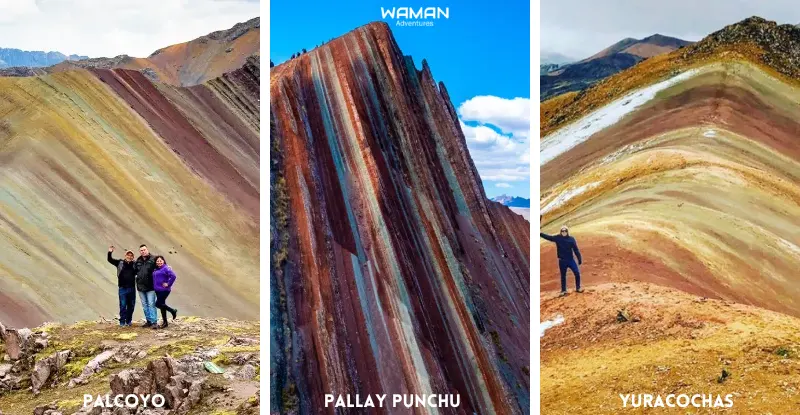
Rainbow Mountains in Peru/Palcoyo – Pallay Punchu – Yuracochas
IS RAINBOW MOUNTAIN WORTH IT?
The Rainbow Mountain is considered by many hikers to be an impressive and unique destination worth visiting. Its unique beauty has led it to be highlighted by Business Insider, which included it in their list of “100 places you must visit before you die.” Its exceptionally colorful landscape makes it an experience you can’t miss.
Here are some reasons why you should visit Vinicunca:
- Unique Color Spectacle: The Rainbow Mountain, or Vinicunca, offers the opportunity to witness an extraordinary natural phenomenon with its vibrant palette of colors ranging from deep red to green and turquoise.
- Geological Wonder: Discover the layers of colors on the mountain’s slopes, resulting from the presence of various minerals like iron and copper chloride, creating a fascinating geological landscape.
- Cultural Connection: The Rainbow Mountain is part of the rich Andean culture, with significance in local mythology and its relationship with the indigenous communities that have inhabited the region for centuries.
- Adventure Challenge: The hike to the top of Rainbow Mountain provides a rewarding physical challenge, allowing you to immerse yourself in the natural beauty of the Peruvian Andes.
- Proximity to Natural Wonders: Its location near Nevado Ausangate, the Red Valley, and other natural attractions allows visitors to explore various marvels in a single expedition.
- Stunning Photography: Capture unforgettable moments with your photographs, as Rainbow Mountain offers unique and picturesque settings perfect for any photography enthusiast.
- Sustainable Practices: By visiting Rainbow Mountain, you contribute to sustainable tourism, promoting the conservation of this natural treasure for future generations.
- Cultural Experience: Local communities provide an authentic cultural experience, allowing you to interact with people, try local food, and learn about their traditions.

Stunning photographs of the 7-Color Mountain
CHALLENGES AND RISKS
How difficult is the hike to Rainbow Mountain?
The difficulty level of Rainbow Mountain Peru varies from moderate to challenging. While the beginning of the ascent poses no major difficulties, about 20% of the trail is steep, being the most challenging part of the journey. This segment requires physical and mental endurance, making it necessary to test both qualities.
The high altitude also contributes to the difficulty, so visitors need to acclimatize properly before embarking on this journey.
Is the Rainbow Mountain dangerous?
The hike to Rainbow Mountain in Peru is not considered dangerous as long as proper precautions are taken and safety guidelines are followed. However, there are some aspects to consider:
- Altitude: Rainbow Mountain Peru is situated at a significant altitude (approximately 5,200 meters), which can cause symptoms of altitude sickness. It is crucial to acclimatize adequately, stay well-hydrated, and listen to your body.
- Physical Condition: Although the hike itself is not extremely technical, it involves challenging terrain and steep paths. Hikers should be in the reasonable physical condition and prepared adequately.
- Weather Conditions: The weather in the Andean region can change rapidly. It’s important to be prepared for temperature fluctuations and wear appropriate clothing. During the rainy season, trails can become slippery.
- Choice of Tour Operator: While it’s possible to hike independently, many visitors choose to join organized tours by local travel agencies. Selecting a reliable operator can significantly contribute to safety and the overall experience.

Hikers walking towards the 7-Color Mountain, panoramic view of the trail
WEATHER IN VINICUNCA
Vinicunca Mountain is located at a high altitude in the Andes mountain range. Generally, the area has a high mountain weather with characteristics typical of the Andean region.
Dry Season
- Climate: During these months, the region experiences drier conditions and cooler temperatures.
- Precipitation: The amount of rainfall is considerably lower compared to the rainy season.
- Temperatures: Daytime temperatures usually range between 10 °C and 20 °C, but they can drop at night, especially at higher altitudes.
- Visibility: The dry season tends to offer better visibility conditions, allowing for a fuller enjoyment of the mountain’s landscapes and colors.
- Tourist Popularity: This is the most popular season to visit the Rainbow Mountain due to more stable weather conditions.
Rainy Season
- Weather: During these months, there is an increase in precipitation, and conditions can become wetter and slippery.
- Precipitation: There is a higher likelihood of rain, which can affect accessibility and safety on the trails.
- Temperatures: Daytime temperatures can remain moderate, but nights may not be as cold as in the dry season.
- Visibility: Visibility may be affected by fog and rain, which can influence the visual experience of the mountain.
- Preparation: During the rainy season, it’s crucial to wear waterproof clothing and be prepared for wet conditions.

Contrast of the Rainbow Mountain/Dry Season – Rainy Season
How Cold is Rainbow Mountain?
The Rainbow Mountain, being located in the Andes mountain range, experiences cold temperatures due to its high altitude. During the day, temperatures range between 10 °C and 20 °C, but at night, especially at higher altitudes, they can drop below 0 °C.
Preparation for changing weather conditions is essential, and it is recommended to bring warm clothing. Also, gradually acclimating to the altitude before hiking contributes to a more comfortable and safe experience, allowing visitors to fully enjoy this stunning natural destination.

Typically in the rainy season, you will see Rainbow Mountain covered in snow, as well as any other rainy day of the year.
Is Rainbow Mountain Open All Year Round?
The Rainbow Mountain is a tourist destination that is generally open all year, but access is not guaranteed due to climatic factors and other specific conditions.
- Rainy Season: During the rainy season (November to March), weather conditions can become less predictable, and the mountain may be more difficult to access due to the possibility of heavy rains and slippery trails.
- Dry Season: The dry season (April to October) is generally considered the best time to visit Rainbow Mountain due to more stable weather conditions and greater visibility of the natural colors.
- Specific Conditions: Although the dry season is the most popular, it is important to check the specific weather conditions before planning your visit, as they can vary from year to year.
- Temporary Closures: Occasionally, for conservation or maintenance reasons, local authorities may temporarily close access to the mountain. It is advisable to check availability with local guides or tourism services before planning your visit.
Rainbow Mountain Month-by-Month
Rainbow Mountain in January
Pros: In this month, the low tourism season continues, allowing you to enjoy tranquility at Rainbow Mountain. The landscapes are covered in snow, providing a unique experience.
Cons: The rainy season occurs, which can lead to slippery trails and more challenging trekking conditions.
Rainbow Mountain in February
Pros: You can observe a peaceful environment and snowy landscapes. The lower tourist influx allows you to enjoy the natural beauty of the mountain with greater serenity.
Cons: Although crowds are sparser, the rains can still affect trail quality and visibility.
Rainbow Mountain in March
Pros: This month can be an attractive option to avoid crowds. Although the rains persist, you might experience improvements in the weather towards the end of March.
Cons: The persistence of rain remains a challenge, and some trails may be slippery.
Rainbow Mountain in April
Pros: April marks the beginning of the dry season, with clearer skies and vibrant colors on the mountain. The transition to better weather conditions makes this month favorable for visiting.
Cons: At the beginning of the month, there may still be unexpected rains.
Rainbow Mountain in May
Pros: The dry season is in full swing, offering vibrant colors and stunning landscapes. This month is ideal for capturing spectacular photographs.
Cons: With the improved weather, tourist influx begins to increase.
Rainbow Mountain in June
Pros: With stable weather conditions, June is perfect for enjoying colorful landscapes and pleasant weather. The colors of the mountain are at their peak.
Cons: The tourist influx continues to rise but does not reach its peak.
Rainbow Mountain in July
Pros: This month offers stable weather conditions, clear skies, and vibrant colors. It is the high season, allowing you to enjoy the mountain’s splendor at its best.
Cons: The high season also means a greater number of tourists and busier trails.
Rainbow Mountain in August
Pros: With good weather and vibrant colors, August is ideal for experiencing Rainbow Mountain in all its glory. Days are generally clear and sunny.
Cons: The tourist influx reaches its peak, which can result in busier trails and a less intimate experience.
Rainbow Mountain in September
Pros: Although it is a popular month, the tourist influx decreases compared to August. Weather conditions remain favorable, offering stunning landscapes.
Cons: You may encounter more tourists than in previous months, but it is still manageable.
Rainbow Mountain in October
Pros: At the end of the dry season, October offers stunning landscapes with fewer tourists than in previous months. Weather conditions are generally good.
Cons: As the rainy season approaches, you might experience some rainfall at the end of the month.
Rainbow Mountain in November
Pros: The tourist influx decreases significantly in November, providing a more tranquil experience. The landscapes are unique with some remnants of rain.
Cons: Rainfall may become more frequent towards the end of the month.
Rainbow Mountain in December
Pros: December marks the beginning of the low season, meaning fewer tourists. Snow-covered landscapes can create a magical atmosphere.
Cons: Although the crowds are smaller, rain persists, which can make the trails slippery.
PLANNING AND ALTERNATIVES
Can you hike to Rainbow Mountain without a guide?
Yes, it is possible to hike to Rainbow Mountain Peru without a guide, but this option is not recommended. Most hikers choose to hire the services of a travel agency due to the lack of reliable public transportation to reach their destination. Renting a vehicle can also be more expensive, so the most convenient option is usually to book an organized tour.
Additionally, the hike is not recommended for novice trekkers, as it is a route that requires the guidance of an expert in this type of adventure. To fully enjoy the experience at Rainbow Mountain Peru, it is advisable to choose a travel agency that handles all the logistics. It’s not worth taking risks; it’s better to travel with professionals like Waman Adventures to ensure a safe and memorable experience.
Can you see Rainbow Mountain without hiking?
Yes, it is possible to reach Rainbow Mountain on ATVs instead of hiking. To embark on this adventure on wheels, the only route that will take you to the base of the mountain starts from Pitumarca.
This journey will take you through stunning high-altitude landscapes of the Vilcanota mountain range, and you will only need to do a light 10-minute walk to the viewpoint of Vinicunca mountain.
Some local travel agencies offer ATV tours that take you directly to the base of the mountain, allowing you to enjoy the views without the 2-hour hike. However, keep in mind that transportation options may vary, and it’s important to check in advance if there are ATV services available to get to Rainbow Mountain.
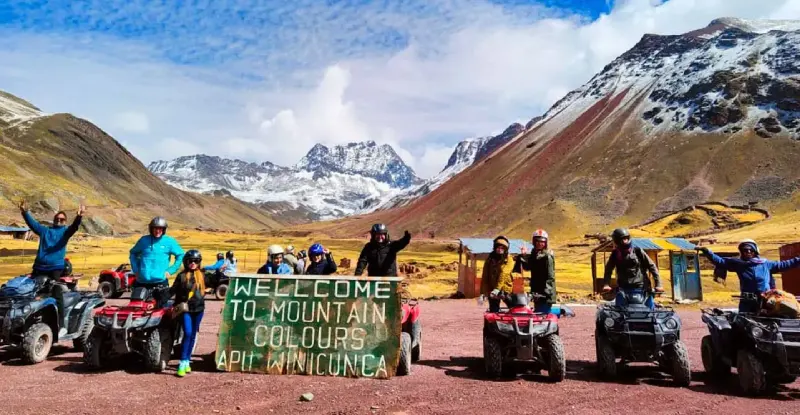
Adventurers embarking on their journey to the 7 Colored Mountain on ATVs
ATTRACTIONS NEAR RAINBOW MOUNTAIN
Red Valley
Red Valley, located in Pitumarca, Cusipata, and Rainbow Mountain make an impressive duo in the Cusco region. At an altitude of 5,020 m, Red Valley stands out for its intense red geological formations, resulting from minerals, especially iron oxides, in the geological layers, giving it distinctive hues. The hike of approximately 2 hours to Red Valley offers stunning views, including the surprising “Red River” during the rainy season. Many adventurers combine a visit to Red Valley with exploring Rainbow Mountain, both located beneath the imposing Ausangate snow-capped peak, allowing them to enjoy two natural wonders in one extraordinary adventure.

Adventurers venturing into the impressive Red Valley
Ausangate Snow Peak
The Ausangate snow peak rises majestically in the Cusco region, being one of the most imposing natural wonders. Located in the Vilcanota mountain range, this snow-capped peak impresses not only with its high altitude but also with its deep cultural significance rooted in Andean mythology. Ausangate occupies a central place in the spirituality of local communities, considered an Apu, a protective deity of the land. Exploring its surroundings gives you the chance to admire the magnificence of condors soaring through the skies and vicuñas grazing on the plains. This environment offers numerous opportunities for birdwatching and capturing photographs that highlight the rich flora of the area.

Impressive view of Ausangate snow peak, considered the fifth highest snow peak in Peru and the most representative of the Cusco region
RECOMMENDATIONS
ALTITUDE ACCLIMATIZATION
Acclimatization to altitude is a crucial aspect if your plans include visiting Rainbow Mountain, which is located at a considerable altitude of approximately 5,200 meters.
What is altitude sickness or soroche?
Altitude sickness is the difficulty the body experiences when adapting to the decrease in oxygen at high altitudes. Symptoms usually appear when people are above 2,000 m (6,561 feet). It is crucial to keep in mind that each individual’s reaction to changes in altitude, temperature, climate, and atmospheric pressure can vary considerably.
Given that Cusco is located at an altitude of 3,400 m above sea level, it is essential to consider that the likelihood of experiencing altitude sickness symptoms increases significantly, especially for those coming from sea level.
Symptoms of altitude sickness at Rainbow Mountain
The symptoms of altitude sickness can vary from person to person and are usually stronger or milder depending on the height and how quickly you have adapted. Some of the symptoms you might experience include:
- Headache
- Dizziness
- Fatigue
- Nausea
- Loss of appetite
- Difficulty breathing
Therefore, it is important to take preventive measures against altitude sickness, such as gradually acclimatizing in the city of Cusco for 2 to 3 days.

Headache, fatigue, and vomiting are some symptoms of altitude sickness
How to prevent altitude sickness or soroche?
To prevent altitude sickness on the Inca Trail, it is advised to follow these tips:
- Gradual acclimatization: Spend 1 to 3 days to adapt to the altitude before engaging in intense activities or ascents.
- Proper hydration: Drink at least 2-3 liters of water a day and avoid alcohol and caffeine.
- Healthy diet: Choose a balanced diet rich in carbohydrates, avoiding heavy and spicy foods.
- Rest Well: Respect your sleeping hours and avoid physical exhaustion.
- Coca tea: Coca tea can help relieve symptoms, but its effectiveness may vary from person to person.
- Medical consultation: If necessary, consult a doctor before taking altitude sickness medication, as each case is unique and requires professional evaluation.

Coca tea is a traditional infusion that combats altitude sickness
What to wear to Rainbow Mountain?
Dressing appropriately for Rainbow Mountain is essential to ensure comfort and protection, given the high mountain environment. Here are some recommendations on how to dress:
- Layers: Temperatures can vary significantly, especially during the early morning hike. Dressing in layers allows you to adjust clothing according to the conditions.
- Thermal clothing: Wear lightweight thermal clothing underneath your outerwear to help retain body heat without adding bulk.
- Waterproof and windproof jacket: Since the weather can be unpredictable, wearing a waterproof and windproof jacket is essential to protect against rain and wind.
- Durable pants: Choose durable yet comfortable pants for hiking. Some trails may be rocky or steep.
- Proper footwear: Use trekking boots or hiking shoes with good ankle support. Make sure they are comfortable and have been worn before to avoid blisters.
- Gloves and hats: Even on warm days, altitude can cause temperatures to drop. Wearing gloves and a hat will help keep you warm.
- Balaclava or bandana: Essential for covering your face and preventing dust you might encounter along the way.
- Sun protection: Altitude increases sun exposure. Use broad-spectrum sunscreen and wear sunglasses to protect against intense UV rays.
- Small backpack: Carry a small backpack with water, snacks, sunscreen, and extra layers.

Everything you need to carry and how to dress for the hike to Rainbow Mountain
Wildlife at Rainbow Mountain
Flora on the hike to Vinicunca
- Ichu: Ichu is a native grass of the Andean heights found on Rainbow Mountain, providing coverage and contributing to the biodiversity of the ecosystem.
- Lichens: Lichens, symbioses of fungi and algae, are common in the region and contribute to the adaptation of flora to the extreme conditions of altitude.

Flora, you can observe on the hike to Rainbow Mountain/ Ichu and lichens
Fauna on the hike to Vinicunca
- Alpacas: Alpacas are South American camelids appreciated for their soft wool and contribution to the wildlife in the mountains.
- Llamas: Llamas, also camelids, share the habitat, providing a distinctive presence and adding to the diversity of fauna.
- Vicuñas: Vicuñas, a wild and elegant species, represent local biodiversity and are often spotted at high altitudes.
- Condors: Majestic condors soar through the skies, adding an imposing touch to the fauna of Rainbow Mountain.
- Kestrels: Kestrels, small raptors, contribute to the avian biodiversity of the region.
- Fox: Foxes, cunning inhabitants of the region, are part of the terrestrial fauna that complements the natural beauty of Rainbow Mountain.

You may observe all this fauna (if you’re lucky) on the hike to Rainbow Mountain.
TOURS TO THE 7 COLORED MOUNTAIN
- TOUR TO THE 7 COLORED MOUNTAIN – FULL-DAY
- TOUR TO RAINBOW MOUNTAIN AND RED VALLEY – 2D/1N
- TOUR TO MACHU PICCHU, RAINBOW MOUNTAIN, AND HUMANTAY LAKE – 6D/5N
- TOUR TO CUSCO, SACRED VALLEY, MACHU PICCHU, AND RAINBOW MOUNTAIN – 6D/5N

Rainbow Mountain or Vinicunca, is one of the rainbow mountains in the Cusco region
Rainbow Mountain is a geological treasure that captivates the senses and imagination. Its dazzling palette of colors, telling the story of millions of years, offers travelers a unique experience amid the imposing Andean landscapes. From its reddish tones to the green and yellow hues, they reveal a distinct chapter of Earth’s natural history. Immersing oneself in this natural spectacle is not only a visual journey but also an opportunity to connect with geological time.
Are you ready to explore the Mountain of 7 Colors and marvel at this unique natural phenomenon? Join us on this unforgettable journey, where you will discover the magic of the Peruvian Andes and immerse yourself in a spectacle of colors that will linger in your memory. Book with Waman Adventures to start your adventure to Vinicunca Mountain and experience the wonder of nature at its finest!

Share:

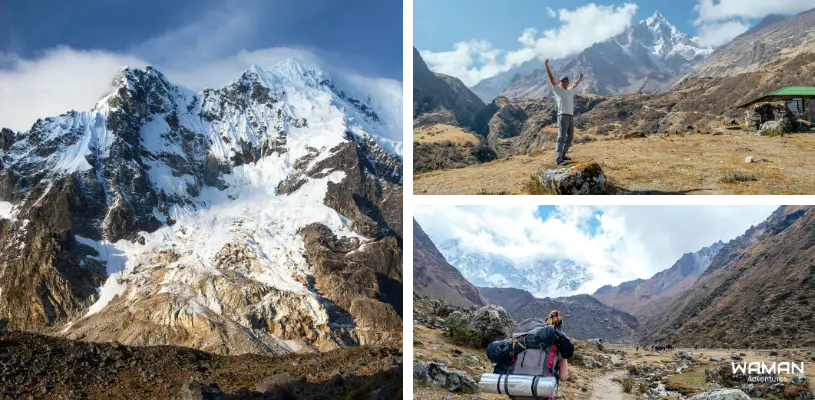


Related tours you might be interested in
Enjoy unique experiences in Cusco and Machu Picchu with the peace of mind that comes from working with a local travel agency
If you liked this article and the information you found, give us 5 stars!
Table of Contents
Related blogs