Uyuni salt flats at night: Where stars reflect on the endless salt
Ultima actualización en 18 May, 2026 por Waman Adventures
Last Updated on 18 May, 2026 by Waman Adventures
- What Makes the Uyuni Salt Flats at Night So Special?
- What’s the Best Time to Visit the Salt Flats at Night?
- How to Get to the Uyuni Salt Flats at Night and Plan a Nighttime Visit
- What to Expect on a Uyuni Salt Flats at Night Tour
- Where to Stay to Experience the Complete Adventure
- What to Bring for a Comfortable and Safe Night Visit
- Tips for Responsible Tourism
- Cultural and Mythical Meaning of the Salt Flat
- Curious Facts About the Uyuni Salt Flats at Night
-
Frequently Asked Questions
- Is it safe to visit the Uyuni salt flats at night?
- What’s the best month to see the mirror effect at night?
- Can you see the starry sky during rainy season?
- Do I need special equipment for night photos?
- Are salt hotels available at night?
- How cold is it on the salt flat at night?
- Is it necessary to hire a night tour?
- Can I visit the salt flat at night on my own?
The Uyuni salt flats at night offers one of the most breathtaking landscapes on Earth, where a star-filled sky reflects perfectly on a thin layer of water, forming an endless mirror between heaven and ground. In this travel guide, you’ll discover how to fully experience the magic of the Uyuni salt flats at night, the best time to visit, and what essentials to bring for an unforgettable adventure under the stars.
What Makes the Uyuni Salt Flats at Night So Special?
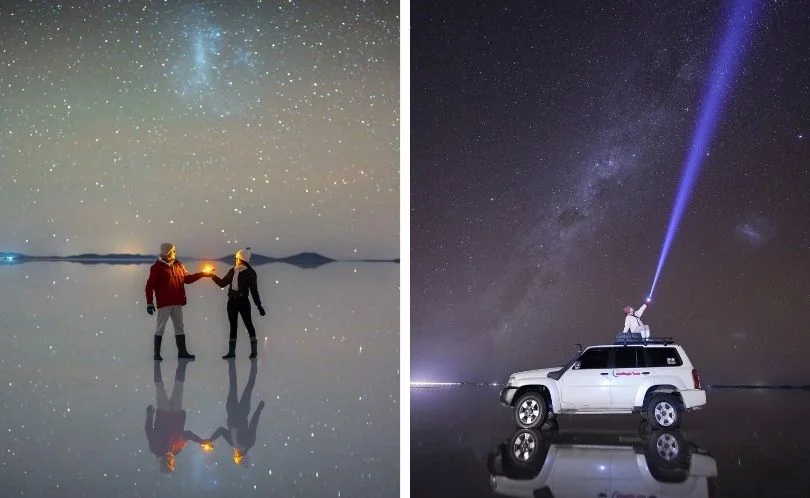
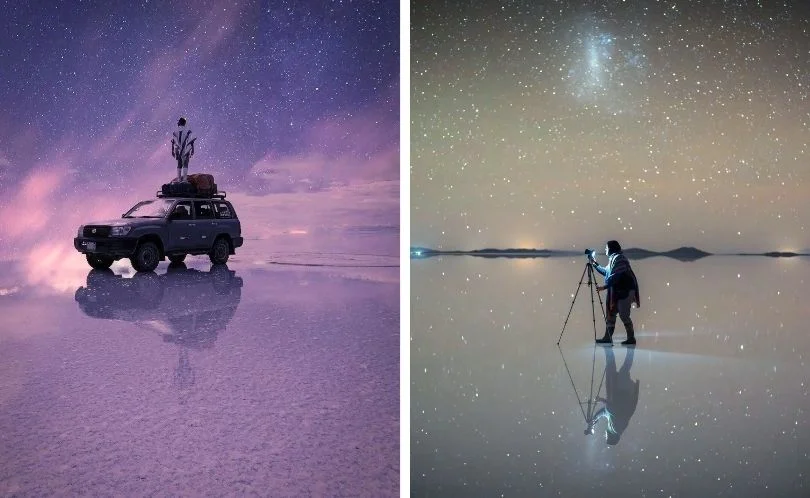
Between December and March, during the rainy season, the salt flat is covered by a thin layer of water that creates a breathtaking mirror effect. On clear nights, the Uyuni salt flats at night offers a perfect reflection of the Milky Way, the Southern Cross, and the Pleiades cluster, turning the ground into a celestial stage. At an elevation of 11,994 feet (3,656 m.a.s.l.) the air remains dry and pure, with almost no light pollution. This makes Uyuni one of the best places in the world for stargazing and for feeling the immensity of the universe in absolute silence.

The combination of that starry sky with the absolute silence of the desert creates an almost mystical atmosphere. There are no visual limits, just you, nature, and the cosmos. If you’re looking to disconnect from the world’s noise and live a deeply spiritual experience, this place is perfect for you.
- Mirror effect: during this time of year, sky and earth seem to unite in a perfect reflection.
- Starry sky: thanks to pure air and lack of artificial lights, it’s ideal for observing stars and the Milky Way.
- Unique experience: the desert’s calm, landscape’s vastness, and connection with the universe make this visit truly unforgettable.
What’s the Best Time to Visit the Salt Flats at Night?
Rainy season (December to March): it’s the perfect time for the mirror effect, although there are risks of cloudy skies and some areas may become inaccessible. But when the sky clears after rain, the spectacle is unforgettable.
- Daytime temperatures stay around 59°F to 68°F (15–20°C), although it still cools down at night.
- Some areas, like Incahuasi Island, could become inaccessible due to flooding. Additionally, tours may be affected by heavy rains.
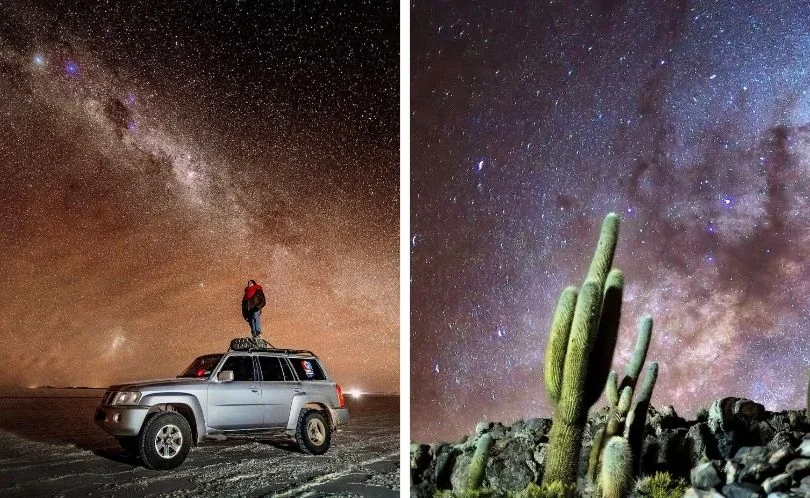
Dry season (April to November): it’s ideal for observing the Milky Way with completely clear skies. The salt flat is firm and accessible. Nights are cold, reaching down to 5°F (−15°C) between June and August.
- The terrain is firmer and more accessible, as the salt flat hardens, allowing you to explore many areas like volcanoes, Incahuasi cacti, labyrinths, and lagoons. This is where 4×4 tours work perfectly.
- Nights can be extremely cold (14°F to -4°F/−10°C to −20°C), especially between June and August.
Transition months (April–May and October–November): There are still water remains to see light reflections and, at the same time, good access and clear skies.
How to Get to the Uyuni Salt Flats at Night and Plan a Nighttime Visit
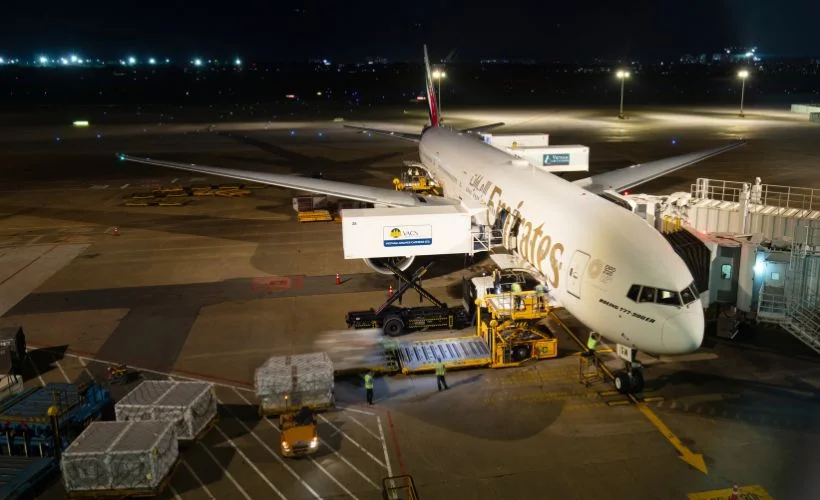
By Plane
- From La Paz: BoA and Ecojet operate direct flights between El Alto Airport (LPB) and Joya Andina Airport (UYU), with approximately 7 weekly flights.
- Advantages: You save between 10 and 12 hours of overnight road travel and reduce risk of fatigue or accidents.
- Disadvantages: Flights usually depart in the morning and may be canceled due to bad weather.
By Bus
- Companies like Todo Turismo or Trans Titicaca cover La Paz–Uyuni in sleeper or semi sleeper services, with a duration of 10 to 12 hours.
- Advantages: economical and frequent.
- Disadvantages: long and tiring journey.
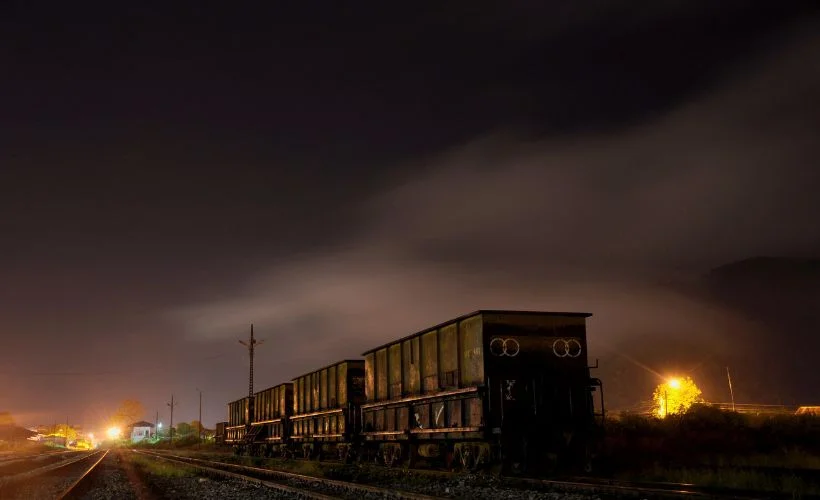
By Train from Oruro
First you take a bus to Oruro (3–4 h) and then an overnight train (5–6 h) to Uyuni. The bus is economical, but can be exhausting and a bit more risky. However, it’s panoramic and quiet.
Night tours: Upon arrival, you’ll find local agencies offering tours from approximately $15 USD (shared group) to over $50 USD for private packages or with extras, like hot springs.
Remember that:
If you want to save and experience something more authentic, the overnight bus is a good option.
What to Expect on a Uyuni Salt Flats at Night Tour
Most tours begin around 4:30 in the afternoon, with hotel pick-up and departure in a 4×4 vehicle to explore the salt flats at sunset. As darkness falls, the vast white surface transforms into a mirror that reflects a breathtaking starry sky. Some tours even depart earlier, around 3 or 4 in the morning, allowing travelers to witness the Milky Way and the first light of dawn over this surreal landscape.
Photography: you can bring a camera with manual mode, tripod, and extra batteries; as the cold drains charge quickly.
Where to Stay to Experience the Complete Adventure
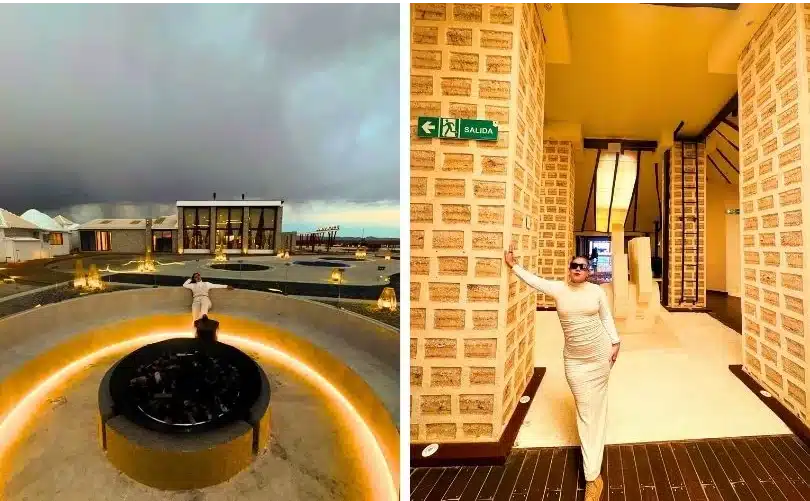
Salt Hotels
- Palacio de Sal: located in Colchani, 15.5 miles (25 km) from Uyuni. Built completely with salt blocks (walls, roof, furniture), it has a saltwater pool, sauna, spa, and restaurant with local products.
- Luna Salada: situated near the salt flat, it offers dome style rooms with cupolas and large windows to contemplate the night sky from bed. It has a breakfast buffet in panoramic restaurant and airport transfer.
Rustic and Glamping Domes
- Kachi Lodge (domes): luxury camps located on platforms to avoid damaging the salt flat, with heated geodesic domes, spectacular views, and pellet stoves to maintain warmth. Other glamping domes offer similar atmospheres: transparent or semi transparent structures that allow sky observation without going outside.
Houses and Accommodations in Uyuni City
- Hotel Sal Andina: located in Uyuni center, Andean rustic style with salt touches in its decoration. It’s comfortable, with breakfast included and good local rating.
- In Uyuni and Colchani there are multiple hostels and family homes, simpler but welcoming options, ideal for brief stays and with direct contact with the local community.
Important note:
Book in advance, especially if you plan to travel during high season.
What to Bring for a Comfortable and Safe Night Visit
Warm clothing:
- Thermal clothing (merino or synthetic).
- Windbreaker jacket or waterproof hardshell.
Accessories:
- Hat, gloves, and scarf.
Extras:
- Camera with manual mode and tripod.
- Extra batteries and memory cards (cold drains them quickly).
- Headlamp with red light.
Important extras:
- 2 L of water per day and energy snacks.
- SPF 50+ sunscreen, lip balm, sunglasses.
- Poncho or raincoat (essential during rainy season).

Tips for Responsible Tourism
- Choose local agencies that respect the environment.
- Don’t extract salt or rocks.
- Take your trash with you.
- Always follow the guide’s instructions.
- Support by buying handicrafts from Andean communities.
Cultural and Mythical Meaning of the Salt Flat
For Andean peoples, the Uyuni Salt Flat is a sacred place full of legends, like that of the goddess Tunupa, whose tears formed this sea of salt. The Aymara and Quechua extract its resources with respect for Pachamama, performing rituals and offerings to maintain balance with nature. Even many night tours include small Andean ceremonies under the starry sky.

Curious Facts About the Uyuni Salt Flats at Night
Covering more than 6,500 square miles, the Uyuni Salt Flats is the largest salt plain on Earth, so vast that it rivals the size of entire countries. Its perfectly flat and reflective surface is so precise that it is used to calibrate satellites with incredible accuracy. Beneath this immense white expanse lies between 25 and 50 percent of the world’s lithium reserves, estimated at around eleven million tons.
When darkness falls, the landscape transforms completely. The Milky Way, the Southern Cross, Orion, Sagittarius, and the Pleiades shine with unmatched clarity under one of the purest skies on the planet. Experiencing the Uyuni Salt Flats at Night is not just about stargazing, it is about feeling connected to the universe in a way that stays with you forever.
At Waman Adventures we take care of every detail to ensure your visit is safe, meaningful, and unforgettable. Join travelers who value culture, nature, and responsible tourism, and let the magic of Uyuni leave its mark on your heart.
If you want to learn more about Uyuni check out: Facts About the Uyuni Salt Flat: a practical guide for travelers.
Frequently Asked Questions
Is it safe to visit the Uyuni salt flats at night?
What’s the best month to see the mirror effect at night?
Can you see the starry sky during rainy season?
Do I need special equipment for night photos?
Are salt hotels available at night?
How cold is it on the salt flat at night?
Is it necessary to hire a night tour?
Can I visit the salt flat at night on my own?

Share:



If you liked this article and the information you found, give us 5 stars!
Table of Contents
Related blogs
Ausangate Trek: The Complete Guide to Planning Your Journey
12 min of reading