Ausangate Trek: The Complete Guide to Planning Your Journey
Ultima actualización en 17 September, 2026 por Jhon Quispe
Last Updated on 17 September, 2026 by Jhon Quispe
Ausangate Trek planning in brief
The Ausangate Trek is a demanding high-altitude hike in the Cusco region that travels around Ausangate Mountain rather than climbing its 20,948-ft (6,385-m) summit. Waman Adventures’ main multi-day options range from 4 to 6 days, with much of the trekking above 13,123 ft (4,000 m) and high passes reaching roughly 16,578–17,716 ft (5,053–5,400 m). Choosing the right route depends mainly on your available time, acclimatization, trekking experience and the landscapes you want to include.
- MachupicchuMachu Picchu & Humantay Lake
- General information
- Ausangate Trek altitude and highest points
- Ausangate Trek location and route overview
- Ausangate Trek routes and duration
- Ausangate Trek difficulty and preparation
- Best time to hike the Ausangate Trek
- Ausangate Trek logistics from Cusco
- What to pack for the Ausangate Trek
- Cultural meaning of Ausangate
- Who the Ausangate Trek is best for
- Choose the Ausangate route that fits your trip
-
Frequently asked questions about the Ausangate Trek
- How many days does the Ausangate Trek take?
- How high is the Ausangate Trek?
- How difficult is the Ausangate Trek?
- What is the best time to hike the Ausangate Trek?
- Do I need to acclimatize before the Ausangate Trek?
- Does the Ausangate Trek go to Machu Picchu?
- Can I hike Ausangate independently?
- What routes are available, and how long does the Ausangate Trek take?
Ausangate is less about reaching one final attraction and more about spending several days in a remote high-Andean landscape of glaciers, lakes, mountain passes and pastoral communities. Because the distance, highest elevation and level of remoteness vary considerably between itineraries, choosing the right route is more useful than following one generic Ausangate Trek plan.
General information
Ausangate Trek altitude and highest points
Altitude is one of the most important factors when deciding whether the Ausangate Trek fits your trip.
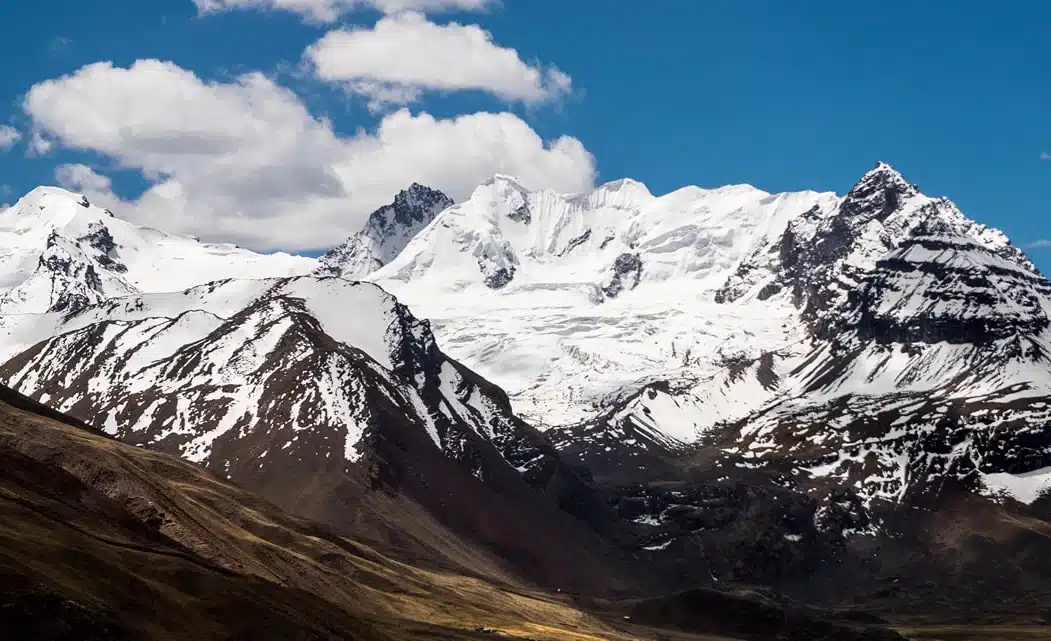
Peru’s tourism inventory places the summit of Nevado Ausangate at 20,948 ft (6,385 m). The standard trekking routes do not climb the summit, but they still spend much of their time above 13,123 ft (4,000 m) and cross passes above 16,000 ft.
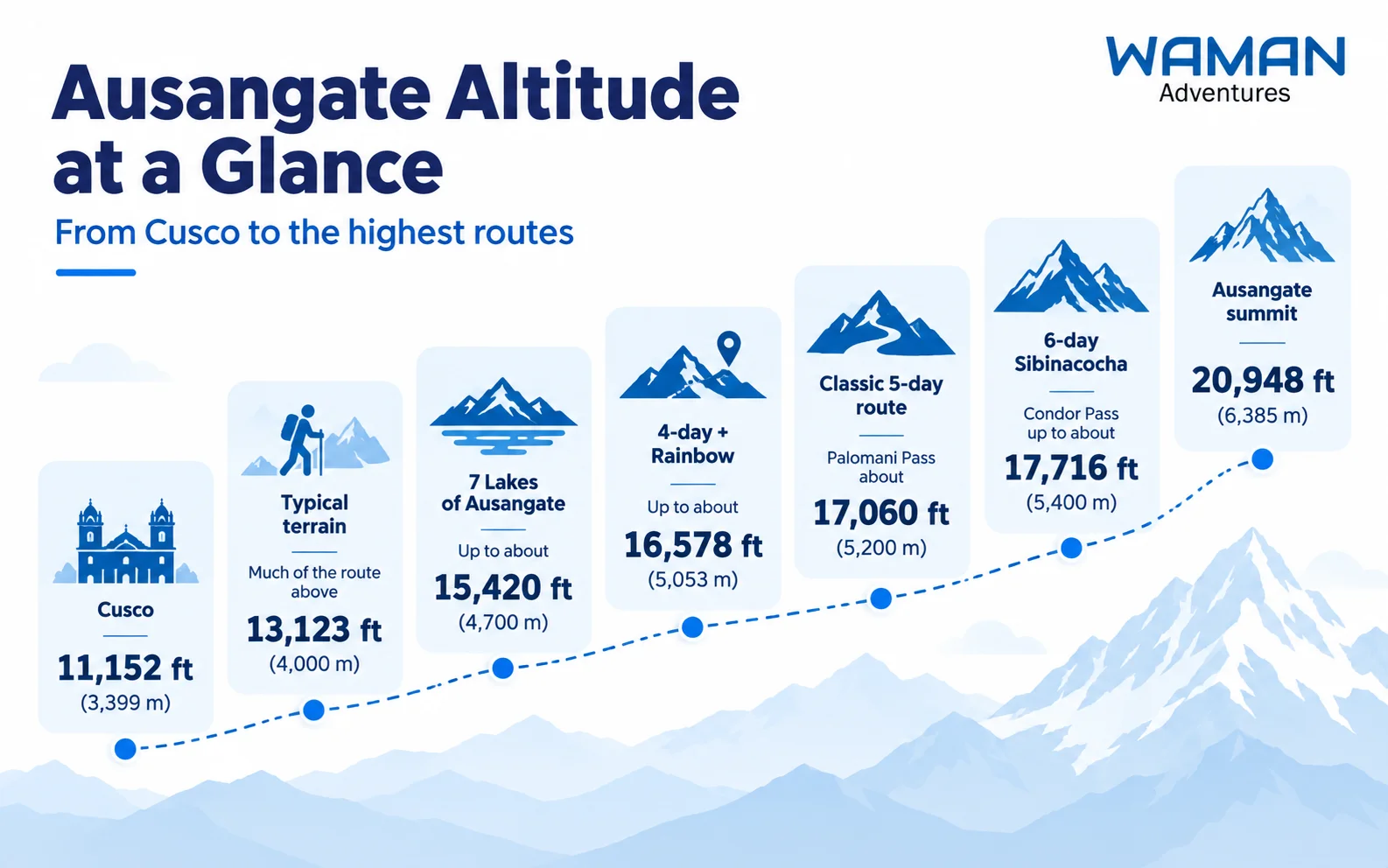
The infographic shows how elevation increases from Cusco across different Ausangate routes, including the Seven Lakes, Rainbow Mountain itinerary, Palomani Pass, Sibinacocha and the summit.
The highest point you actually reach depends on the itinerary. A traveler hiking the 5-day classic route does not necessarily cross the same pass as someone continuing toward Sibinacocha.
For the official geographic reference for Nevado Ausangate, see Peru’s MINCETUR tourism inventory.

Ausangate Trek location and route overview
Ausangate Mountain lies in the district of Ocongate, within the Vilcanota mountain range southeast of Cusco. MINCETUR places the mountain roughly 75 mi (120 km) southeast of Cusco by geographic reference, although actual road distance to a trailhead depends on the itinerary.
There is no single starting point for every Ausangate Trek. Multi-day routes can use areas around Upis, Tinki, Pacchanta or Ocongate, while the 7 Lakes hike is normally approached through Pacchanta.
This is also an important distinction from summit climbing: standard trekking itineraries travel through the valleys and passes surrounding Ausangate rather than attempting the glaciated summit.
Keep this in mind:
The standard Ausangate Trek travels around the mountain. Climbing the 20,948-ft (6,385-m) summit is a separate mountaineering objective that requires technical skills, specialized equipment and a different expedition plan.
For geography, glacial context and the mountain itself rather than trekking logistics, use the Ausangate Mountain guide.
Ausangate Trek routes and duration
There is no single Ausangate Trek itinerary. The practical differences are the number of days, total distance, highest pass and whether the route continues toward Sibinacocha or Rainbow Mountain.
| Route | Approx. distance | Highest point | Best fit |
| Ausangate to Sibinacocha 6D/5N | About 49 mi (79 km) | About 17,716 ft (5,400 m) | Experienced trekkers wanting a longer and more remote route |
| Classic Ausangate 5D/4N | About 34 mi (55 km) | About 17,060 ft (5,200 m) | Travelers wanting the traditional multi-day Ausangate experience |
| Ausangate and Rainbow Mountain 4D/3N | About 23 mi (37 km) | About 16,578 ft (5,053 m) | Travelers wanting a shorter trek that also reaches Rainbow Mountain |
| 7 Lakes of Ausangate Full Day | About 6.2 mi (10 km) | About 15,420 ft (4,700 m) | Travelers who cannot commit to a multi-day camping trek |
Ausangate to Sibinacocha 6 days
The 6-day route extends beyond the classic circuit toward remote Sibinacocha Lake. It is the longest option summarized here, covering about 49 mi (79 km) and reaching approximately 17,716 ft (5,400 m) at Condor Pass.
Choose it if your priority is a longer expedition, greater remoteness and the Sibinacocha landscape rather than minimizing trekking days.

Classic Ausangate Trek 5 days
The 5-day route is the most representative multi-day option in this comparison. It crosses high terrain around Ausangate and reaches Palomani Pass at approximately 17,060 ft (5,200 m).
It is the stronger fit if you want a substantial circuit around Ausangate without extending the trek toward Sibinacocha.
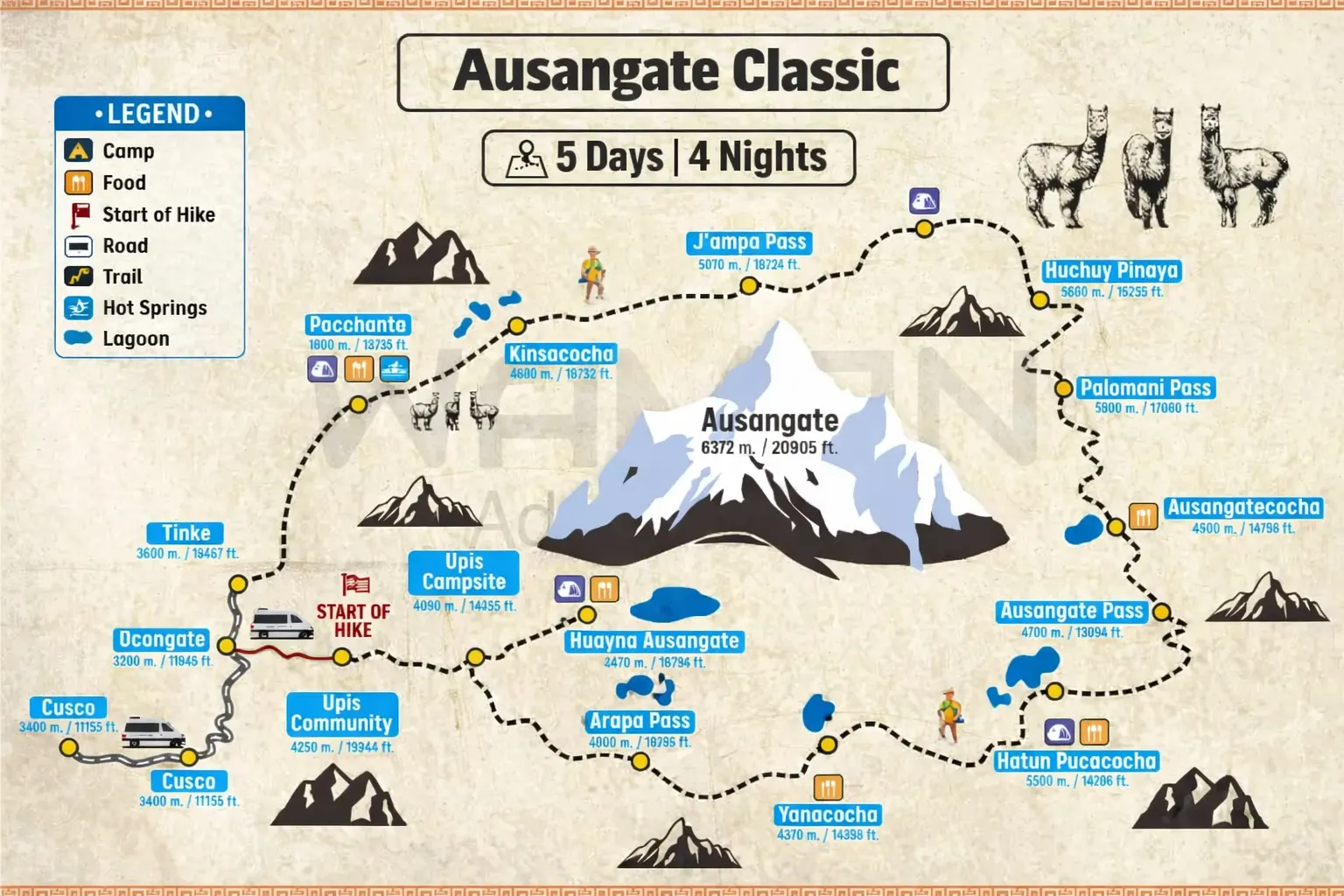
Ausangate and Rainbow Mountain 4 days
The 4-day route compresses the trekking schedule and connects the Ausangate landscape with Rainbow Mountain and the Red Valley area.
Its highest point reaches roughly 16,578 ft (5,053 m), so fewer days should not be confused with low-altitude hiking.

7 Lakes of Ausangate Full Day
The 7 Lakes of Ausangate tour is a separate full-day experience near Pacchanta rather than a one-day version of the complete Ausangate circuit.
Waman Adventures’ current service lists approximately 6.2 mi (10 km) of hiking, about five hours of walking and a maximum altitude around 15,420 ft (4,700 m). The itinerary visits a group of high-Andean lakes and can include time at the Pacchanta hot springs.

The Seven Lakes hike explores Pacchanta without completing the full circuit.
Ausangate Trek difficulty and preparation
The Ausangate Trek is physically demanding primarily because of its elevation, repeated hiking days and remote environment rather than technical climbing.
A shorter itinerary does not automatically make the trek easy. The 4-day route still reaches above 16,500 ft, while the longer routes add more cumulative fatigue.
Altitude is the main challenge
Much of the multi-day trek takes place above 13,123 ft (4,000 m), with the main routes reaching passes above 16,500 ft.
At those elevations, a walking pace that feels comfortable at lower altitude can require considerably more effort. Cold, wind and rapidly changing weather can add to the physical demand.
Warning:
Altitude affects travelers differently. If you develop symptoms that concern you or become worse during the trek, tell your guide promptly rather than using a general difficulty rating as a substitute for individual medical advice.
Acclimatization before the trek
Ausangate should not normally be the first demanding high-altitude activity you attempt immediately after arriving in Cusco.
Many trekking plans allow at least a couple of days at altitude before departure so travelers can adjust and see how they respond before committing to a remote multi-day route.
More time can be appropriate depending on your travel history and individual response. Acclimatization does not guarantee that altitude symptoms will not occur.
Physical training
Preparation should focus on the type of effort the trek actually requires.
Regular walking and cardiovascular exercise can help build endurance, while hills and stairs better reproduce the repeated climbs and descents found on the route. Leg-strength work can complement hiking preparation.
Use your hiking footwear and daypack before traveling so you can identify fit or comfort problems before beginning several consecutive trekking days.
Best time to hike the Ausangate Trek
For most travelers, the drier part of the year provides the most practical conditions for a multi-day Ausangate Trek.
| Period | Typical planning conditions |
| May to September | Generally drier trekking conditions and clearer mountain views, with colder nights |
| April and October | Transition periods that can balance trail conditions and lower seasonal demand |
| November to March | Higher probability of rain, cloud and more difficult high-altitude trail conditions |
Even during the drier months, conditions at high elevation can change rapidly. Warm layers and waterproof protection remain useful throughout the trekking season.
Seasonal patterns are more useful for planning than trying to predict exact mountain weather month by month.
Ausangate Trek logistics from Cusco
Most Ausangate itineraries begin operationally in Cusco, but the trail itself starts several hours away in the Ocongate and Ausangate area.
Trailheads and transportation
The correct transportation plan depends on the route.
The 5-day and 4-day itineraries commonly use the Upis area, the 6-day Sibinacocha route can begin through Pacchanta, and the 7 Lakes day hike is organized around Pacchanta.
An organized trek normally coordinates transportation between Cusco and the relevant trailhead. Independent travelers need to confirm both their outbound transport and how they will leave the route at its finishing point.
Guided vs independent trekking
An organized service can simplify transportation, camping arrangements, meals, pack-animal logistics and route coordination in a region where services become limited once you leave the road network.
Independent trekking is possible, but it is better suited to travelers who already have experience with self-supported multi-day mountain routes, navigation and high-altitude camping.
Warning:
Ausangate is a remote high-altitude trekking area. If you do not already have experience managing multi-day routes, navigation, changing weather and self-supported camping, this is not an ideal place to learn those skills through trial and error.
Cash and local expenses
Carry some cash in Peruvian soles, preferably including small bills.
Communities participate in services and management along different sections of the Ausangate routes, and local payments can vary according to the itinerary, campsite or service included by your operator.
Pacchanta also has thermal baths that may require a separate local payment when admission is not already included.
Confirm your inclusions before departure rather than assuming all community fees, campsites or hot springs are covered.
What to pack for the Ausangate Trek
Pack for sustained altitude, cold nights and rapidly changing mountain conditions rather than for daytime weather in Cusco.
| Category | Useful items |
| Clothing | Base layers, insulating layer, waterproof shell, trekking pants, warm hat and gloves |
| Footwear | Broken-in hiking boots or trekking shoes with reliable grip |
| Daypack | Around 25–35 L for personal items carried during the hiking day |
| Sun protection | Sunscreen, sunglasses and a sun hat |
| Hydration | Reusable bottles or hydration system and water treatment when required |
| Personal equipment | Headlamp, personal medication, hygiene items and power bank |
| Documents and money | Identification and cash in Peruvian soles, including small bills |
If you are using an organized service, check exactly which camping equipment is included before carrying a tent, sleeping system or other bulky gear unnecessarily.

Cultural meaning of Ausangate
Ausangate is not only a trekking landscape. The mountain has long-standing cultural and religious importance for communities in the Cusco region.
Apu Ausangate
Within Andean traditions, Ausangate is regarded as an important Apu, a sacred mountain associated with protection and the surrounding landscape.
For local communities, mountains, water, livestock and agricultural life can form part of the same cultural relationship with the environment. This context helps explain why traveling through Ausangate is different from treating the area simply as an outdoor sports destination.

Kintu offerings reflect enduring respect for the sacred mountain landscape.
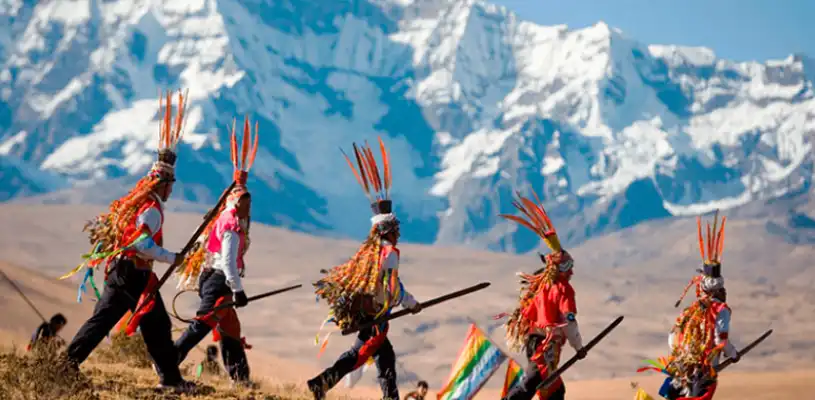
Qoyllur Rit’i connects Andean and Catholic traditions near Ausangate.
Qoyllur Rit’i and the Ausangate landscape
The broader Ausangate region is closely connected with the pilgrimage to the Sanctuary of the Lord of Qoyllur Rit’i.
UNESCO inscribed the pilgrimage on the Representative List of the Intangible Cultural Heritage of Humanity in 2011. The tradition brings together Catholic religious practice with older relationships to sacred mountains and the natural environment.
The tourism trek is not the same activity as participating in Qoyllur Rit’i, but knowing this context helps explain why Ausangate holds cultural importance beyond its scenery.
You can read UNESCO’s description of the tradition on the Qoyllur Rit’i heritage page.
Who the Ausangate Trek is best for
Ausangate is a strong choice when mountain scenery and the trekking experience itself are the main reasons for your trip.
| Ausangate is a strong choice if… | Consider another trek if… |
| You want remote high-Andean mountain scenery. | Your main goal is reaching Machu Picchu on foot. |
| You enjoy multi-day camping and wilderness trekking. | You strongly prefer hotel accommodation every night. |
| You are prepared for sustained hiking above 13,000 ft. | You have very limited time to acclimatize. |
| You value lakes, glaciers and mountain passes more than archaeological sites. | You primarily want an archaeological trail. |
| You want a quieter and more remote trekking environment. | You want easy road access throughout the itinerary. |
The 5-day route provides the most traditional multi-day experience among the options summarized here. The 6-day route places greater emphasis on remoteness and Sibinacocha, while the 4-day itinerary is more suitable when Rainbow Mountain is also a priority.
Choose the Ausangate route that fits your trip
The right Ausangate itinerary depends less on finding one “best” route and more on matching the trek to your available days, acclimatization, physical preparation and the landscapes you most want to experience.
Choose the 5-day option for the classic multi-day format, consider the 6-day Sibinacocha route if you want a longer and more remote expedition, or use the 4-day route when combining Ausangate with Rainbow Mountain is a priority. If you only have one day, the 7 Lakes hike provides a separate introduction to the area rather than replacing the full circuit.
Frequently asked questions about the Ausangate Trek
How many days does the Ausangate Trek take?
How high is the Ausangate Trek?
How difficult is the Ausangate Trek?
What is the best time to hike the Ausangate Trek?
Do I need to acclimatize before the Ausangate Trek?
Does the Ausangate Trek go to Machu Picchu?
Can I hike Ausangate independently?
What routes are available, and how long does the Ausangate Trek take?
Share:

Related tours you might be interested in
Enjoy unique experiences in Cusco and Machu Picchu with the peace of mind that comes from working with a local travel agency

Tour to Chinchero, Maras & Moray – Private Service
Discover with us this beautiful, charming and historic places, where we will visit the enigmatic...

2-Day Trip to Machu Picchu from Cusco with Machu Picchu Mountain
LIVE A UNIQUE EXPERIENCE EXPLORING THE BREATHTAKING LANDSCAPES ON A 2-DAY JOURNEY TO MACHU PICCHU...
6-Day Tour Cusco, Sacred Valley, Machu Picchu and Rainbow Mountain
EXPERIENCE THE MAJESTY OF THE INCAS: SACRED VALLEY, MACHU PICCHU & RAINBOW MOUNTAIN IN ONE TRIP If...

6 Day Andean Adventures Tour│With Flights from Chile
ENJOY THE BEST OF CUSCO CITY – MUST VISIT DESTINATIONS ARE WAITING FOR YOU! Want to explore Cusco...
If you liked this article and the information you found, give us 5 stars!
Table of Contents
Related blogs