



Peru Trip Cost from the US: What to Budget Beyond the Package
Ultima actualización en 4 November, 2026 por Jhon Quispe
Last Updated on 4 November, 2026 by Jhon Quispe
What belongs in a Peru travel budget from the US?
Your Peru travel budget should include international airfare, your tour package, excluded domestic travel, uncovered meals, personal expenses, and selected extras. Use dated quotes for your travel dates and room arrangement. To estimate your total Peru trip cost accurately, separate included services from expenses you still need to pay.
- The main parts of your Peru Trip Cost
- Domestic flights can change the comparison
- Comparable quotes need the same starting assumptions
- Your arrival and departure dates affect the full budget
- Meals and free time need their own allowance
- Optional upgrades belong in the final total once
- Adjust the route when a quote exceeds your budget
- Request a quote built around your whole trip
-
Frequently asked questions about Peru Trip Cost
- Is the deposit an additional cost on top of the package price?
- How should solo travelers budget for accommodation?
- Do children pay the same price as adults?
- How do I budget for flights booked with points or miles?
- How should we split shared trip expenses?
- How long is a travel quote valid?
- How do cancellation terms affect my budget?
The package price is only part of what you will spend on a trip to Peru. Before comparing options, check which flights, hotel nights, meals, and activities you will need to pay for separately.
The main parts of your Peru Trip Cost
A useful budget separates the amount you pay for an organized trip from the costs you arrange yourself. Keep every amount in the same currency, and label whether it applies to one traveler or your entire party.
| Budget category | What to record | How to avoid double counting |
| International airfare | Your flights between the US and Peru, including any selected baggage or seat charges. | Check what the airfare already includes before adding airline extras. |
| Confirmed tour package | The quoted amount for your dates, travelers, room arrangement, and selected services. | Keep included hotels, transport, admissions, and meals within this amount. |
| Travel outside the package | Domestic flights, airport transfers, or hotel nights that your quote excludes. | Add only the routes, transfers, and nights missing from the package. |
| Personal spending | Uncovered meals, drinks, shopping, tips, and independent activities. | Use the daily itinerary to identify meals and activities already covered. |
| Optional extras | Requested room, train, or activity upgrades and other separately priced additions. | Check whether the final package quote already incorporates your selections. |
| Other trip expenses | Travel insurance and any additional costs associated with your departure from the US. | Separate confirmed purchases from money reserved for unexpected expenses. |

Planning a travel budget in advance helps separate expenses such as flights, accommodation, transportation, activities and money reserved for personal spending or unexpected costs.
Total planned spending: international airfare + confirmed package + uncovered travel services + personal spending + selected extras + other trip expenses.
Keep a separate contingency allowance if you want room in your budget for changes. An allowance is money you set aside, not a confirmed charge.
Domestic flights can change the comparison
Two package prices may cover different parts of your journey. Before comparing them, check each flight segment individually instead of assuming that all organized trips include local airfare.
For example, the published seven-day Echoes of Peru itinerary includes the Lima–Cusco and Cusco–Lima domestic flights. International flights are excluded. When budgeting for that itinerary, avoid adding those same included domestic flights a second time.
The published ten-day Millenary Peru itinerary excludes airfare, including the Lima–Cusco and Cusco–Puerto Maldonado flights and the onward flight after the Amazon stay. Those journeys need their own budget lines.
These examples explain a difference in scope; they do not establish which trip costs less. Use your dated booking quote to confirm the services and amounts that apply to your departure.

Comparable quotes need the same starting assumptions
You can compare quotes more easily when each uses the same traveler details. Make any differences in duration, route, accommodation, or included services explicit.
- Travel dates: specify your intended departure period and any flexibility.
- Travelers: use the same party size and provide ages when relevant to pricing.
- Room arrangement: identify shared rooms, separate rooms, and any single occupancy request.
- Duration: record both itinerary days and included hotel nights.
- Flights: list the included and excluded segments separately.
- Service level: identify hotel categories, train services, and shared or private excursions.
- Price conditions: record the currency, quote date, validity, taxes, and any applicable payment charges.
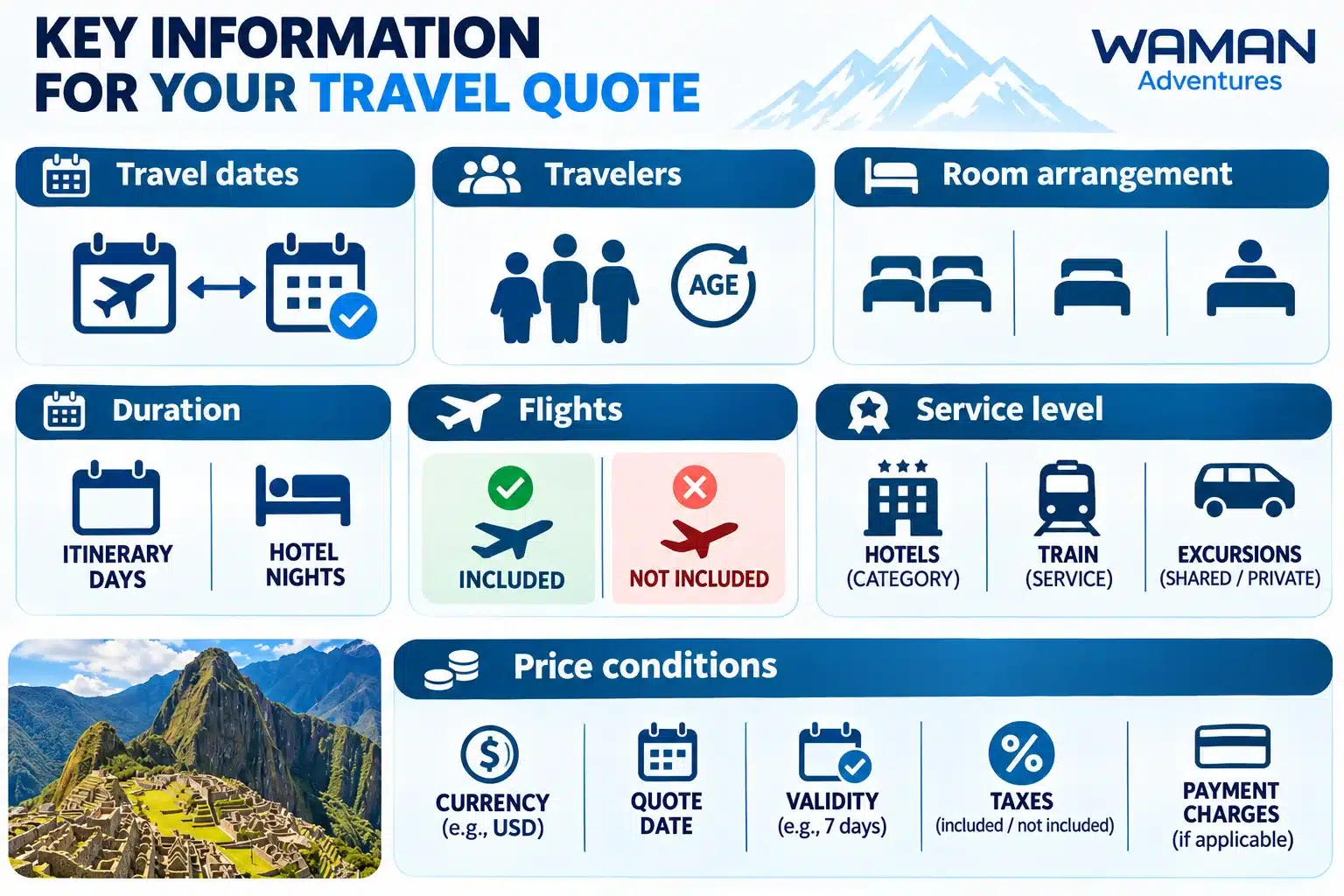
The infographic summarizes the details travelers should define before requesting a quote, including dates, traveler count and ages
If you compare a shorter trip with a longer route, treat the result as a choice between different vacations. A per-day calculation can provide context, but it does not account for differences in destinations, transport, or included experiences.
Your arrival and departure dates affect the full budget
Match your international flight schedule to the first and last services in your itinerary. Record any hotel nights or transfers needed before the package starts or after it ends. A package described by its number of days does not necessarily include the same number of hotel nights. Check the overnight schedule directly, especially on the final day.
Your departure airport also belongs in the calculation. If reaching that airport requires a separate flight, parking, ground transport, or an overnight stay, include those expenses in your total vacation budget.

Meals and free time need their own allowance
Read the itinerary day by day and mark each included breakfast, lunch, and dinner. Build your food allowance around the remaining meals instead of adding a full daily meal budget on top of meals you have already paid for.
Apply the same approach to free time. Separate independent activities you intend to book from possibilities you may decide on later. Keep shopping and discretionary spending in their own category. This makes it easier to adjust your budget without confusing personal choices with the cost of completing the planned route.

Optional upgrades belong in the final total once
Decide which extras matter before comparing final quotes. Ask for the cost of your selected room arrangements, train upgrades, and additional activities to appear clearly in writing. If an upgrade replaces a service in the base package, confirm whether the amount shown is the additional charge or the full replacement price. Do not add both unless the quote explicitly requires it.

Treat alternative upgrades as choices. Selecting one train option, for example, does not mean you should budget for every available train upgrade.
Adjust the route when a quote exceeds your budget
When a quote exceeds your spending target, request a revised version with specific changes. You might compare fewer destinations, a different room arrangement, or a version without optional upgrades.
Ask the operator to show the effect of each change. Removing an activity or changing a hotel does not establish a saving until you receive the revised amount.
Keep the experiences you care about most visible in the comparison. The useful question is whether each option covers the trip you want within your total budget.
Request a quote built around your whole trip

Frequently asked questions about Peru Trip Cost
Is the deposit an additional cost on top of the package price?
How should solo travelers budget for accommodation?
Do children pay the same price as adults?
How do I budget for flights booked with points or miles?
How long is a travel quote valid?
How do cancellation terms affect my budget?
Share:




If you liked this article and the information you found, give us 5 stars!
Table of Contents
Related blogs


Machu Picchu Sunrise: Between Ancient Stones and Living Mist
9 min of reading
Sacred Valley and Machu Picchu 2-Day Itinerary
13 min of reading

