Mexico to Peru Travel Guide for Distance, Flights and Entry Rules
Ultima actualización en 15 September, 2026 por Jhon Quispe
Last Updated on 15 September, 2026 by Jhon Quispe
How do you travel from Mexico to Peru?
The easiest way to travel from Mexico to Peru is by air, usually through Lima’s Jorge Chávez International Airport. Nonstop Mexico City–Lima flights take about 6 hours and cover roughly 4,240 km (2,635 mi). Mexican citizens traveling as tourists currently do not need a Peruvian visa, but their passport should have at least six months of validity. Peru normally grants Mexican tourists around 90 days of authorized stay, and travelers should keep their return itinerary, accommodation details and proof of funds available.
- Mexico to Peru at a glance
- Mexico to Peru distance and travel time
- Entry requirements for Mexican travelers
- Flights from Mexico to Peru and arrival in Lima
- A practical first Peru itinerary from Mexico
- Best time to travel from Mexico to Peru
- Before your first days in Peru
- Common Mexico to Peru planning mistakes
- Build your Peru itinerary after your international flight is clear
- Frequently asked questions about traveling from Mexico to Peru
Once the international flight is clear, the main planning decisions are your entry requirements, arrival in Lima and how many regions you can realistically include. Peru is much larger than many first-time visitors expect, so a well-paced itinerary is usually more useful than trying to cover several distant destinations in one short trip.

Most Mexico to Peru trips begin with an international flight to Lima.
Mexico to Peru at a glance
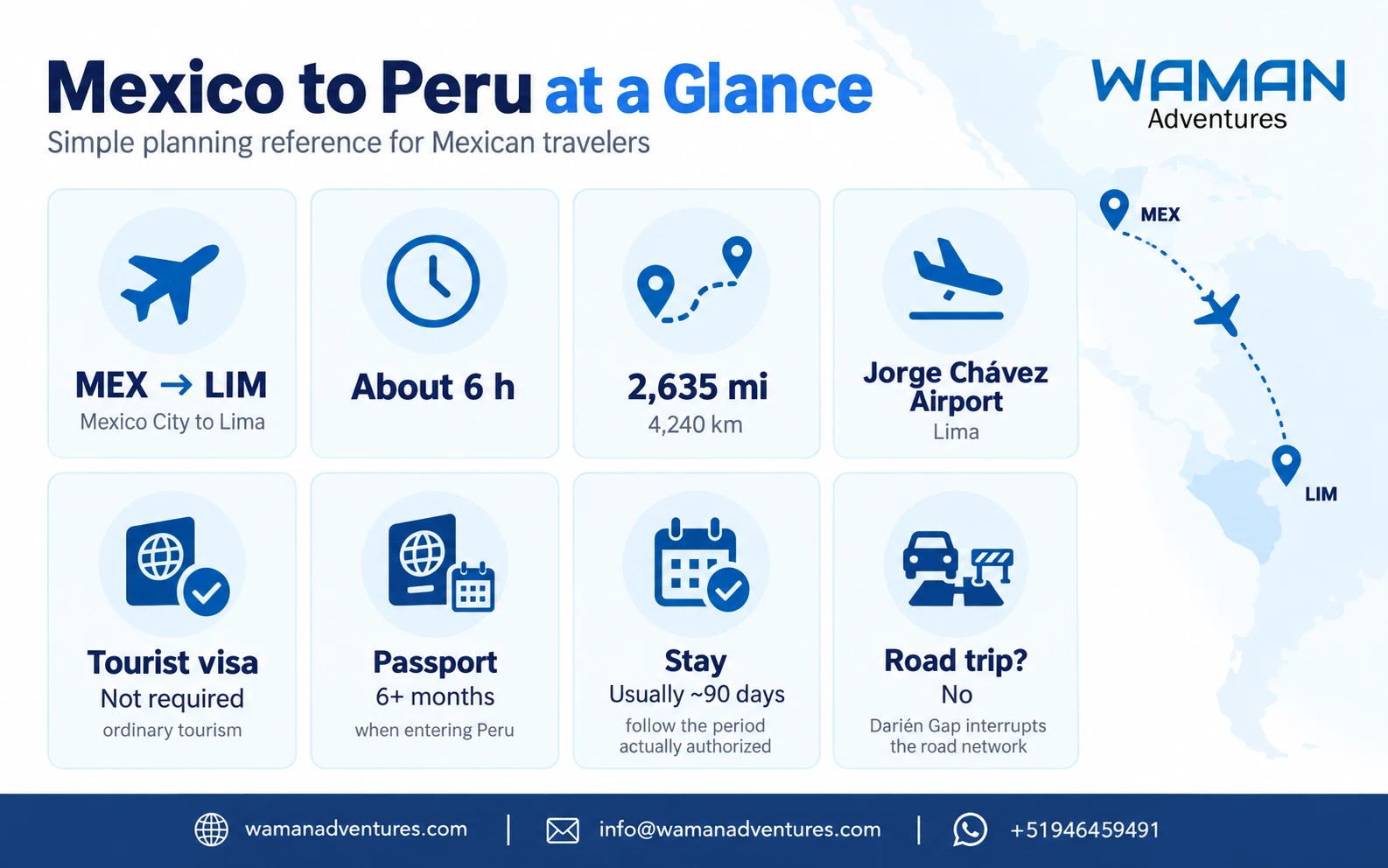
The infographic summarizes key planning information for travel from Mexico to Peru, including the Mexico City–Lima flight, approximate travel time, immigration documents and general guidance on authorized tourist stays.
Mexico to Peru distance and travel time
For most travelers, the useful way to measure the distance is not from one country boundary to another but between the cities they will actually fly between. The main reference is therefore Mexico City to Lima.
How far is Peru from Mexico?
The approximate air distance from Mexico City to Lima is 2,635 mi (4,240 km).
Mexico and Peru are separate countries on different continents: Mexico is in North America, while Peru lies on the Pacific side of South America.
Because both countries cover large territories, other city pairs can produce different distances. Use the departure and arrival cities on your actual itinerary when comparing routes.
Mexico to Peru flight time
A nonstop flight between Mexico City and Lima takes approximately 6 hours.
Connecting itineraries can take considerably longer depending on the connection city, layover length and baggage arrangements.
Always check the exact schedule on the flight you intend to buy because airline frequencies and departure times can change.
Can you drive from Mexico to Peru?
Not as one uninterrupted road journey.
The Pan-American road network is interrupted between Panama and Colombia by the Darién Gap, where there is no continuous highway connecting Central America with South America.
Traveling with a vehicle would therefore require separate arrangements to move the vehicle around that section. For most visitors, flying is considerably simpler.
Entry requirements for Mexican travelers
Mexican citizens currently do not require a tourist visa for an ordinary tourism trip to Peru, but they still need to meet Peru’s entry conditions and comply with the period of stay authorized by immigration officials.
Do Mexican citizens need a visa for Peru?
No. Mexican passport holders traveling as tourists currently enter Peru without applying for a tourist visa in advance.
Mexico’s Foreign Ministry also states that Mexican tourists are normally granted around 90 days. The important number, however, is the period actually authorized when you enter Peru.
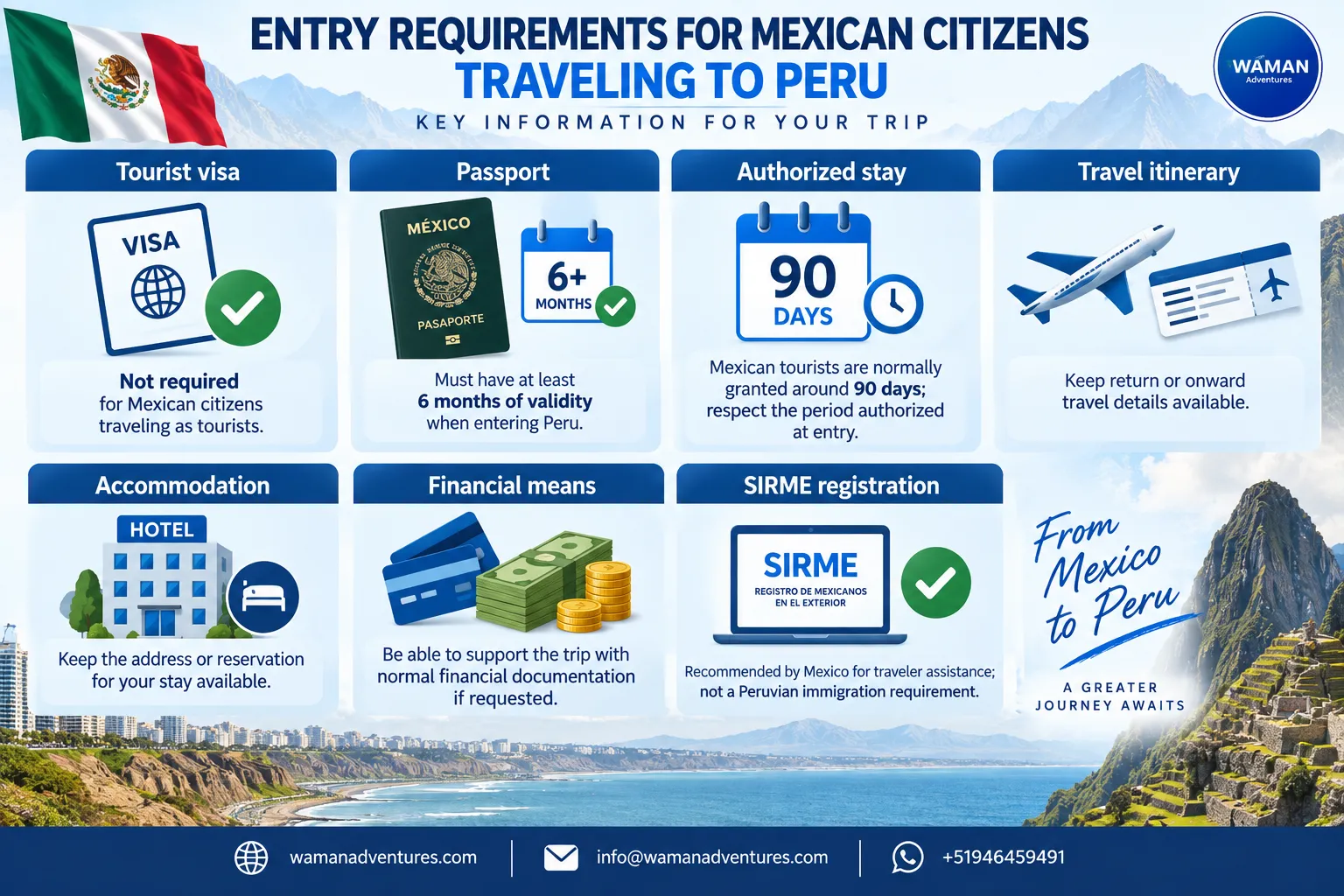
The infographic summarizes key documents and travel details Mexican citizens should review before entering Peru, including accommodation, financial means, itinerary information and SIRME registration.
You can also register your trip through Mexico’s SIRME system so the Foreign Ministry can communicate with you more easily if assistance is needed abroad.
Important note:
Mexico’s current official guidance states that Mexican travelers can continue with their Peru travel plans despite the diplomatic situation between both countries, and Mexican consular assistance in Peru continues to operate. For the political and consular context, use the Peru–Mexico diplomatic travel update.
Flights from Mexico to Peru and arrival in Lima
Lima is the main international gateway for travelers arriving from Mexico and the most practical starting point for onward connections inside Peru.
Direct Mexico City to Lima flights
Aeroméxico currently sells Mexico City–Lima itineraries, making MEX–LIM the clearest direct international route for many Mexican travelers.
A nonstop flight takes roughly six hours, although departure times, frequency, baggage rules and fares depend on the selected travel date.
Check the current Aeroméxico Mexico–Lima schedule before purchasing.

Aeromexico is one of the airlines travelers may encounter when planning international connections from Mexico. Before booking a Peru trip, compare routes, layovers, schedules and baggage conditions.
Connecting flights from other Mexican cities
Travelers departing from Guadalajara, Monterrey, León or other cities may use a domestic connection to Mexico City or an itinerary through another Latin American hub.
When comparing options, look beyond the headline airfare and check:
- Total journey time.
- Length of the connection.
- Baggage allowance.
- Whether checked baggage continues automatically to Lima.
- Fare-change and cancellation conditions.
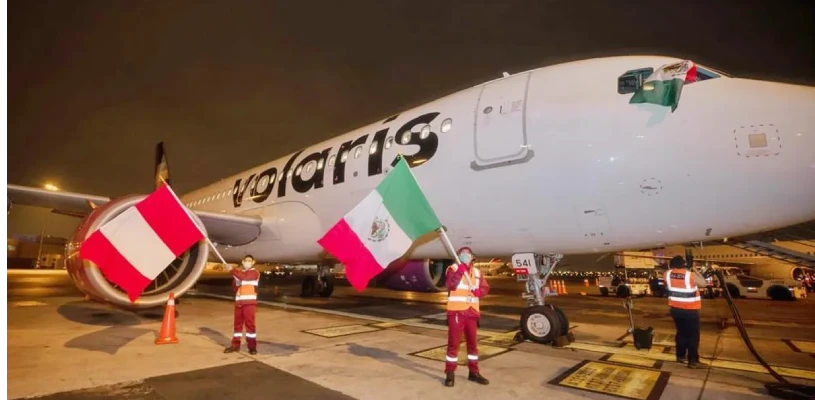
Lima as the main international gateway
Jorge Chávez International Airport is Peru’s principal air hub and provides domestic connections to destinations such as Cusco, Arequipa and other regions.
For most first-time visitors, this makes Lima the simplest point for separating the international flight from the domestic itinerary.
If Machu Picchu is the main reason for your trip, use the Mexico to Machu Picchu guide for the next stage rather than trying to plan trains, buses and Machu Picchu access from this general article.

A practical first Peru itinerary from Mexico
A first trip does not need to cover every major Peruvian destination. Internal flights, long-distance buses and altitude changes can make an overloaded itinerary more tiring than useful.
A better approach is to build the trip around the number of days you genuinely have.
| Trip length | Practical first-trip structure |
| 7 days | Lima + Cusco + Sacred Valley + Machu Picchu |
| 8–9 days | Lima + Cusco region + Machu Picchu with more acclimatization or an additional local day |
| 10–12 days | Core Lima–Cusco–Machu Picchu route plus one additional region such as Arequipa, Puno, Ica/Paracas or the Amazon |
| 13+ days | More flexibility to add a second region without compressing every transfer |
For many first-time travelers, the most efficient sequence is Lima → Cusco → Sacred Valley → Machu Picchu, followed by one additional region only if the schedule allows it.
Important note:
If Machu Picchu is the non-negotiable part of your trip, confirm the entrance date and route before purchasing nonrefundable domestic transportation. Machu Picchu availability can determine when the rest of the Cusco itinerary should happen.
For ticket types and current routes, use the Machu Picchu entrance ticket guide.

Best time to travel from Mexico to Peru
There is no single best month for every Peru itinerary because the coast, Andes and Amazon follow different weather patterns.
For a first trip focused on Cusco, the Sacred Valley and Machu Picchu, the generally drier period from roughly May through September is usually the easiest planning window.
The Peruvian coast tends to be warmer during the southern summer, roughly December through March, while the Amazon remains warm and humid throughout the year.
Choose the season according to the regions on your itinerary rather than applying one weather rule to all of Peru.

Before your first days in Peru
International arrival is only one part of the trip. Your first days also need to account for altitude, travel insurance and keeping essential documents accessible.
If your route continues to Cusco, avoid treating the first day at altitude like a normal sightseeing day at sea level. Cusco sits much higher than Mexico City, and travelers respond differently after arrival.
For specific altitude planning, use the Cusco acclimatization guide.
Mexico’s Foreign Ministry recommends international travel insurance with medical coverage for travelers visiting Peru. Insurance is useful for medical problems, interruptions, cancellations or baggage issues, even though it is not listed as an ordinary tourist-entry requirement.
Keep digital copies of your passport, flights and accommodation confirmations somewhere separate from the original documents.
Common Mexico to Peru planning mistakes
- Using one generic country-to-country distance: compare your actual city pair, normally Mexico City to Lima.
- Assuming Peru is geographically close to Mexico: the countries are on different continents, even though nonstop flights simplify the trip.
- Assuming a tourist visa is required: Mexican citizens currently travel to Peru for tourism without obtaining one in advance.
- Traveling with less than six months of passport validity: current official guidance requires at least six months when entering Peru.
- Assuming every visitor automatically receives the same stay: Mexican tourists are normally granted around 90 days, but the authorized period is the one that applies.
- Treating SIRME as a Peruvian immigration requirement: it is a Mexican traveler-registration and assistance system.
- Planning too many regions in one short trip: domestic distances can create unnecessary flights and long overland transfers.
- Buying nonrefundable Cusco transport before confirming Machu Picchu: ticket availability can change the most efficient itinerary dates.
- Using old COVID-era entry lists: verify current official requirements close to departure.
- Assuming you can drive continuously from Mexico to Peru: the Darién Gap interrupts the through-road connection between Central and South America.
Build your Peru itinerary after your international flight is clear
Once your Mexico–Lima dates are confirmed, the next step is coordinating Cusco, Machu Picchu and any additional region without creating unnecessary connections or duplicate reservations.
For many first-time travelers, Lima, Cusco, the Sacred Valley and Machu Picchu already create a complete 7- to 9-day itinerary. Additional regions make more sense when the trip is long enough to absorb the extra transportation.
Frequently asked questions about traveling from Mexico to Peru
Is Peru in Mexico?
How long is the flight from Mexico to Peru?
Are there direct flights from Mexico City to Lima?
Do Mexican citizens need a visa for Peru?
How long can Mexican tourists stay in Peru?
What airport should I fly into from Mexico?
How many days should I spend in Peru on a first trip?
Share:




If you liked this article and the information you found, give us 5 stars!
Table of Contents
Related blogs