


How to Prepare for the Inca Trail and Train for the Trek
Ultima actualización en 29 October, 2026 por Jhon Quispe
Last Updated on 29 October, 2026 by Jhon Quispe
How do you train for the Inca Trail?
Prepare for the Classic Inca Trail with 8–12 weeks of progressive hiking, hill and stair workouts, leg-strength exercises and longer walks with a daypack. Practice consecutive hiking days and controlled descents. Adjust the training plan to your fitness level and allow time to acclimatize in Peru.
- MachupicchuMachu Picchu & Humantay Lake
- How to Prepare for Inca Trail at a glance
- How fit do you need to be for the Inca Trail?
- Inca Trail training plan for 8–12 weeks
- Best exercises for Inca Trail training
- Prepare for consecutive hiking days
- Altitude acclimatization before the Inca Trail
- Nutrition, hydration and gear testing during training
- How to know if your Inca Trail training is working
- Common Inca Trail training mistakes
- Get ready for your Classic Inca Trail adventure
-
Frequently asked questions about How to Prepare for Inca Trail
- How long should I train for the Inca Trail?
- Do you need to train for the Inca Trail?
- What exercises are best for Inca Trail training?
- Should I run to prepare for the Inca Trail?
- Should I train with a backpack?
- How can I prepare for the downhill sections?
- Can physical fitness prevent altitude sickness?
The biggest challenge is sustaining effort across several days, not completing a single difficult workout. Uneven stone steps, long climbs and repeated descents place different demands on your body, so a useful training plan needs more than flat walking or occasional cardio sessions.
How to Prepare for Inca Trail at a glance
| Training element | Practical recommendation |
| Preparation period | Approximately 8–12 weeks for many travelers, adjusted to starting fitness |
| Main training focus | Hiking endurance, hills, stairs and leg strength |
| Key physical challenge | Repeated climbs, long descents and consecutive hiking days |
| Cardio training | Brisk walking, hiking, incline walking or other sustainable aerobic exercise |
| Strength training | Squats, lunges, step-ups, controlled step-downs and core exercises |
| Long hiking sessions | Gradually increase duration and elevation while practicing with a daypack |
| Recovery | Include rest days and reduce training volume before departure |
| Altitude preparation | Allow time for acclimatization in Peru; physical fitness does not prevent altitude illness |
Keep this in mind:
An 8–12 week training plan is a practical starting framework, not a mandatory fitness requirement. Travelers who already hike regularly may need less structured preparation, while beginners often benefit from starting earlier.
How fit do you need to be for the Inca Trail?
The Classic Inca Trail requires practical hiking fitness rather than elite athletic ability. You do not need to be a runner or experienced mountaineer, but you should be comfortable walking uphill for sustained periods, managing uneven stone steps and remaining active over several consecutive days.
The most useful fitness indicators are endurance, leg strength, balance and the ability to recover after longer hikes. Your starting level determines how gradually you should increase training.
| Your current fitness level | Main preparation priority |
| You hike or exercise several times per week | Focus on sustained hills, long walks and consecutive hiking days |
| You exercise regularly but mostly on flat terrain | Add stair climbing, elevation gain and controlled downhill walking |
| You are active but rarely walk for several hours | Gradually increase hiking duration and time on your feet |
| You currently exercise very little | Begin with comfortable walking and basic strength before progressing to demanding hills |
| You have health or mobility concerns | Discuss the planned workload and altitude with an appropriate healthcare professional before starting a demanding training program |
A useful preparation benchmark is being able to complete a sustained hilly walk with a manageable daypack, recover reasonably afterward and remain capable of another moderate walk the following day. This is a training goal rather than a guarantee that the trek will feel easy.
Inca Trail training plan for 8–12 weeks
For many travelers, preparing over 8–12 weeks allows enough time to improve endurance and strength without making sudden increases in activity. The program should become more specific as the trek approaches, progressing from basic walking to longer hikes, hills and consecutive training days.
The stages below are approximate and may overlap. If you begin 12 weeks before departure, use the earlier weeks to establish consistency. If you already have a strong hiking base, you may be able to progress through the introductory stages more quickly.
| Preparation stage | Training focus | Practical objective |
| 8–12 weeks before | Cardio endurance and basic leg strength | Become comfortable exercising consistently |
| 6–8 weeks before | Hills, stairs and longer walking sessions | Improve sustained climbing and descent control |
| 4–6 weeks before | Longer hikes with elevation and a daypack | Practice several hours of walking with your expected equipment |
| 2–4 weeks before | Consecutive hiking days and recovery | Understand how your legs respond to cumulative fatigue |
| Final week | Reduced training volume and rest | Arrive recovered rather than exhausted |
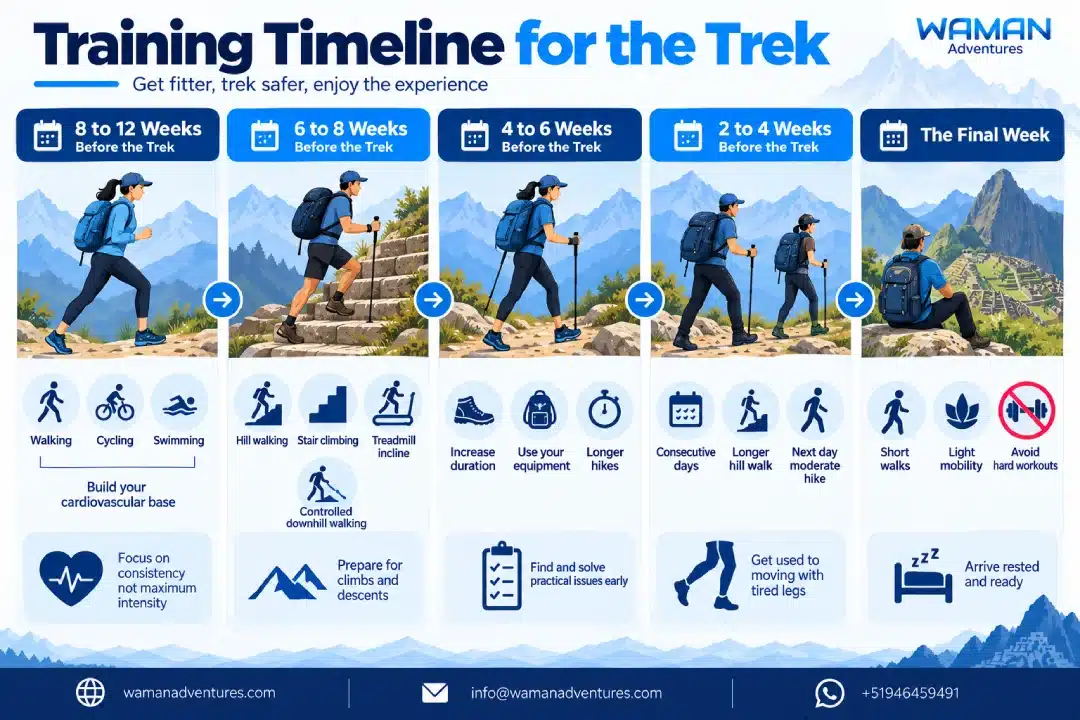
A progressive training timeline helps organize endurance, strength and recovery.
Sample weekly Inca Trail workout schedule
The following schedule shows how an intermediate training week might combine endurance, strength, hills and recovery. It is an example rather than a fixed prescription; session duration and intensity should reflect your experience and current fitness.
| Day | Training session | Primary benefit |
| Monday | Rest or gentle mobility | Recovery from previous sessions |
| Tuesday | Brisk walking with hills or treadmill incline | Cardiovascular endurance and climbing |
| Wednesday | Leg-strength and core exercises | Muscular strength and stability |
| Thursday | Stair climbing, hill repeats or controlled descents | Trail-specific movement and downhill control |
| Friday | Rest | Recovery before the longer hike |
| Saturday | Longer hike with gradual elevation and a daypack | Endurance and equipment familiarity |
| Sunday | Comfortable recovery walk or moderate hike | Practice activity on consecutive days |
The number and length of sessions should increase gradually only when you are recovering comfortably. Beginners may need fewer demanding sessions or additional rest days, while experienced hikers can adapt the program to their established training routine.
Best exercises for Inca Trail training
Effective Inca Trail preparation combines cardiovascular endurance with strength and movements that resemble the terrain. Walking for several hours is important, but hills, stone steps and uneven surfaces also require muscular control.
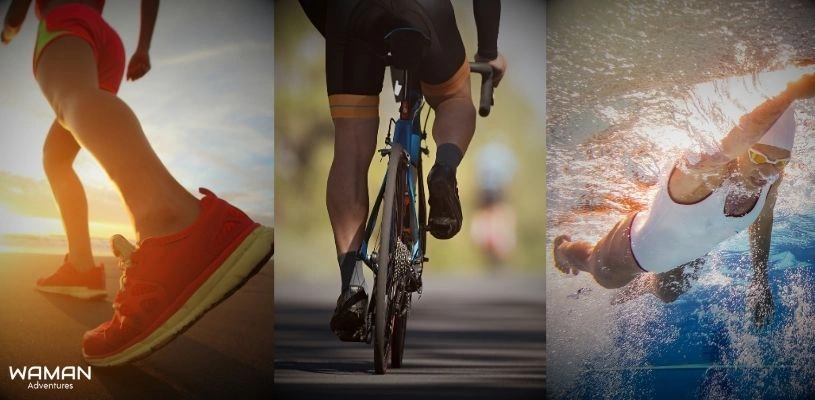
Cardiovascular endurance
Aerobic training helps you sustain physical effort without repeatedly reaching an intensity you cannot maintain. The most useful activities are those you can perform consistently and gradually extend over time.
Suitable activities include:
- Brisk walking.
- Outdoor hiking.
- Incline treadmill walking.
- Cycling.
- Swimming.
- Easy running, if you already run comfortably.
Hiking and incline walking are especially useful because they combine cardiovascular work with time on your feet. Running can complement training, but it is not necessary for completing the Classic Inca Trail.
Hill and stair training
Hills and stairs deserve particular attention because the Classic Inca Trail includes long climbs and repeated stone steps. Training on inclines also helps you learn to maintain a sustainable pace rather than using too much energy early in a climb.
Travelers living in relatively flat areas can use stadium stairs, stair machines, incline treadmills or repeated climbs on the longest accessible hill.
As your fitness improves, gradually increase the time spent climbing. Descending under control should also be part of these sessions.
Leg strength and downhill control
Strong legs help support sustained climbing, but descending can be equally demanding. Long downhill sections require repeated braking from the quadriceps while the knees and ankles control movement over uneven surfaces.
Useful exercises include:
- Squats: develop general lower-body strength.
- Lunges: strengthen the legs while challenging balance.
- Step-ups: simulate repeated upward movement on stairs.
- Split squats: improve single-leg strength and control.
- Calf raises: strengthen the lower legs.
- Controlled step-downs: practice the muscular control needed for descents.
Controlled step-downs are particularly relevant to the Inca Trail because downhill walking places substantial eccentric demands on the quadriceps. Start with a manageable step height and prioritize control rather than speed.

Core strength, balance and mobility
Core stability and balance complement endurance and leg strength, especially when walking on irregular surfaces or carrying a daypack. Planks, side planks, single-leg balance exercises and controlled carries can help develop these abilities.
Gentle mobility work for calves, quadriceps, hamstrings and hips may improve comfort after longer workouts. Stretching should complement strength and endurance training rather than replace them.

Prepare for consecutive hiking days
A single successful long hike is useful, but the Classic Inca Trail involves repeated physical effort over several days. Training should therefore include opportunities to practice walking when your legs are still recovering from a previous session.
Practice longer hikes with your daypack
During the later training weeks, complete some longer walks with the daypack you expect to use on the trail. Carry a realistic personal load rather than deliberately making your bag excessively heavy.
These sessions can reveal practical issues with:
- Shoulder strap adjustment.
- Hip belt position.
- Access to drinking water.
- Storage of extra layers.
- Availability of snacks while walking.
- Trekking-pole attachment.
- Comfort during climbing and descending.
Testing the equipment while walking provides more useful information than trying it on briefly at home. For a complete clothing and equipment checklist, use the Inca Trail packing list.
Build recovery between hiking days
Back-to-back hikes help you understand how your body responds to cumulative fatigue. For example, a long hike followed by a shorter walk the next day may reveal discomfort in your footwear, lingering muscle soreness or difficulty maintaining a steady pace.
You do not need to recreate the entire four-day trekking itinerary in training. The objective is to build confidence in your ability to remain active on consecutive days without repeatedly reaching exhaustion.
Pro tip:
Progressive training should improve your endurance without leaving you exhausted for several days after each workout. If recovery becomes increasingly difficult, reduce the workload and build more gradually.
Altitude acclimatization before the Inca Trail
Physical fitness and altitude acclimatization are separate parts of preparing for the Classic Inca Trail. Training improves hiking capacity, but it does not guarantee protection against altitude-related illness.
The route reaches approximately 13,800 ft (4,200 m) at Warmiwañusqa, commonly called Dead Woman’s Pass. Even experienced and physically fit hikers may experience symptoms at high elevation.
When possible, allow time in the Cusco region before beginning the trek. During this period, lighter activity can help you assess how you feel rather than adding demanding workouts immediately after arrival.
Significant or worsening altitude symptoms require appropriate medical attention. Fitness should never be used as a reason to ignore them.

Fitness and altitude acclimatization require separate preparation before trekking.
For more detailed information about altitude, terrain, weather-related hazards and other trail risks, see the Inca Trail safety guide.
Nutrition, hydration and gear testing during training
Preparing for the Inca Trail does not require an extreme diet or a complicated equipment routine. The practical goal is to become comfortable eating, drinking and using your hiking equipment during sustained activity.
Food and water during longer hikes
Long training walks provide an opportunity to learn which foods are comfortable for you before, during and after exercise.
- Before hiking: eat a familiar meal that provides enough energy without leaving you uncomfortably full.
- During longer sessions: carry convenient snacks and drink according to your needs, conditions and activity level.
- After training: eat a normal recovery meal, replace fluids and allow adequate rest before another demanding workout.
Practicing food and hydration routines in advance can reduce the uncertainty of managing them during several hours on the trail.
Hiking boots, daypack and trekking poles
Equipment should be tested before departure because discomfort or unfamiliarity often becomes more noticeable during longer walks and repeated descents.
| Equipment | What to check during training |
| Hiking footwear | Comfort, grip, heel movement and possible blister points |
| Daypack | Fit, strap adjustment and access to water or clothing layers |
| Trekking poles | Comfortable length, rhythm and use on hills and descents |
| Rain layer | Freedom of movement and comfort while walking |
| Hydration system | Ease of drinking and sufficient capacity for your training sessions |
| Hiking clothing | Comfort during sweat, wind and changing conditions |
New hiking boots or unfamiliar equipment should not be introduced for the first time immediately before the trek. Testing them gradually helps identify adjustments while there is still time to address problems.
How to know if your Inca Trail training is working
Progress is best measured through practical hiking ability rather than a particular running speed or gym performance. The following improvements can indicate that your training is becoming more specific to the trek.
- You can walk uphill for longer without frequent extended breaks.
- Your breathing settles more comfortably when you reduce your pace.
- You can descend stairs and hills with better control.
- Your hiking footwear remains comfortable during longer sessions.
- Your daypack feels manageable over several hours.
- You recover well enough to walk again the following day.
- You understand which pace you can sustain without becoming exhausted early.
Not every session needs to be harder than the previous one. Steady improvement over several weeks is more useful than repeatedly pushing to your maximum effort.
Common Inca Trail training mistakes
Some preparation habits appear productive but do not address the actual demands of a multi-day mountain trek.
- Training only on flat roads: flat walking builds basic endurance but does not fully prepare the legs for steep slopes and repeated steps.
- Ignoring descents: long downhill sections require muscular control that uphill workouts alone may not develop.
- Doing one exhausting workout each week: consistent training is generally more useful than occasional extreme sessions.
- Increasing workload too quickly: sudden increases in hiking duration, elevation or intensity can contribute to overuse problems.
- Using new equipment too late: unfamiliar boots, backpacks and trekking poles may cause avoidable discomfort.
- Assuming fitness prevents altitude sickness: cardiovascular conditioning does not guarantee altitude tolerance.
- Training hard immediately before departure: last-minute strenuous sessions can create fatigue without providing meaningful additional fitness.
Recognizing these mistakes early allows the preparation plan to remain gradual, specific and sustainable.
Get ready for your Classic Inca Trail adventure
A well-structured Inca Trail training plan helps you arrive with greater confidence in your endurance, climbing ability and recovery. Consistent walking, strength exercises, hills, controlled descents and occasional consecutive hiking days are more useful than chasing maximum workout intensity. To understand how these preparations relate to the actual route, explore the 4-day Classic Inca Trail itinerary or talk to a travel specialist about your trekking plans.

Frequently asked questions about How to Prepare for Inca Trail
How long should I train for the Inca Trail?
Do you need to train for the Inca Trail?
What exercises are best for Inca Trail training?
Should I run to prepare for the Inca Trail?
Should I train with a backpack?
How can I prepare for the downhill sections?
Can physical fitness prevent altitude sickness?
Share:


Related tours you might be interested in
Enjoy unique experiences in Cusco and Machu Picchu with the peace of mind that comes from working with a local travel agency
Rural and Agritourism Experience in Chichubamba
TRADITIONAL LIFE IN THE HEART OF THE SACRED VALLEY Let yourself be immersed in the mystique and...

Birdwatching Experience at Chacán Dam & Ensifera Camp
BIRD WATCHING IN CUSCO: CHACÁN & ENSIFERA CAMP Cusco is far more than history and dramatic...

Cusco Soccer Game Experience
EXPERIENCE CUSCO SOCCER LIKE A LOCAL Immerse yourself in one of Cusco’s most intense cultural...

Huacarpay Birdwatching Experience
HUACARPAY: ANDEAN BIRD SANCTUARY Discover the natural richness of Huacarpay, a high-Andean wetland...
If you liked this article and the information you found, give us 5 stars!
Table of Contents
Related blogs
Explore Huayna Picchu like an expert: Our guide will take you gradually
12 min of reading
Ausangate Trek: The Complete Guide to Planning Your Journey
12 min of reading
How to choose and compare a Peru tour package before booking
8 min of reading

