


Explore Huayna Picchu like an expert: Our guide will take you gradually
Ultima actualización en 16 November, 2026 por Jhon Quispe
Last Updated on 16 November, 2026 by Jhon Quispe
What should you know before hiking Huayna Picchu?
Huayna Picchu reaches about 8,923 ft (2,720 m) and is accessed with Circuit 3 Route 3-A, the official Waynapicchu Mountain route. The mountain route covers about 1.5 mi (2.4 km), includes steep Inca stairs and exposed sections, and allows up to three hours between the mountain entry and exit controls.
- MachupicchuMachu Picchu & Humantay Lake
- Huayna Picchu at a glance
- Huayna Picchu location, meaning and altitude
- Huayna Picchu in the Machu Picchu landscape
- Huayna Picchu ticket and Route 3-A
- Huayna Picchu difficulty and safety
- How long does it take to climb Huayna Picchu?
- Best time to hike Huayna Picchu
- How to access Huayna Picchu
- What to bring for the Huayna Picchu hike
- Choosing between Machu Picchu mountain hikes
- Is Huayna Picchu worth it?
- Common mistakes when planning Huayna Picchu
-
Frequently asked questions about Huayna Picchu
- Can I visit Huayna Picchu without a guide?
- Does Route 3-A include the classic Machu Picchu photo viewpoint?
- Is there an official minimum age for Huayna Picchu?
- Can I hike Huayna Picchu during the rainy season?
- Can I visit the Great Cavern with a Route 3-A ticket?
- Can I combine Huayna Picchu and Machu Picchu Mountain on the same ticket?
- What can I do if Route 3-A is sold out?
Huayna Picchu is not simply another Machu Picchu viewpoint. Its steep stone stairways, limited Route 3-A ticket and exposed mountain terrain create a very different experience from a standard archaeological circuit, so ticket choice, timing and physical expectations matter before booking.

Huayna Picchu rises behind Machu Picchu and requires its own ticketed mountain route.
Huayna Picchu at a glance
| Planning detail | Current reference |
| Mountain | Huayna Picchu, also written Wayna Picchu or Waynapicchu |
| Maximum altitude | About 8,923 ft (2,720 m) |
| Official route | Circuit 3 Route 3-A Waynapicchu Mountain |
| Mountain-route distance | About 1.5 mi (2.4 km) |
| Maximum mountain time | 3 hours between entry and exit registration at the mountain control |
| Trail character | Steep stone stairs, narrow passages and exposed mountain terrain |
| Best suited to | Travelers comfortable with steep climbing and heights |
| Main planning constraint | Limited Route 3-A ticket availability |
Huayna Picchu access is linked to a specific Machu Picchu route. A general entrance ticket does not automatically include the mountain, so Route 3-A needs to be selected when planning the visit.
Huayna Picchu location, meaning and altitude
Huayna Picchu rises immediately north of the Machu Picchu archaeological site and forms the steep mountain backdrop visible in many familiar views of the Inca city.
What Huayna Picchu means
The name comes from Quechua and is commonly translated as “Young Mountain” or “Young Peak.” Huayna Picchu, Wayna Picchu and Waynapicchu are spelling variants used for the same mountain, while current official visitor information uses the name Waynapicchu for Route 3-A.
Huayna Picchu altitude
The summit reaches approximately 8,923 ft (2,720 m) above sea level. This is lower than Cusco, but elevation is only one part of the challenge.
For most hikers, the more noticeable difficulty comes from sustained climbing, uneven Inca stairs, narrow passages and exposed terrain. Individual responses to elevation vary, so acclimatization should never be treated as guaranteed simply because the mountain sits below Cusco.
Huayna Picchu in the Machu Picchu landscape
Huayna Picchu forms part of the wider archaeological landscape of Machu Picchu rather than serving only as a natural viewpoint. Inca-built stairs, terraces and other structures demonstrate that the mountain was incorporated into the broader use of the site.
The exact purpose of every structure on the mountain is not fully established. Religious or ceremonial interpretations exist, but they should not be presented as a single proven explanation for Huayna Picchu’s role during the Inca period.
Huayna Picchu ticket and Route 3-A
The current ticket for climbing Huayna Picchu is Circuit 3 Route 3-A Waynapicchu Mountain. Older references to “Circuit 4 + Waynapicchu” belong to a previous Machu Picchu visitor system and should not be used for current travel planning.
Route 3-A belongs to Circuit 3, also called the Royalty Circuit. Your ticket determines which archaeological sectors and mountain route you can follow, so it is better to secure the correct Machu Picchu entrance before organizing trains and other timed services.
For the broader differences between current circuits and routes, see the Machu Picchu entrance ticket guide.
Current Route 3-A ticket
Electronic tickets are currently sold through the official Ministry of Culture platform, TuBoleto Cultura.
Do not rely on older articles or screenshots that still direct visitors to Joinnus. The official booking platform should always be checked for the exact travel date because Route 3-A availability is limited.
Important note:
Do not plan Huayna Picchu around an old fixed daily-capacity figure. Route availability is controlled through the current official allocation, so check Route 3-A inventory for your exact date before arranging the rest of the itinerary.
Huayna Picchu ticket prices
The current 2026 tariff for Route 3-A distinguishes between the standard national tariff and promotional prices available to qualifying travelers.
| Traveler category | Standard Route 3-A tariff | 2026 promotional tariff where eligible |
| General | S/200 | S/112 |
| Student | S/125 | S/80 |
| Minor | S/118 | S/80 |
Promotional eligibility applies only to qualifying categories established by the Ministry of Culture, including applicable Peruvian, resident and Andean Community travelers. Student and minor fares also require the corresponding documentation.
USD conversions are intentionally omitted because the official tariff is published in Peruvian soles and exchange rates change over time.
Keep this in mind:
Older Huayna Picchu articles often mention a minimum age of 12 as if it were a universal current rule. Do not treat that recommendation as the official Route 3-A age requirement. Families should instead evaluate the steep stairs, exposure and the child’s ability to follow safety instructions.
Route 3-A entry times
The current Route 3-A regulation organizes Waynapicchu access through two principal entrance periods. The published planning framework lists Machu Picchu entry windows of 6:00–6:30 a.m. and 9:00–9:30 a.m., with corresponding deadlines for reaching the Waynapicchu mountain control.
| Route 3-A planning point | First period | Second period |
| Machu Picchu entry window | 6:00–6:30 a.m. | 9:00–9:30 a.m. |
| Latest arrival at Waynapicchu control | 8:00 a.m. | 11:00 a.m. |
| Maximum time on Waynapicchu Mountain | 3 hours | 3 hours |
Operational schedules can be updated, and the time printed on the issued ticket should take precedence when planning the day. Confirm the current Route 3-A time on TuBoleto before coordinating train and transfer schedules.
For railway planning, use the train to Machu Picchu guide.
Huayna Picchu difficulty and safety
Huayna Picchu is relatively short compared with a multi-day Andean trek, but its distance should not be confused with an easy hike. The mountain trail includes steep stone stairs, narrow passages and exposed sections where careful movement matters.
Waynapicchu reopened on July 1, 2026 after a month of specialized conservation and maintenance work along Route 3-A. The work included pre-Hispanic stairways, retaining walls, drainage, vegetation management and additional safety infrastructure in steep sectors.
Steep stairs and exposed sections
Stone stairways form a major part of the ascent. Some sections are steep and narrow, while the level of exposure changes throughout the route.
A single slope percentage should not be used to describe the entire hike because the trail gradient varies considerably. The practical issue is that hikers need confidence on irregular stairs and should be comfortable moving through exposed mountain terrain.
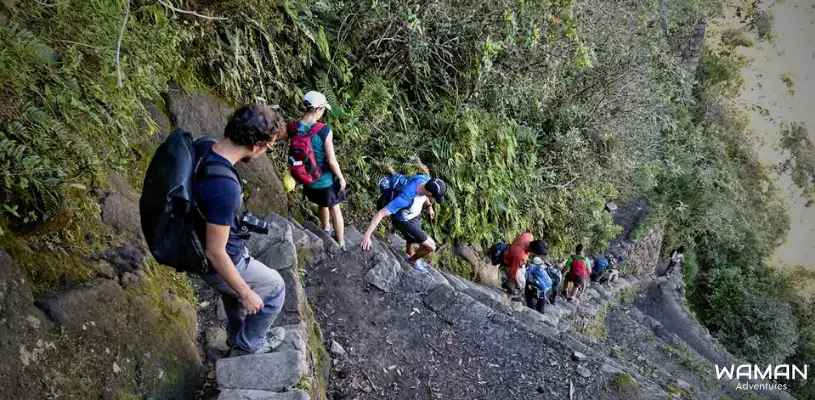
Steep stairs and exposed terrain make Huayna Picchu different from a standard archaeological circuit.
Stairs of Death
The section commonly known as the “Stairs of Death” consists of especially steep and narrow Inca stone steps. The nickname sounds dramatic, but it is not an official risk classification.
Move carefully, maintain stable footing and use available safety infrastructure where provided. Rushing on narrow stone stairs adds unnecessary difficulty, particularly when surfaces are wet.

The so-called Stairs of Death require careful footing on steep Inca stonework.
Fear of heights and mobility considerations
Travelers with a strong fear of heights should consider the route carefully before purchasing Route 3-A. Some sections provide wide mountain views but also create a noticeable sense of exposure.
The hike requires repeated movement on uneven stone steps. Travelers with significant mobility or balance limitations should compare the route with other Machu Picchu options rather than assuming that its short distance makes it suitable for everyone.
Is Huayna Picchu dangerous?
Huayna Picchu is a managed visitor route with conservation and safety infrastructure, but that does not eliminate the physical characteristics of the mountain. Steep stairs, exposed sections, wet stone and changing weather can increase the difficulty.
Following the established route, moving at a controlled pace and respecting staff instructions are more useful safety strategies than treating the mountain as either completely harmless or inherently dangerous.
How long does it take to climb Huayna Picchu?
Plan approximately 2–3 hours for the mountain portion of the Huayna Picchu experience, depending on walking pace, visitor movement and current trail conditions.
The official Route 3-A framework allows a maximum of three hours between mountain entry and exit registration, so the hike should not be planned as an unrestricted visit where travelers can remain on the mountain indefinitely.
Hikers who move steadily may finish earlier, while those taking more breaks or spending additional time at viewpoints may use more of the permitted period.
Best time to hike Huayna Picchu
May through September forms the core drier period around Machu Picchu, generally offering a better chance of firmer stone steps and clearer mountain views. April and October are transition months and can also work, although conditions tend to be more variable.
During wetter months, Route 3-A can still operate, but rain may reduce visibility and make steep stone surfaces more slippery. Cloud and showers can also occur during the drier season, so no month guarantees a clear summit view.
For detailed rainfall, temperatures and month-by-month conditions, use the Machu Picchu weather by month guide.
How to access Huayna Picchu
Huayna Picchu is accessed from within the Machu Picchu visitor system. It is not a separate trail that starts in Cusco or Machu Picchu Pueblo.
- Secure a valid Circuit 3 Route 3-A ticket for your travel date.
- Coordinate your train and transfer schedule around the confirmed Machu Picchu entry.
- Travel from Machu Picchu Pueblo to the archaeological entrance.
- Enter through the Route 3-A visitor system and follow the established Circuit 3 path.
- Reach the Waynapicchu control point within the permitted time and register before beginning the mountain section.
- Register again when leaving the mountain and continue according to the current Route 3-A visitor flow.
For the complete transportation sequence from Cusco or the Sacred Valley, use the train to Machu Picchu guide and the Machu Picchu ticket guide.

Your transport schedule must leave enough time to reach the entrance.
What to bring for the Huayna Picchu hike
Huayna Picchu does not require a multi-day trekking pack. Keep your gear compact so that it is easier to move through steep and narrow sections while remaining within Machu Picchu’s current visitor rules.

Do not pack food for consumption inside the archaeological site simply because the mountain route takes several hours. Huayna Picchu remains subject to Machu Picchu’s general visitor and prohibited-item rules.
For bag dimensions and current restricted items, use the Machu Picchu backpack guide.
You can also review the official Machu Picchu code of conduct before traveling.
Choosing between Machu Picchu mountain hikes
Huayna Picchu is the steeper and more exposed option among the commonly compared mountain routes. Huchuy Picchu offers a shorter mountain experience, while Machu Picchu Mountain follows a different ascent and provides another panoramic perspective over the archaeological landscape.
If you are choosing between the two shorter mountain routes, use the Huchuy Picchu or Huayna Picchu comparison.
If your decision is between Huayna Picchu and the larger Machu Picchu Mountain hike, use the Huayna Picchu or Machu Picchu Mountain comparison.
Is Huayna Picchu worth it?
Huayna Picchu can be worth the additional ticket planning if you specifically want a steep mountain hike, elevated perspectives over Machu Picchu and the experience of climbing Inca stone stairs above the archaeological site.
It may be a poor fit if steep exposure, narrow steps or a strong fear of heights are major concerns. It is also not the route to choose solely because you want the classic upper panoramic photograph of Machu Picchu, since Route 3-A belongs to Circuit 3 and follows different archaeological sectors.
The better question is therefore not whether Huayna Picchu is universally worth it, but whether the physical challenge and Route 3-A experience match what you want from your Machu Picchu visit.
Common mistakes when planning Huayna Picchu
- Buying a general Machu Picchu ticket and assuming Huayna Picchu is automatically included.
- Using outdated advice that still refers to Circuit 4 + Waynapicchu.
- Following old Joinnus links instead of checking the current TuBoleto platform.
- Using a fixed historical daily-capacity figure instead of checking current Route 3-A availability.
- Planning train times before confirming the mountain ticket and entrance period.
- Assuming the short route distance means Huayna Picchu is easy.
- Publishing “12 years and older” as a current official entry restriction without checking the latest rules.
- Underestimating steep stone stairs if you have a strong fear of heights.
- Expecting one specific season or morning hour to guarantee clear summit views.
- Choosing Route 3-A only because you expect the classic Machu Picchu postcard viewpoint.
- Using an old Circuit 4 map to understand the current Route 3-A route.
- Bringing an oversized backpack or items prohibited inside Machu Picchu.

Frequently asked questions about Huayna Picchu
Can I visit Huayna Picchu without a guide?
Does Route 3-A include the classic Machu Picchu photo viewpoint?
Is there an official minimum age for Huayna Picchu?
Can I hike Huayna Picchu during the rainy season?
Can I visit the Great Cavern with a Route 3-A ticket?
Can I combine Huayna Picchu and Machu Picchu Mountain on the same ticket?
What can I do if Route 3-A is sold out?
Share:



Related tours you might be interested in
Enjoy unique experiences in Cusco and Machu Picchu with the peace of mind that comes from working with a local travel agency
6-Day Tour Cusco, Sacred Valley, Machu Picchu and Rainbow Mountain
EXPERIENCE THE MAJESTY OF THE INCAS: SACRED VALLEY, MACHU PICCHU & RAINBOW MOUNTAIN IN ONE TRIP If...
6 Day Andean Adventures Tour│With Flights from Chile
ENJOY THE BEST OF CUSCO CITY – MUST VISIT DESTINATIONS ARE WAITING FOR YOU! Want to explore Cusco...
6 Days Andean Adventure │ With Flights from Mexico
EXPERIENCE THE BEST OF CUSCO – THE MOST BREATHTAKING DESTINATIONS AWAIT Do you want to explore...
5 Day Cusco, Sacred Valley and Machu Picchu
DISCOVER THE MAJESTY OF MACHU PICCHU AND THE BEAUTY OF THE SACRED VALLEY IN ONE EPIC JOURNEY! The...
If you liked this article and the information you found, give us 5 stars!
Table of Contents
Related blogs

How to Get to Machu Picchu from the US: Flights, Airports and Routes
13 min of reading
OUR DEFINITIVE GUIDE TO CONQUER THE SALKANTAY TREK
26 min of reading
10 Incredible Places in Peru for Epic Scenery
12 min of reading

