Train to Machu Picchu Schedules, Stations and Routes
Ultima actualización en 28 September, 2026 por Jhon Quispe
Last Updated on 28 September, 2026 by Jhon Quispe
Train to Machu Picchu
Book your Machu Picchu entrance first, then choose a train that works with your confirmed entry time. PeruRail and Inca Rail operate the main tourist services, with Ollantaytambo as the most common rail departure point; the ride from there usually takes about 1.5–2 hours, while Cusco itineraries can take about 4 hours or more when road transfers are included. Trains stop in Machu Picchu Pueblo, not at the archaeological entrance, so leave enough time for the final shuttle or walk.
- Train to Machu Picchu at a glance
- Train to Machu Picchu schedules
- Where to board the train to Machu Picchu
- How long is the train ride to Machu Picchu
- Train companies and services to Machu Picchu
- Bimodal train service from Cusco
- How to book a train to Machu Picchu
- Train luggage and boarding requirements
- Best season for train travel to Machu Picchu
- What the train journey is like
- From Machu Picchu Pueblo to the archaeological entrance
- Common train booking mistakes
- Plan your Machu Picchu train around your entrance time
-
Frequently asked questions about the train to Machu Picchu
- Is there a direct train from Cusco to Machu Picchu?
- Can I take a train from Lima to Machu Picchu?
- Does the train go directly to the Machu Picchu entrance?
- Should I book the train or Machu Picchu entrance first?
- Can I board in Ollantaytambo after visiting the Sacred Valley?
- Can I take a suitcase on the Machu Picchu train?
- Which is better PeruRail or Inca Rail?
- How early should I arrive at the train station?
The train is the main rail-based option for reaching Machu Picchu Pueblo, but the right booking depends on more than choosing a company. Your departure station, schedule, train category, luggage allowance and final transfer from Aguas Calientes all need to work with the entrance ticket you already hold.
Train to Machu Picchu at a glance
| Planning detail | What to know |
| Train destination | Machu Picchu Pueblo, also known as Aguas Calientes |
| Main tourist operators | PeruRail and Inca Rail |
| Most common rail departure | Ollantaytambo in the Sacred Valley |
| Ollantaytambo travel time | Usually about 1.5 to 2 hours depending on the train and operating schedule |
| Cusco itineraries | Can use regular rail or a coordinated road-and-train service depending on the operator, season and frequency |
| Standard luggage planning | Travel light and verify the weight and dimensions for your exact operator and service |
| After the train | Continue from Machu Picchu Pueblo to the archaeological entrance by shuttle bus or on foot |
Train to Machu Picchu schedules
Train schedules should be checked for the exact travel date rather than copied from an older yearly timetable. PeruRail publishes timetable periods for regular and bimodal services, while Inca Rail uses a live schedule finder for the itineraries currently available from Cusco and Ollantaytambo.
Important note:
Times and frequencies can change for operational or seasonal reasons. Use the examples below for planning context, then verify the exact departure on the operator’s official platform before coordinating it with your Machu Picchu entrance.
PeruRail 2026 schedule examples
| Departure | Arrival | Train | Service | Approx. duration |
| Wanchaq 3:20 a.m. | Machu Picchu Pueblo 7:40 a.m. | Expedition | Bimodal | 4 hr 20 min |
| Ollantaytambo 5:05 a.m. | Machu Picchu Pueblo 6:37 a.m. | Expedition | Regular rail | 1 hr 32 min |
| Wanchaq 5:10 a.m. | Machu Picchu Pueblo 9:15 a.m. | Expedition / Vistadome Observatory | Bimodal | 4 hr 05 min |
PeruRail publishes its timetable by operating period, including regular and bimodal frequencies. Check the official PeruRail schedules and frequencies for your travel date.
Inca Rail current schedules
Inca Rail schedules vary by date, boarding point and train category, so use the operator’s live schedule finder instead of relying on a static timetable. Cusco itineraries are coordinated road-and-rail journeys: the road segment connects with Ollantaytambo, where the rail portion continues to Machu Picchu Pueblo.
| Starting point | Service pattern | Planning note |
| Cusco | Coordinated road-and-rail itinerary | Confirm the bus departure, Ollantaytambo connection and total arrival time for your date |
| Ollantaytambo | Rail service to Machu Picchu Pueblo | Compare the available frequency with your Machu Picchu entry time |
Verify the available times and train categories in the official Inca Rail schedule finder.
Where to board the train to Machu Picchu
The correct boarding point depends on the operator, service and where you are staying. Ollantaytambo is the most important rail departure for most travelers, especially when a Sacred Valley stay is already part of the itinerary.
| Boarding point | Operator or service | Planning use |
| Ollantaytambo | PeruRail and Inca Rail | Main Sacred Valley rail departure and a practical option after visiting the valley |
| San Pedro | PeruRail on selected regular services | Central Cusco rail station used by specific frequencies |
| Poroy | PeruRail when included in the current timetable | Cusco-area rail station used by selected services and operating periods |
| Wanchaq | PeruRail bimodal services | Bus boarding point for selected combined road-and-train itineraries |
| Cusco city departure sold by Inca Rail | Inca Rail bimodal itinerary | Coordinated road transfer to Ollantaytambo followed by the train segment |
| Urubamba | PeruRail on selected services | Useful for some travelers staying in the Sacred Valley |
| Machu Picchu Pueblo | PeruRail and Inca Rail | Arrival and return station for standard tourist services |
If you plan to spend time in the valley before boarding, the Sacred Valley travel guide can help you decide whether an Ollantaytambo departure fits your route better than returning to Cusco.

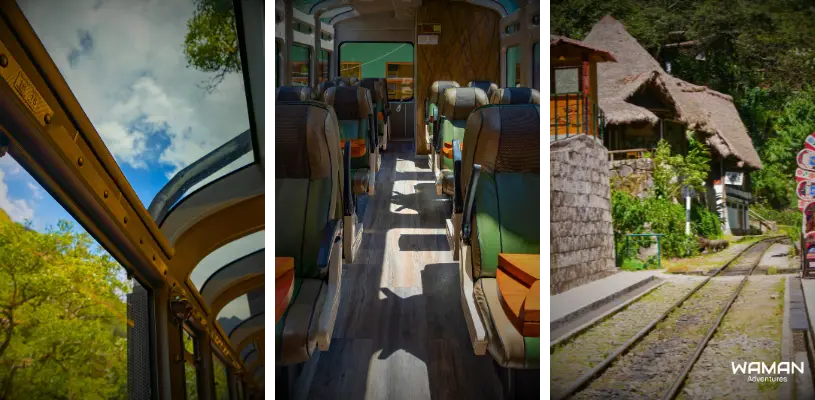
The train enters greener scenery as it approaches Machu Picchu Pueblo.
How long is the train ride to Machu Picchu
The travel time depends on the boarding point and whether the itinerary is regular rail or bimodal. From Ollantaytambo, tourist trains commonly take around 1.5 to 2 hours. An itinerary sold from Cusco can take about 4 hours or more because it may include a road transfer before the train segment.
| Starting point | Typical planning range | What affects the duration |
| Ollantaytambo | About 1.5 to 2 hours | Train frequency, stops and operating conditions |
| Cusco | About 4 hours or more | Boarding point, regular rail vs. bimodal itinerary, transfer point and timetable |
| Sacred Valley lodging | Varies | Whether you board in Ollantaytambo, Urubamba or connect from another point |
The classic Ollantaytambo rail corridor is roughly 37 miles (60 km) to Machu Picchu Pueblo. For planning, travel time matters more than distance because your archaeological admission uses a fixed entry slot.
Train companies and services to Machu Picchu
PeruRail and Inca Rail both operate tourist services toward Machu Picchu Pueblo, but the useful comparison starts with schedule and station rather than the brand name. Once the timing works with your Machu Picchu entrance, compare the service category and onboard experience.
PeruRail
| PeruRail service | Main planning difference |
| Expedition | Standard tourist service focused on practical transportation and basic onboard comfort |
| Vistadome | Panoramic service with larger windows and additional onboard experience elements |
| Vistadome Observatory | Panoramic category with an observatory car on applicable departures |
| Hiram Bingham, A Belmond Train | Luxury service with premium dining and additional experience components |
Expedition is the practical standard category, while Vistadome and Vistadome Observatory emphasize panoramic viewing. Hiram Bingham is the premium luxury option, and its package can include more than rail transportation, so confirm the current inclusions before booking.
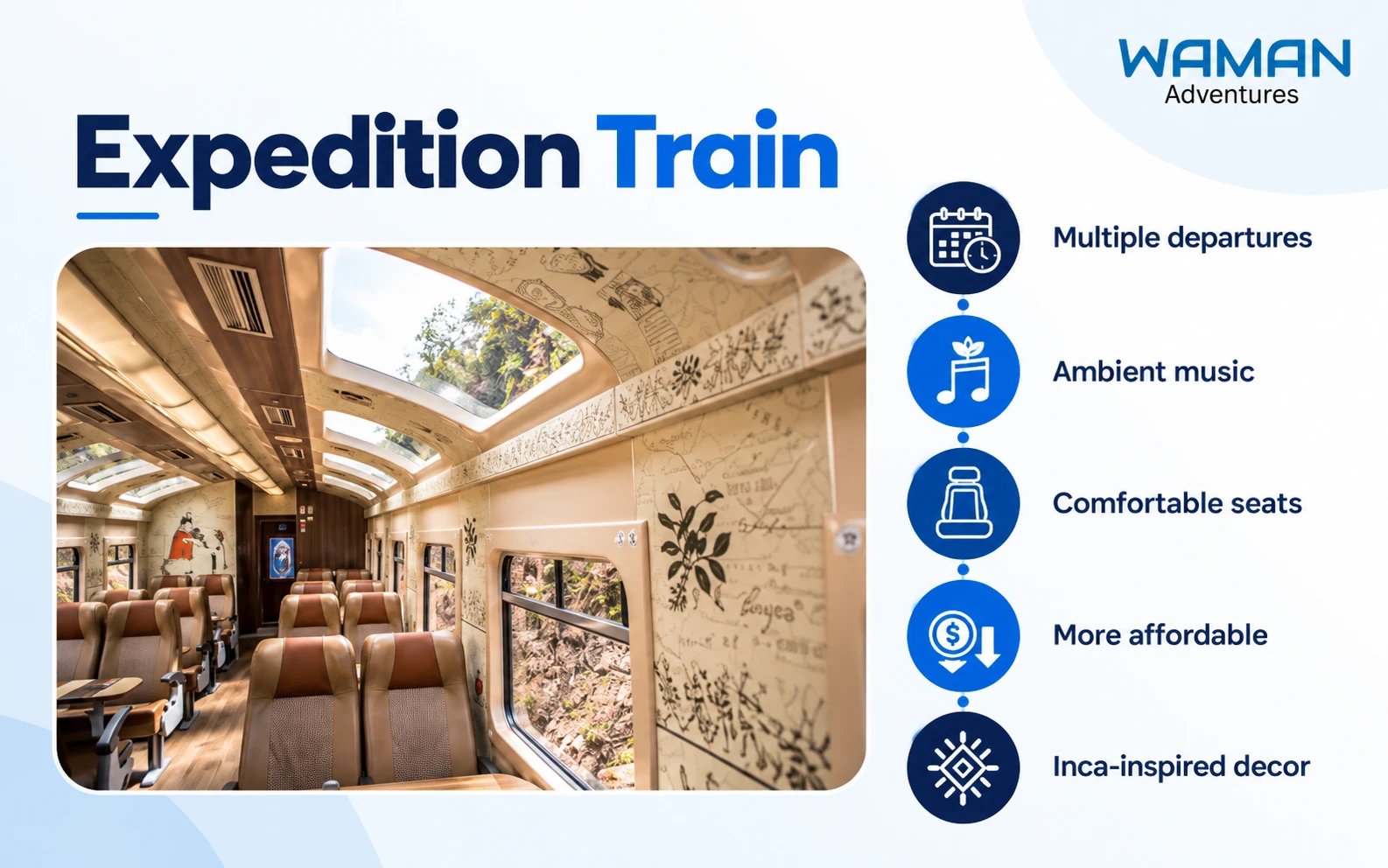
Expedition is PeruRail’s practical standard tourist train category.
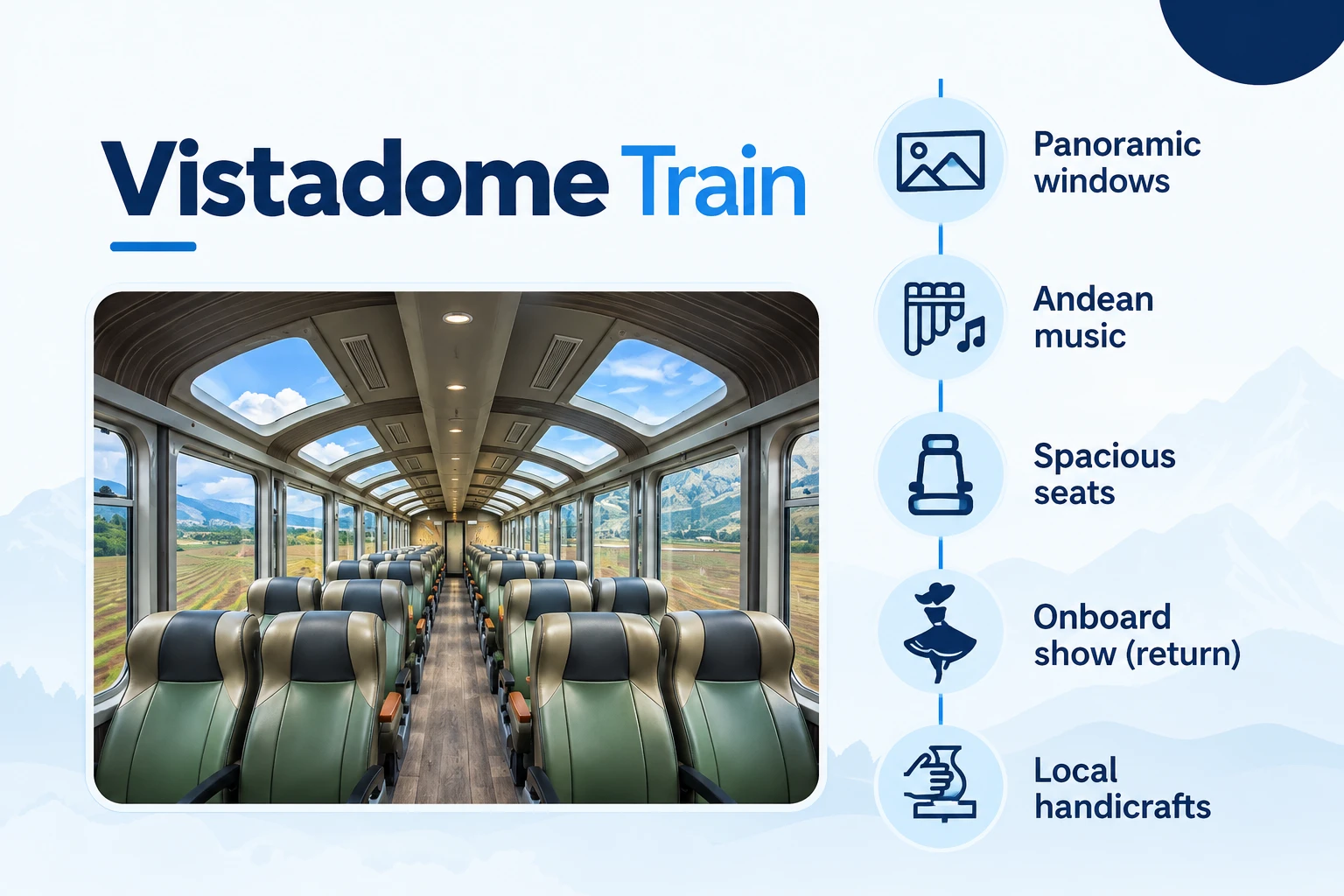
Vistadome adds panoramic windows for wider views during the journey.

Hiram Bingham combines luxury rail travel with premium service elements.
If your decision is specifically between PeruRail’s standard and panoramic categories, use the dedicated Expedition vs Vistadome comparison.
Inca Rail
| Inca Rail service | Main planning difference |
| The Voyager | Economy-oriented tourist service |
| The 360° | Premium-economy category focused on panoramic viewing |
| The Prime | Premium-economy category with upgraded service and cultural elements |
| The First Class | Premium service available on selected departures |
| The Private | Fully private rail experience for travelers or groups seeking an exclusive carriage |
The Voyager is the practical economy-oriented category, while The 360° and The Prime add upgraded experience elements. The First Class appears on selected departures, and The Private is a specialized booking rather than a standard seat category available across the timetable.
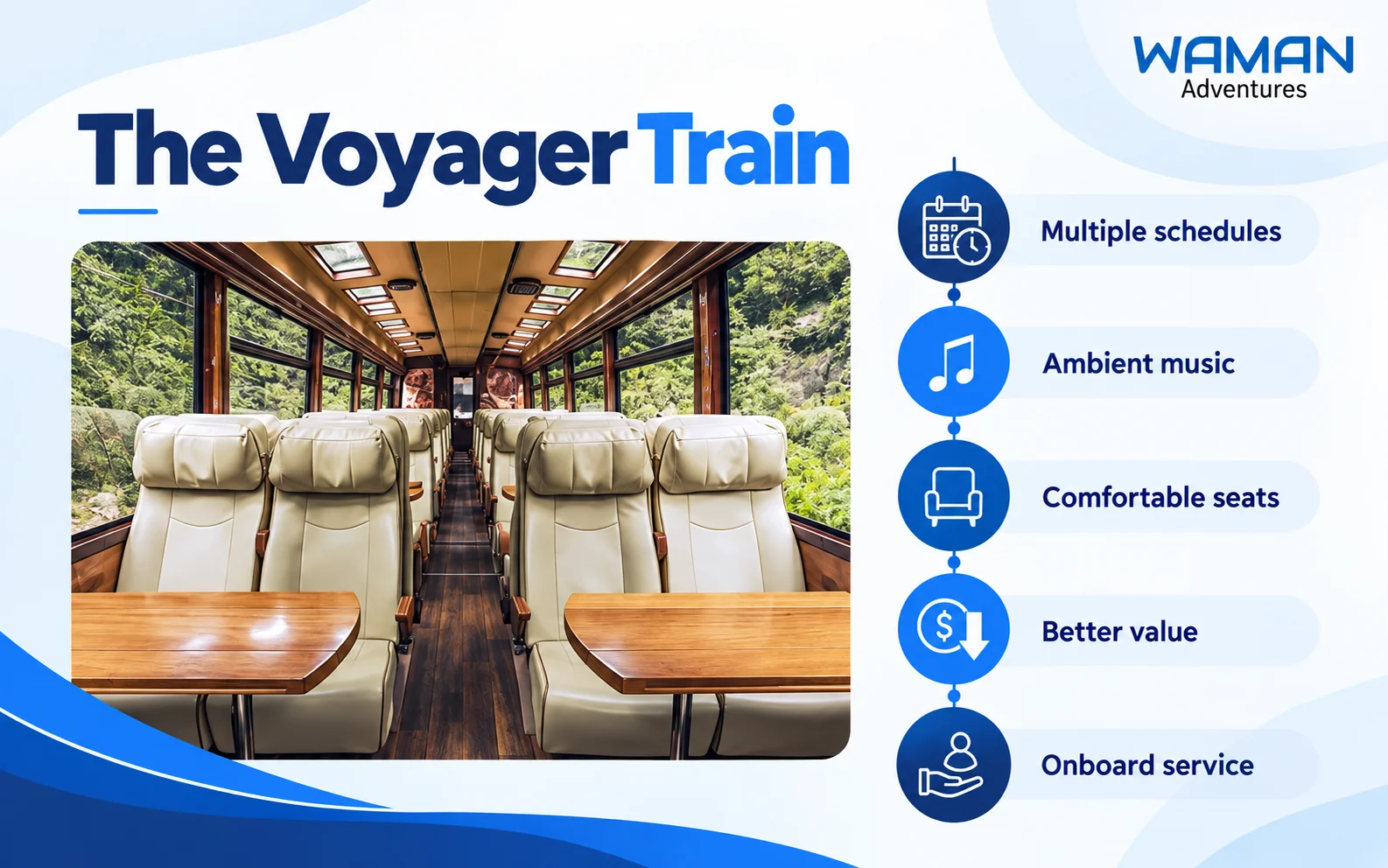
The Voyager is Inca Rail’s economy-oriented tourist service.
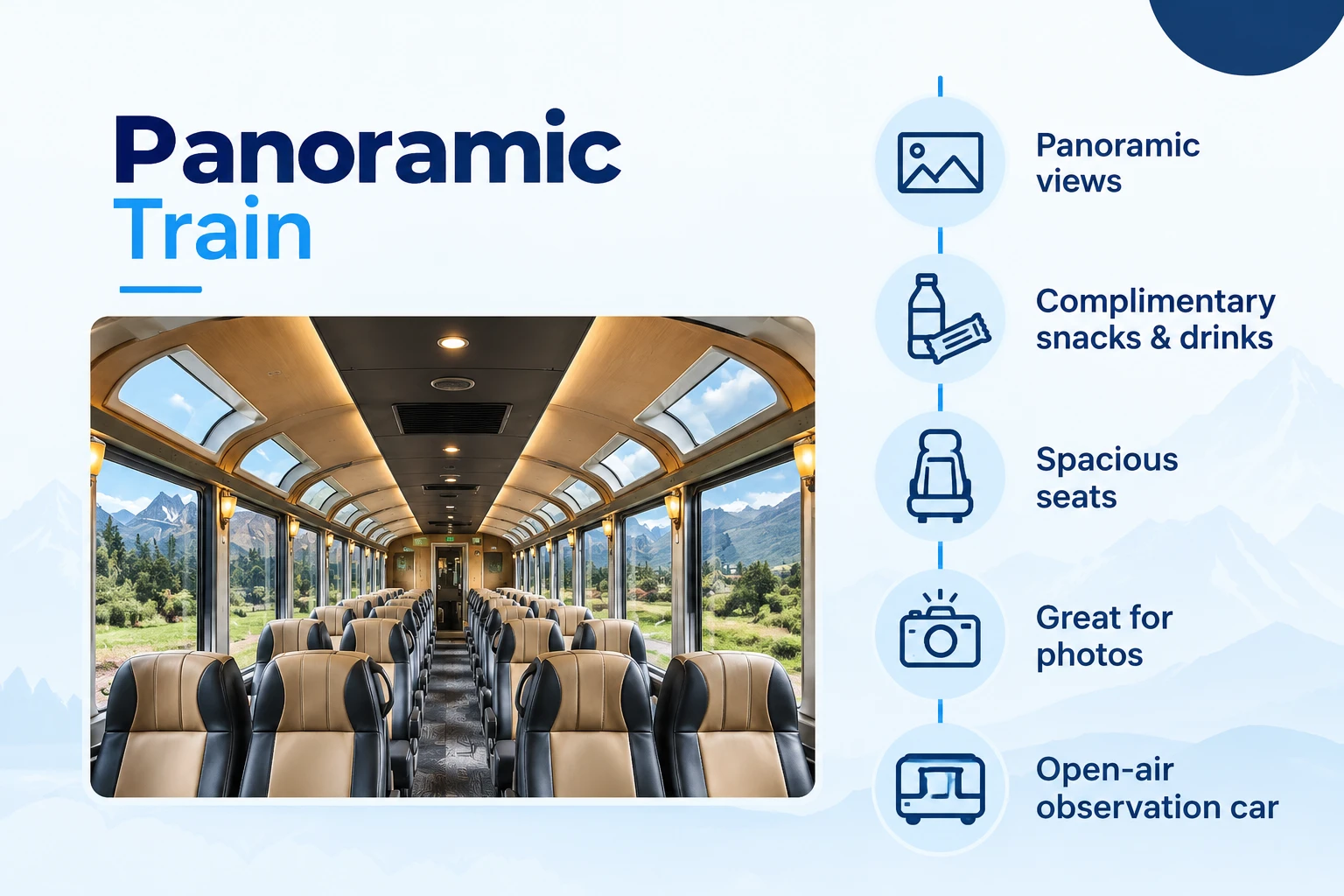
The 360° focuses on panoramic views during the rail journey.
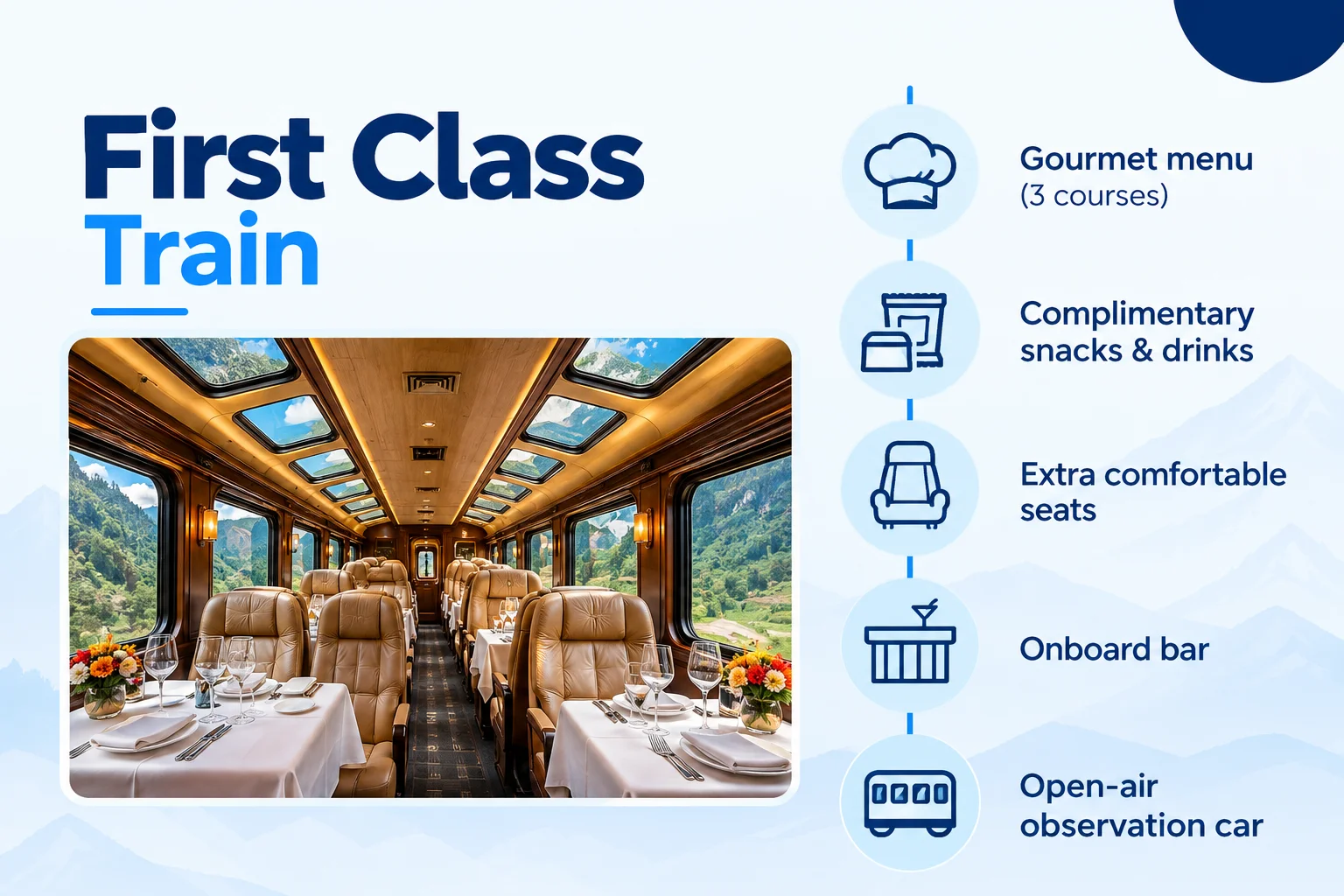
The First Class is available on selected Inca Rail departures.
PeruRail vs Inca Rail
| Comparison point | PeruRail | Inca Rail |
| Main Machu Picchu corridor | Cusco and Sacred Valley connections to Machu Picchu Pueblo | Cusco bimodal and Ollantaytambo connections to Machu Picchu Pueblo |
| Current category examples | Expedition, Vistadome, Vistadome Observatory, Hiram Bingham | The Voyager, The 360°, The Prime, The First Class, The Private |
| Combined service | Bimodal services operate on selected itineraries | Cusco itineraries use a coordinated road-and-rail connection |
| Best comparison criterion | Choose the departure and service that work with your Machu Picchu entry | Choose the departure and service that work with your Machu Picchu entry |
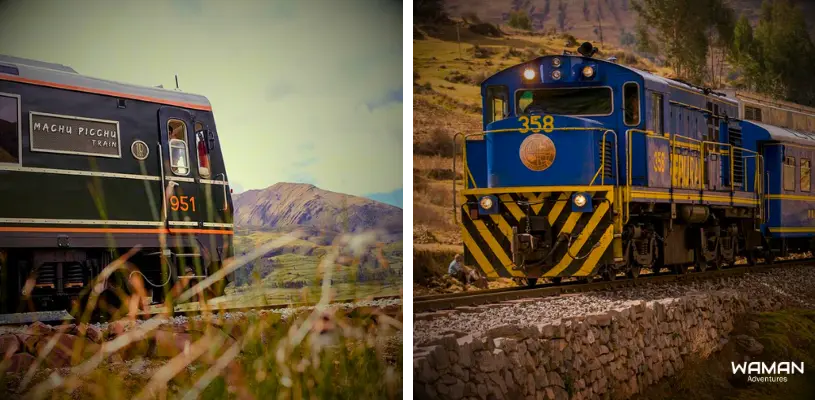
Compare schedules and stations before choosing PeruRail or Inca Rail.
Bimodal train service from Cusco
A bimodal itinerary combines a road transfer with a train ride under one coordinated journey. It is still sold as a single transport itinerary, but you do not remain on a train for the full trip from Cusco to Machu Picchu Pueblo.
PeruRail bimodal service
PeruRail uses Wanchaq as the starting point for selected bimodal departures. The road segment connects with the railway later in the Sacred Valley, and the transfer point can vary by frequency and operating period. Follow the transfer point shown on your current ticket rather than assuming every bimodal service uses the same connection.
Inca Rail bimodal service
Inca Rail sells coordinated Cusco itineraries that begin with a road transfer and continue by train from Ollantaytambo. Travelers using this option should treat the full road-and-rail sequence as one itinerary when calculating arrival time.
How to book a train to Machu Picchu
For a standard train-based trip, the Machu Picchu entrance should anchor the rest of the itinerary. Once the visit date, route and entry time are confirmed, choose a train that reaches Machu Picchu Pueblo with enough margin for the final transfer.
- Confirm the Machu Picchu entrance. The admission fixes the date, route and entry time.
- Choose the train around that entry. Leave enough time between arriving in Machu Picchu Pueblo and reaching the archaeological entrance.
- Confirm the boarding point. Check whether your service starts in Ollantaytambo, San Pedro, Poroy, Wanchaq or another point stated on the ticket.
- Review the luggage conditions. Allowances depend on the operator and service.
- Coordinate the last segment. The train ends in Machu Picchu Pueblo, so you still need to account for the uphill shuttle or walking time.
The Machu Picchu booking checklist explains the full order for coordinating the entrance, train, shuttle and remaining reservations.
Where to buy train tickets
Independent travelers can book directly through the official operator websites. A travel agency can also coordinate the train with entrance tickets, transfers and other services, but check exactly what is included before purchasing the same component twice.
Train ticket prices
Train fares vary by operator, route, departure time, train category, date, demand and promotional conditions. Because those prices change frequently, use the live booking engine for the amount that applies to your exact trip instead of relying on a static fare table.
Train luggage and boarding requirements
Identification for boarding
Bring the valid identification document associated with your reservation and keep the train ticket accessible. International travelers should make sure the name and passport details used for the booking match the document they carry on travel day.
PeruRail luggage
For Machu Picchu services, PeruRail’s current luggage policy distinguishes between a backpack and a carry-on bag. A backpack can be up to 17.64 lb (8 kg) and about 39.4 linear inches (100 cm). A carry-on bag can be up to 26.46 lb (12 kg) and about 45.3 linear inches (115 cm). Verify the conditions shown for your exact ticket because service-specific restrictions and additional luggage options can apply.
Inca Rail luggage
Inca Rail generally allows one piece of hand luggage per passenger up to 17 lb (8 kg) and 46 linear inches (118 cm). Larger suitcases are better left at the hotel or an available storage point before boarding.
| Operator | Useful planning reference | What to verify |
| PeruRail | Backpack up to 17.64 lb (8 kg) / 39.4 linear in (100 cm), or carry-on up to 26.46 lb (12 kg) / 45.3 linear in (115 cm) | Current ticket and service-specific conditions |
| Inca Rail | One bag up to 17 lb (8 kg) and 46 linear in (118 cm) | Current conditions for the train and package purchased |
PeruRail publishes current baggage conditions on its official luggage page. Inca Rail also maintains luggage guidance in its current help-center information.
How early to arrive
A 30-minute pre-departure arrival is a useful planning reference for the main tourist services, but follow the reporting time shown by your operator. Give yourself additional margin during busy travel periods or when a road transfer is part of the itinerary.
Best season for train travel to Machu Picchu
Train services operate through both drier and rainier periods, although weather can affect visibility, road transfers and railway operations. For this logistics guide, the practical difference is more important than a full month-by-month climate breakdown.
| Period | General conditions | Train planning effect |
| April to October | Generally drier conditions | High demand on many dates, so preferred train times can sell earlier |
| November to March | More frequent rainfall | Build additional flexibility around weather-sensitive transfers and possible operational changes |
For a destination-focused seasonal comparison, use Waman Adventures best time to visit Machu Picchu guide.
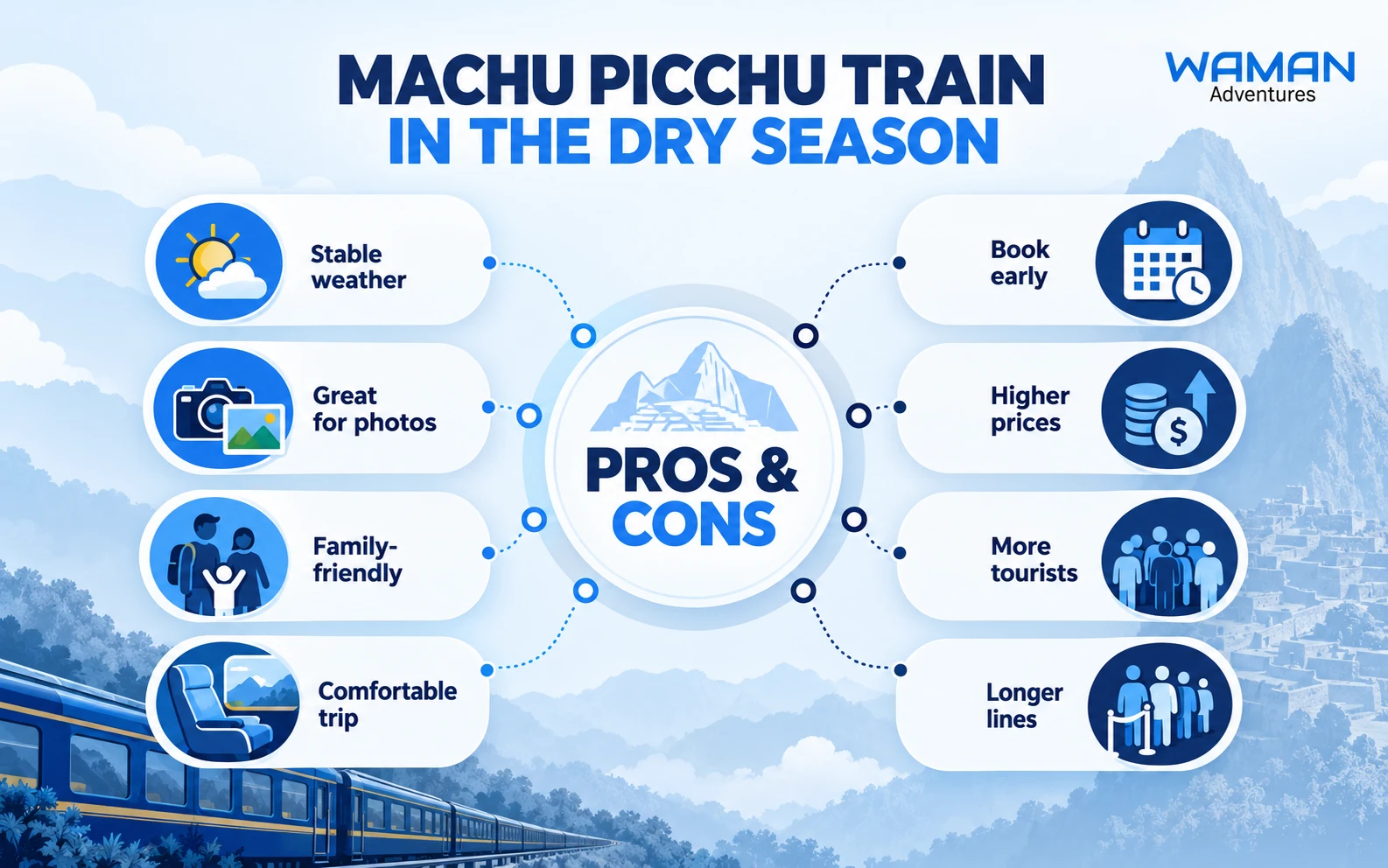
Drier months bring clearer scenery but stronger demand for train times.
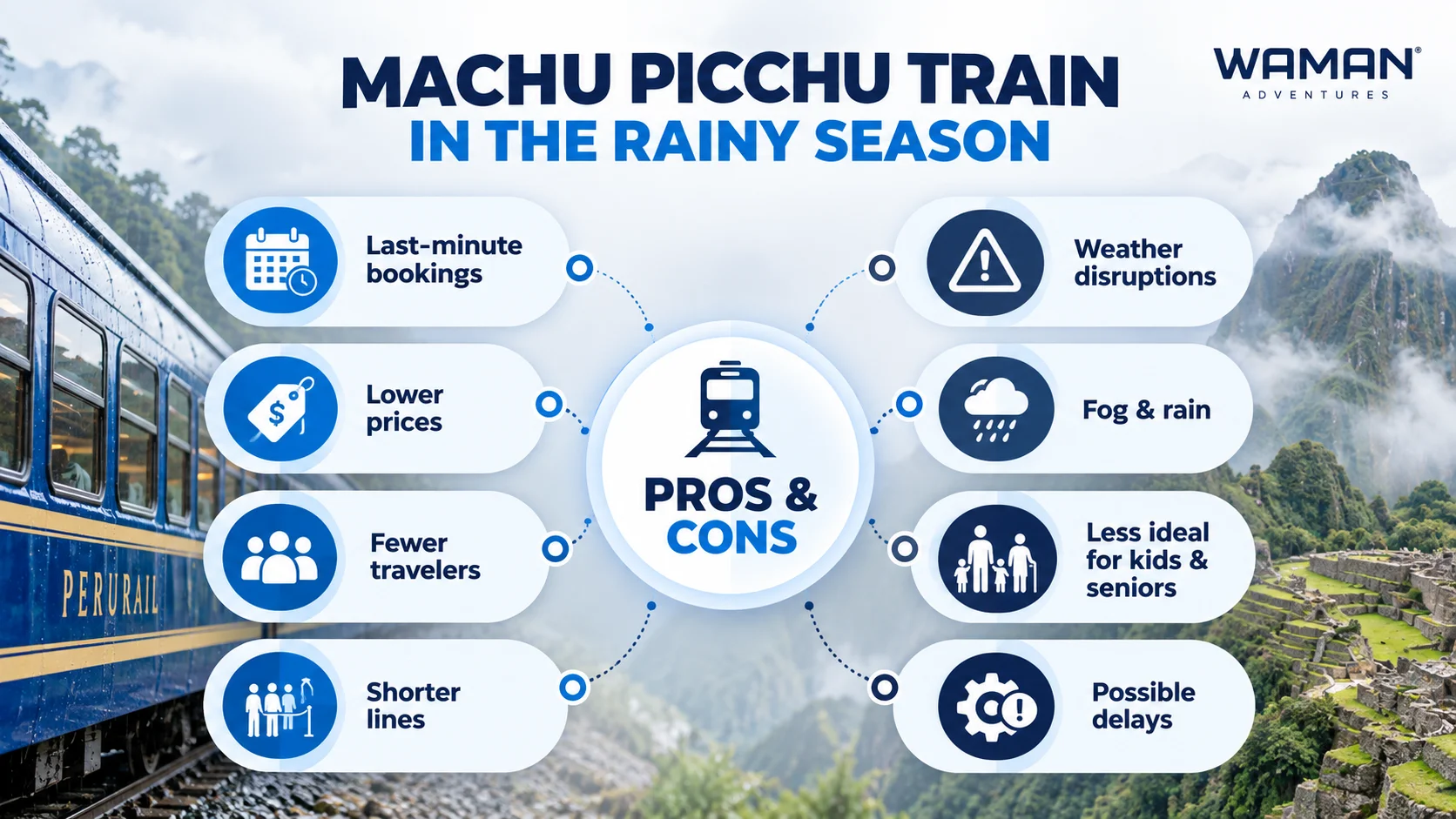
Rainy-season travel needs more flexibility around transfers and railway operations.
What the train journey is like
The railway follows the Urubamba River and passes through changing scenery, from Sacred Valley farmland and steep Andean slopes to increasingly green cloud-forest vegetation. Panoramic train categories provide larger viewing areas, while standard categories focus more on practical transportation and seating comfort.
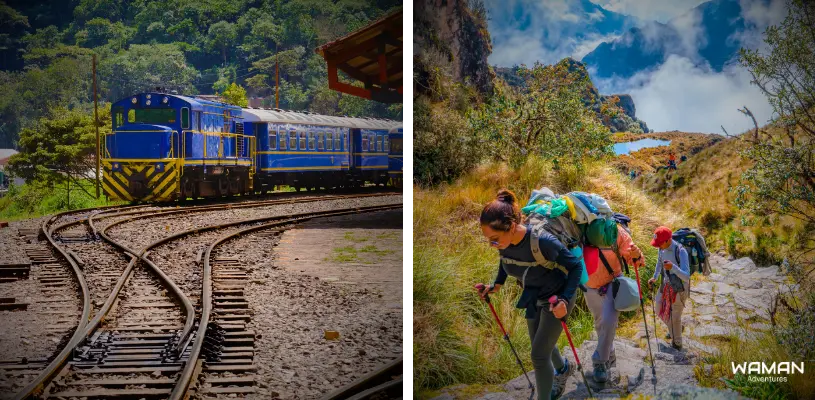
Train travel and the Inca Trail use different Machu Picchu approaches.
Travelers who want a hiking approach rather than the standard rail-based visit can review the Short Inca Trail, which uses the regulated Inca Trail network and requires a different reservation process.
From Machu Picchu Pueblo to the archaeological entrance
The train does not climb to the Machu Picchu entrance. After arriving in Machu Picchu Pueblo, travelers continue uphill by shuttle bus or on foot, and that final transfer should be coordinated with the archaeological entry time.
The dedicated bus to Machu Picchu guide covers current operators, fares, boarding logistics and the road journey from Aguas Calientes to the entrance without duplicating those details in this train owner.
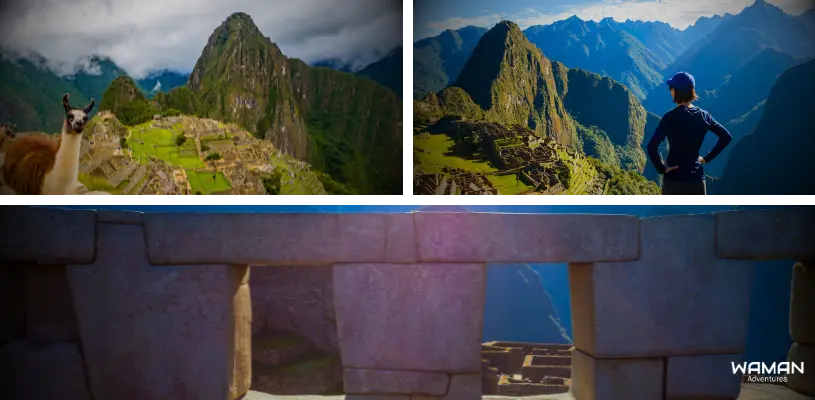
The archaeological entrance requires a separate transfer from Machu Picchu Pueblo.
Common train booking mistakes
- Buying a train before confirming that a compatible Machu Picchu entrance is available.
- Using an old timetable for a current trip.
- Assuming every Cusco itinerary is a direct train with no road transfer.
- Booking the wrong boarding point after a Sacred Valley stay.
- Arriving with large luggage without checking the current operator allowance.
- Assuming the train ticket includes Machu Picchu admission or the uphill shuttle bus.
- Leaving too little time between the archaeological visit and the return departure.
- Choosing a train only by category name instead of comparing the actual schedule and station.
Plan your Machu Picchu train around your entrance time
Once your Machu Picchu date, route and entry time are confirmed, choose the train and station that create a realistic connection. If you want help coordinating the entrance, rail service, Sacred Valley transfer and final Aguas Calientes connection, talk to a travel specialist.
Frequently asked questions about the train to Machu Picchu
Is there a direct train from Cusco to Machu Picchu?
It depends on the operator and current timetable. PeruRail can operate regular rail and bimodal itineraries from the Cusco area, while Inca Rail’s Cusco service is coordinated as a road transfer to Ollantaytambo followed by the train to Machu Picchu Pueblo.
Can I take a train from Lima to Machu Picchu?
No direct tourist train connects Lima with Machu Picchu. Travelers normally reach Cusco first by air or road, then continue toward Machu Picchu Pueblo using a train or coordinated road-and-rail itinerary.
Does the train go directly to the Machu Picchu entrance?
No. Tourist trains arrive at Machu Picchu Pueblo, also called Aguas Calientes. From there, travelers continue uphill to the archaeological entrance by shuttle bus or on foot.
Should I book the train or Machu Picchu entrance first?
For a standard rail-based visit, confirm the Machu Picchu entrance first because it fixes the date, route and entry time. Then choose train times that create a workable connection before and after the visit.
Can I board in Ollantaytambo after visiting the Sacred Valley?
Yes, when your booked service departs from Ollantaytambo. It is the main Sacred Valley rail departure for both PeruRail and Inca Rail and can avoid returning to Cusco before continuing toward Machu Picchu Pueblo.
Can I take a suitcase on the Machu Picchu train?
Small luggage is allowed within each operator’s current limits, but large suitcases may exceed the standard allowance. PeruRail and Inca Rail publish different weight and size conditions, so check the exact ticket and leave larger luggage at your hotel or an available storage point when necessary.
Which is better PeruRail or Inca Rail?
The better fit depends on your departure time, station, budget and preferred service level. Compare the exact frequency first, then look at the train category and onboard features. A schedule that works with your Machu Picchu entrance is usually more useful than choosing only by brand.
How early should I arrive at the train station?
Arriving about 30 minutes before departure is a useful planning reference for the main tourist services. Follow the reporting time on your ticket and allow additional margin when the itinerary includes a road transfer or you are traveling during a busy period.
Share:



Related tours you might be interested in
Enjoy unique experiences in Cusco and Machu Picchu with the peace of mind that comes from working with a local travel agency

Choquequirao to Machu Picchu Trek 7 Days | Private Service
The most epic and challenging adventure awaits! Dare to push your limits and embark on the ultimate...
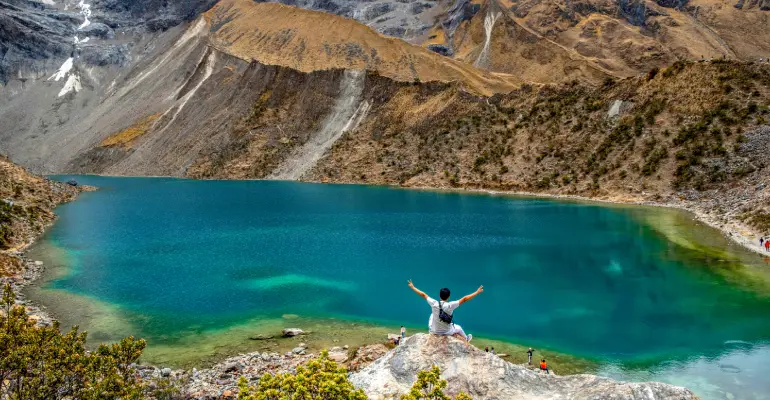
HUMANTAY LAKE TOUR FULL DAY – Group Service
Venture to the heights with a dream trip to the Humantay Lagoon! In the depths of Peru's imposing...

Full Day to Rainbow Mountain / Vinicunca – Group Service
Be dazzled by the breathtaking and colorful natural landscape of the Andes! Enjoy the epic...

Tour to Chinchero, Maras & Moray – Private Service
Discover with us this beautiful, charming and historic places, where we will visit the enigmatic...
If you liked this article and the information you found, give us 5 stars!
Table of Contents
Related blogs