A Full Guide of The Sacred Valley: An Unforgettable Paradise for Travelers and Adventurers
Ultima actualización en 27 September, 2026 por Jhon Quispe
Last Updated on 27 September, 2026 by Jhon Quispe
- Sacred Valley Peru at a glance
- What is the Sacred Valley of the Incas?
- Where is the Sacred Valley in Peru?
- Best places to visit in the Sacred Valley
- Sacred Valley altitude and elevation
- How to get to the Sacred Valley from Cusco
- Sacred Valley tickets and entrance fees
- How many days do you need in the Sacred Valley?
- Sacred Valley itineraries from Cusco
- Things to do in the Sacred Valley beyond the main archaeological sites
- Best time to visit the Sacred Valley
- Common Sacred Valley planning mistakes
- Plan a Sacred Valley route that fits your Machu Picchu trip
-
Frequently asked questions about the Sacred Valley
- Is the Sacred Valley worth visiting if I am already going to Machu Picchu?
- Is Cusco inside the Sacred Valley?
- How far is the Sacred Valley from Cusco?
- Is Machu Picchu in the Sacred Valley?
- Can I visit the Sacred Valley without a tour or guide?
- Which Cusco Tourist Ticket do I need for the Sacred Valley?
- Should I stay overnight in the Sacred Valley?
- Can you drive directly from the Sacred Valley to Aguas Calientes?
The valley covers a broad corridor northwest of Cusco, so distances, elevation and your next destination matter as much as the attractions themselves. Pisac, Ollantaytambo, Chinchero, Moray and Maras should be organized as a route, especially when a Machu Picchu train is already fixed.
Sacred Valley Peru at a glance
| Planning detail | What to know |
| Location | Northwest of Cusco along the Urubamba River corridor, with Pisac and Ollantaytambo among the principal stops. |
| Best for | Inca archaeology, traditional towns, Andean landscapes, markets, textiles and a practical stop before Machu Picchu. |
| Time needed | 1 full day for major highlights; 2 days for a slower route or an overnight stay. |
| Typical altitude | About 9,350–9,750 ft (2,850–2,970 m) in the main valley towns, with higher surrounding sites above 11,000 ft (3,350 m). |
| Main archaeological ticket | Cusco Tourist Ticket Circuit III covers Pisac, Ollantaytambo, Chinchero and Moray. |
| Common starting point | Cusco, using a guided tour, private transfer, taxi or a combination of local transportation. |
What is the Sacred Valley of the Incas?
The Sacred Valley is not one town or one archaeological park. It is a broad cultural and geographic corridor in the Cusco region shaped by the Urubamba River, fertile farmland, Inca settlements and present-day communities. For travelers, the best-known route links places such as Pisac, Urubamba and Ollantaytambo, while Chinchero, Maras and Moray are commonly added to a wider Sacred Valley itinerary.
The valley was important to the Incas because of its agricultural conditions, strategic routes and settlements. Today, it is one of the easiest places near Cusco to combine archaeology with living communities, traditional markets and access toward Machu Picchu.
Where is the Sacred Valley in Peru?
The Sacred Valley lies northwest of Cusco. Pisac is about 20 miles (32 km) from Cusco by road, while Ollantaytambo is about 45 miles (72 km) away depending on the route.
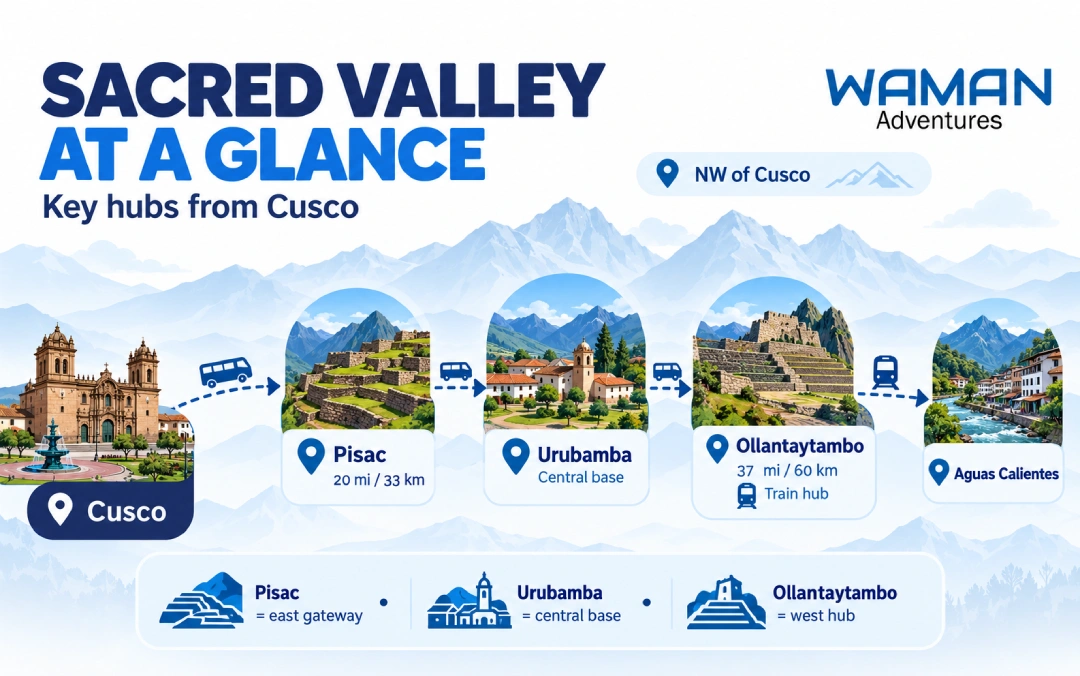
Key Sacred Valley hubs connect Cusco with Ollantaytambo and Machu Picchu.
Best places to visit in the Sacred Valley
Pisac archaeological park and town
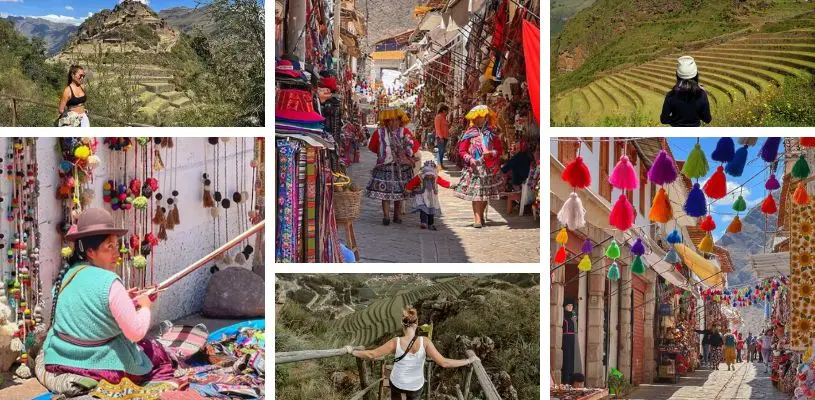
Pisac is one of the strongest eastern gateways to the Sacred Valley. Its archaeological park is known for extensive agricultural terraces, ceremonial areas and viewpoints over the valley. The town below adds a traditional market, restaurants and an easy place to slow down after visiting the higher ruins.
The archaeological park sits above town, so allow time for the road ascent and walking inside the site. If shopping is part of your trip, the Pisac market section of our Cusco markets guide explains what travelers can expect from the artisan stalls.


Ollantaytambo archaeological park and living Inca town
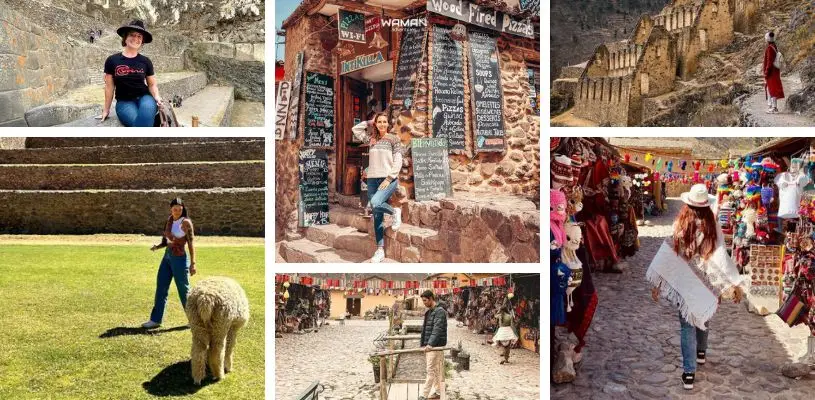
Ollantaytambo is both an archaeological destination and a functioning town whose historic core preserves narrow streets, stone foundations and water channels. The archaeological park rises above the settlement with terraces and monumental stonework, so the visit involves a significant climb.
Ollantaytambo is also a major rail hub for travelers continuing to Machu Picchu. If your itinerary ends here, check your departure station and timing in our train to Machu Picchu planning guide before committing to the rest of the day.

Urubamba and Yucay
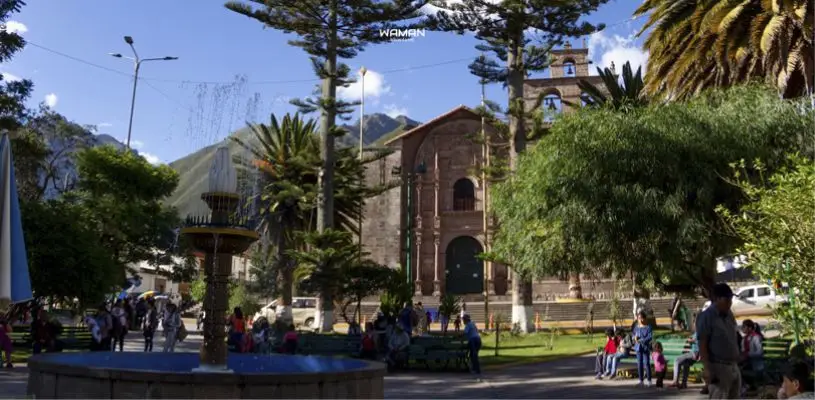
Urubamba sits near the center of the valley and works well as an overnight base for travelers who want hotels, restaurants and easier connections in both directions. It is less about one major archaeological monument and more about location, services and a slower valley stay.
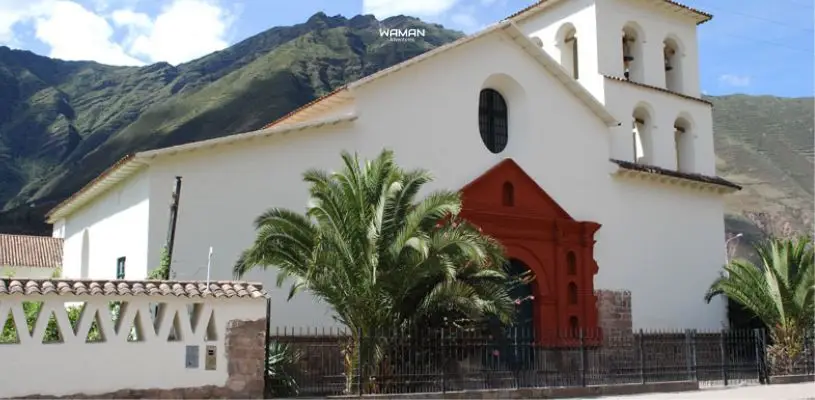
Nearby Yucay is quieter and is known for its agricultural terraces, historic buildings and broad mountain setting. These towns make more sense for travelers staying overnight than for visitors trying to fit every major archaeological site into a single day.
Chinchero and traditional textile culture
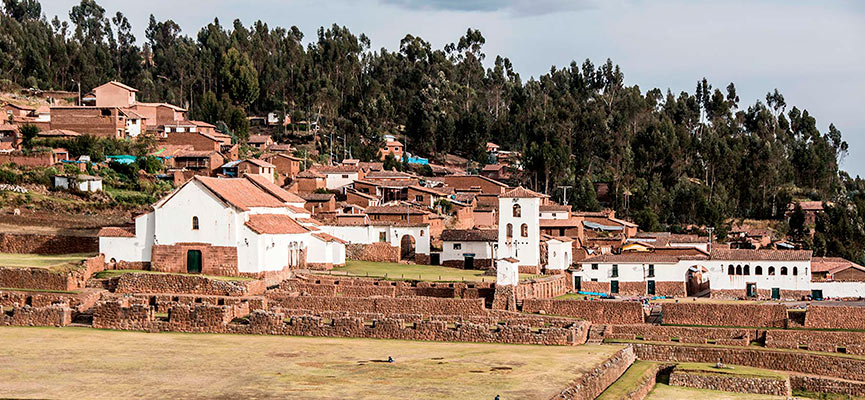
Chinchero sits much higher than the valley floor and combines an archaeological complex, colonial-era architecture and active textile traditions. Because of the elevation, weather can feel cooler and windier here than in Urubamba or Ollantaytambo.
Textile demonstrations can help travelers understand spinning, natural dyes and weaving techniques, but choose workshops that clearly explain how purchases support the artisans rather than treating the visit as only a shopping stop.

Moray archaeological terraces
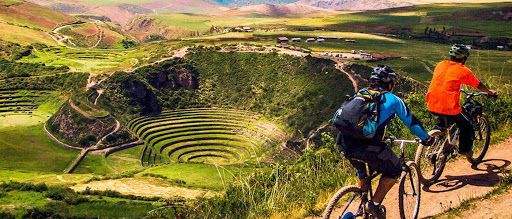
Moray is known for its large circular and elliptical terraces set into natural depressions on the high plateau. The site is commonly interpreted as a place connected with Inca agricultural experimentation, although simplified claims about exact temperature differences or the precise number of microclimates should be treated cautiously.
Moray is included in Cusco Tourist Ticket Circuit III and combines naturally with Chinchero and Maras on a half-day or full-day route.
Maras Salt Mines
Maras is famous for thousands of small salt evaporation pools fed by a naturally saline spring. The site is visually different from the archaeological parks covered by the Tourist Ticket and uses its own entrance system.
Maras and Moray are close enough to combine efficiently, but they are not the same attraction. Plan separate time for walking, viewpoints and the drive between them.

Huchuy Qosqo
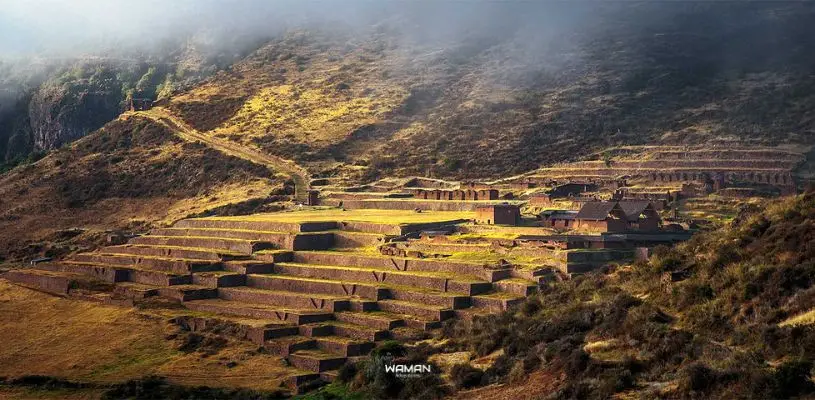
Huchuy Qosqo is a hiking-focused archaeological option above the valley rather than a standard roadside stop. It suits travelers who want a more active day and have enough acclimatization and time for a mountain route. For access options, hiking distances and route planning, use our Huchuy Qosqo guide.
Sacred Valley altitude and elevation
There is no single Sacred Valley elevation because the route changes significantly from one town or archaeological site to another. The main valley floor is generally lower than central Cusco, which sits at about 11,150 ft (3,400 m), but several surrounding attractions climb above that level.
| Place | Approximate elevation | Planning note |
| Pisac | 9,751 ft (2,972 m) | Lower than Cusco, but the archaeological park sits above the town and involves uphill walking. |
| Urubamba | 9,416 ft (2,870 m) | A common overnight base with a lower elevation than Cusco. |
| Ollantaytambo town | 9,354 ft (2,851 m) | Lower than Cusco; the archaeological site requires climbing steep stone terraces and stairs. |
| Yucay | About 9,373 ft (2,857 m) | A quieter valley-floor option between Pisac and Ollantaytambo. |
| Maras | About 11,106 ft (3,385 m) | Noticeably higher than the main valley floor. |
| Moray | About 11,106 ft (3,385 m) | High plateau conditions can feel cooler and windier than Urubamba. |
| Chinchero | About 12,418 ft (3,785 m) | One of the highest common stops on a Sacred Valley circuit. |
If you have just arrived in Cusco, the lower towns of the Sacred Valley can feel easier than higher areas, but altitude symptoms are still possible. Walk at a comfortable pace, stay hydrated and avoid treating a lower elevation as proof that acclimatization is complete.
How to get to the Sacred Valley from Cusco
The best transportation depends on how many stops you want to make and whether you will return to Cusco. A guided day tour is efficient for first-time visitors, while private transportation gives you more control over timing. Independent travelers can combine colectivos, buses and taxis, but changing vehicles makes multi-stop days less predictable.
| Option | Best for | Main tradeoff |
| Guided day tour | First visits and travelers who want several archaeological sites in one day | Fixed route and schedule |
| Private transfer | Families, small groups and travelers continuing to Ollantaytambo | Higher cost than public transportation |
| Colectivos and local buses | Independent travelers focusing on one or two towns | More transfers and less efficient for a full circuit |
| Taxi | Point-to-point travel or short connections between towns | Agree on price and route before departure |
Travel times can change with traffic, roadworks and rainy-season conditions, so avoid building a train connection around the minimum possible driving time.
Sacred Valley tickets and entrance fees
Several of the most important archaeological sites are covered by the Cusco Tourist Ticket. According to COSITUC, the Integral Tourist Ticket costs S/130 for foreign visitors and is valid for 10 days. The Partial Tourist Ticket Circuit III costs S/70 and is valid for 2 days; it covers the archaeological parks of Pisac, Ollantaytambo, Chinchero and Moray.
| Ticket | Validity | Relevant Sacred Valley sites |
| Integral Cusco Tourist Ticket | 10 days | Pisac, Ollantaytambo, Chinchero and Moray, plus other Cusco attractions in the complete ticket. |
| Partial Tourist Ticket Circuit III | 2 days | Pisac, Ollantaytambo, Chinchero and Moray. |
Important note:
Maras Salt Mines use a separate entrance and are not part of COSITUC Circuit III. Ticket prices and conditions can change, so verify the current tariff on the official COSITUC tariff page before your visit.
How many days do you need in the Sacred Valley?
| Time available | Realistic plan | Best for |
| 1 full day | Choose a classic route focused on Pisac, Urubamba and Ollantaytambo, or a Chinchero–Moray–Maras circuit. | First-time visitors with limited time |
| 2 days | Separate the eastern and western valley, add Maras or Moray and stay overnight in Urubamba or Ollantaytambo. | Travelers who want less rushing |
| 3 days | Add hiking, community activities or slower town visits instead of simply adding more archaeological stops. | Travelers using the valley as a destination, not only a day trip |
Sacred Valley itineraries from Cusco
One-day Sacred Valley itinerary
A practical classic route starts early from Cusco and prioritizes Pisac before continuing through the valley toward Urubamba and Ollantaytambo. Chinchero can be visited on the return toward Cusco when timing and ticket hours allow.
- Morning: Cusco to Pisac archaeological park and Pisac town.
- Midday: Continue through the valley toward Urubamba for lunch.
- Afternoon: Visit Ollantaytambo archaeological park and historic streets.
- Late afternoon: Return toward Cusco, adding Chinchero only if the schedule remains realistic.
If you have an evening train from Ollantaytambo, do not build the day around a late Chinchero return. End in Ollantaytambo and leave enough buffer for traffic, luggage collection and station check-in.
Two-day Sacred Valley itinerary
Two days give the valley a much better rhythm and reduce the need to rush through major sites.
- Day 1: Cusco → Pisac archaeological park → Pisac town → Urubamba or Yucay. Stay overnight in the central valley.
- Day 2: Chinchero → Moray → Maras Salt Mines → Ollantaytambo. Stay in Ollantaytambo or continue by train according to your Machu Picchu itinerary.
This order is flexible. If you already have a fixed train departure, build the entire second day backward from that departure time rather than adding attractions until the schedule is full.
Things to do in the Sacred Valley beyond the main archaeological sites
Walk through local markets and textile workshops
Pisac and Chinchero are the easiest places to combine sightseeing with artisan traditions. Give yourself enough time to compare products, ask how pieces were made and distinguish a cultural demonstration from a quick souvenir stop.
Explore Maras and Moray by ATV or bicycle
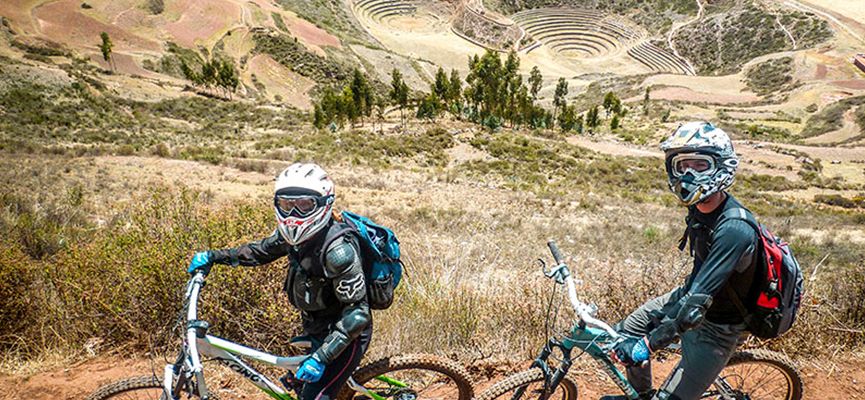
The high plateau around Maras and Moray is popular for cycling and ATV routes. These activities add open landscapes and rural roads to an archaeological day, but the exact route and whether vehicles enter sensitive areas depend on the operator and current local rules. For a dedicated option, review the ATV Maras and Moray itinerary.
Hike from Chinchero toward Urquillos
The Chinchero–Urquillos route descends from the high plateau toward the valley, passing Andean scenery and sections associated with old Inca paths. Because the trail loses substantial elevation, sturdy footwear and weather protection matter even though much of the route is downhill.

Visit Poc Poc Waterfall
Poc Poc is reached on foot from the Chinchero area and works best for travelers who have extra time beyond the archaeological circuit. Trail conditions can change after rain, so footwear and local route information are more important than treating it as a guaranteed quick stop.

Try ziplining, rafting or paragliding with a specialist operator
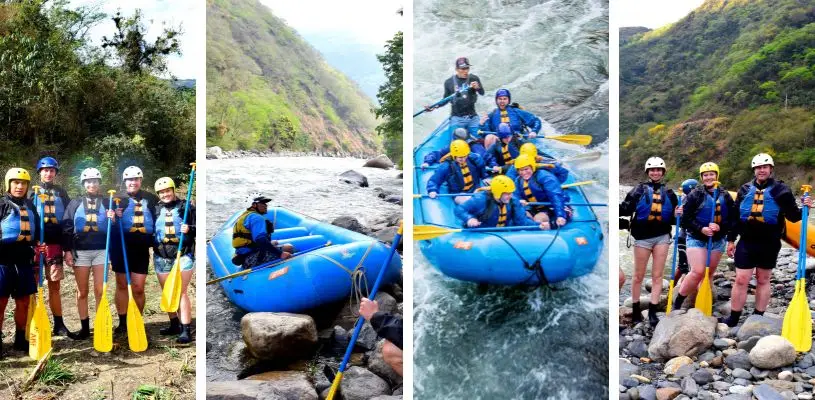
Adventure activities are available in different parts of the valley, including ziplining near Racchi, rafting on sections of the Urubamba River and paragliding from high viewpoints. Conditions, age limits, weight limits and operating areas vary by provider, so confirm safety standards and current weather restrictions before booking.

Stay overnight for community experiences or unusual lodging
An overnight stay changes the Sacred Valley from a fast sightseeing circuit into a place where you can experience quieter mornings, local food, community activities and smaller towns after day-trip traffic leaves. Lodging ranges from conventional hotels to unusual properties such as cliffside capsules, with access requirements that should be checked before booking.
Best time to visit the Sacred Valley
The Sacred Valley can be visited year-round. The drier period generally runs from roughly May through September or October and usually offers more predictable conditions for archaeological sites, hiking and photography. The wetter period generally runs from November through March, when landscapes become greener but rain, cloud and road conditions are less predictable. April and October often behave as transition months.
Weather changes with elevation. Urubamba and Ollantaytambo can feel milder than high stops such as Chinchero and Moray, so pack layers even when the forecast on the valley floor looks comfortable.
| Month | Typical pattern | Planning note |
| January | Wet season | Green scenery and frequent rain; allow extra transport flexibility. |
| February | Wet season | Among the wetter periods; trails can be muddy and visibility changes quickly. |
| March | Wet season easing | Rain remains possible, with gradually more stable periods. |
| April | Transition | A useful balance of greener landscapes and improving weather. |
| May | Dry season begins | Generally favorable for archaeology, viewpoints and hiking. |
| June | Dry season | Clearer conditions are common; mornings and nights can be cold at higher elevations. |
| July | Dry season | Popular travel month with dry conditions and stronger demand. |
| August | Dry season | Usually dry and sunny, with cool high-altitude mornings. |
| September | Late dry season | Good outdoor conditions, though occasional showers can return. |
| October | Transition | Warmer days and increasing chance of afternoon rain. |
| November | Wet season developing | Greener landscapes and more frequent showers. |
| December | Wet season | Rain is more common; protect electronics and keep timing flexible. |
For more detailed wet-season planning around Cusco and the valley, see our Cusco rainy season practical tips.


Common Sacred Valley planning mistakes
- Treating the valley as one attraction: distances between Pisac, Ollantaytambo, Chinchero, Maras and Moray add up quickly.
- Assuming every entrance uses the same ticket: the Cusco Tourist Ticket covers key archaeological parks, while Maras Salt Mines use a separate entrance.
- Ignoring elevation changes: Urubamba and Ollantaytambo are lower than Cusco, but Chinchero and Moray are considerably higher.
- Overloading a train day: if you continue to Machu Picchu, protect your train connection with a realistic buffer.
- Planning only from weather in Cusco: conditions can differ between the valley floor and high plateau stops on the same day.
- Trying to see everything in one day: a shorter route with enough time at each site is often more useful than collecting rushed stops.
Plan a Sacred Valley route that fits your Machu Picchu trip
If you want the main archaeological sites organized into one day, the Sacred Valley tour from Cusco connects the core route with transportation and a guide. If you are continuing to Machu Picchu, confirm your train and ticket times first so the valley itinerary supports the next stage of your trip instead of competing with it. If you are still deciding where to stay, how many sites to combine or how to coordinate the route with Machu Picchu, talk to a travel specialist.
Frequently asked questions about the Sacred Valley
Is the Sacred Valley worth visiting if I am already going to Machu Picchu?
Yes, if you want more context for Inca archaeology and present-day Andean communities. Pisac, Ollantaytambo, Chinchero, Moray and Maras offer experiences that are different from Machu Picchu rather than smaller versions of it.
Is Cusco inside the Sacred Valley?
No. Cusco is a separate city and the usual starting point for trips into the Sacred Valley, which lies northwest of the city in the wider Cusco region.
How far is the Sacred Valley from Cusco?
The answer depends on the stop. Pisac is about 20 miles (32 km) from Cusco by road, while Ollantaytambo is about 45 miles (72 km) away depending on the route. Travel time varies with traffic and road conditions.
Is Machu Picchu in the Sacred Valley?
For travel planning, treat Machu Picchu as a separate destination. It lies farther downstream in the broader Urubamba River corridor and uses its own tickets, circuits and access logistics. Sacred Valley trips normally focus on places such as Pisac, Ollantaytambo, Chinchero, Moray and nearby towns.
Can I visit the Sacred Valley without a tour or guide?
Yes. You can travel independently using colectivos, buses, taxis or private transfers, and a guide is not required simply to move through the valley. A qualified guide can add historical and archaeological context at major sites, while independent travel works best when you focus on fewer stops and organize entrances and timing yourself.
Which Cusco Tourist Ticket do I need for the Sacred Valley?
For the main Sacred Valley archaeological circuit, Partial Tourist Ticket Circuit III covers Pisac, Ollantaytambo, Chinchero and Moray. The Integral Tourist Ticket also includes these sites and is useful if you plan to visit other covered attractions in Cusco.
Should I stay overnight in the Sacred Valley?
An overnight stay is useful if you want a slower pace, an early start from Ollantaytambo or a convenient connection to a Machu Picchu train. Urubamba offers a central base, while Ollantaytambo is especially practical for rail departures.
Can you drive directly from the Sacred Valley to Aguas Calientes?
There is no conventional road that takes tourist vehicles directly into Aguas Calientes. Most travelers continue by train from Ollantaytambo or another operating station, while trekking and alternative routes use different combinations of road, rail and walking.
Share:



Related tours you might be interested in
Enjoy unique experiences in Cusco and Machu Picchu with the peace of mind that comes from working with a local travel agency

02 DAY «EXPLORING» THE SACRED VALLEY AND MACHU PICCHU
CHINCHERO, MARAS AND MORAY WILL ENVELOP YOU IN THE MAGIC OF THE SACRED VALLEY. EACH EXPERIENCE WILL...

Full Day – «Exploring» Machu Picchu
MACHU PICCHU EPIC ADVENTURE TOUR FROM CUSCO This full-day option is an excellent opportunity to...

04 DAY CUSCO – SACRED VALLEY – MACHU PICCHU
DISCOVER THE MAGIC OF CUSCO, THE SERENITY OF THE SACRED VALLEY AND THE GRANDEUR OF MACHU PICCHU On...

10 Days Andean Dreamscapes – Lima, Ica, Cusco & Puno with Local Flights
YOUR NEXT DESTINATION IS PERU, THE LAND OF FASCINATING STORIES AND OUTSTANDING LANDSCAPES! With our...
If you liked this article and the information you found, give us 5 stars!
Table of Contents
Related blogs