Salkantay Mountain: Ancestral Meaning, Location, and Why It Is So Important
Ultima actualización en 24 January, 2026 por Amy Pérez
Last Updated on 24 January, 2026 by Amy Pérez
- Quick answer
- Key facts about Salkantay Peak
- Meaning and importance
- Offerings to Apu Salkantay
- History and current presence
-
Frequently asked questions
- What exactly is Salkantay, and why do so many people seek it out?
- Which months offer the best chance of clear views of Salkantay?
- What time of day is best to see the mountain without clouds?
- Can you see Salkantay Mountain without doing the full Salkantay Trek?
- Are Salkantay and Humantay Lake in the same area?
- What is the practical difference between a one-day Humantay visit and the Salkantay Trek?
- What fitness level do you need to enjoy Salkantay without struggling the entire way?
- How long does it take to reach the main access points of the Salkantay corridor from Cusco?
Quick answer
The Salkantay Mountain is the highest peak in the Vilcabamba Mountain Range in Cusco and one of the most striking snow-capped mountains in southern Peru. Its name comes from Quechua and is often interpreted as “untamed mountain,” and it continues to be regarded as a protective spirit by Andean communities.
You can visit Salkantay from Cusco, and you’ll usually see it from viewpoints and high-altitude lakes, or experience it on foot during the multi-day Salkantay Trek on the way to Machu Picchu.
The Salkantay Mountain or Salcantay is a massive glaciated peak in the Vilcabamba range, with deep cultural significance in the Cusco region and a critical role as a freshwater reserve. For many communities, it is an Apu (protective mountain) and also serves as a key water reserve through its glaciers and glacial lakes. In this article, you will learn what Salkantay means, where it is located, and why it matters both culturally and environmentally.
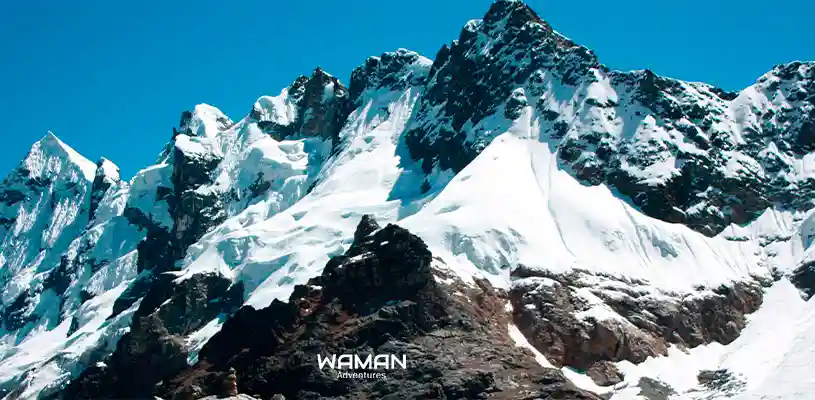
Sacred Salkantay Mountain
Key facts about Salkantay Peak
Elevation
The most widely cited elevation for the summit of Salkantay Peak is 20,574 ft (6,271 m), according to the official MINCETUR tourism inventory, the government body responsible for identifying Peru’s tourist attractions.
Other sources list the elevation as 20,551 ft (6,264 m). This small difference of 23 ft (7 m) is usually attributed to variations in mapping and measurement methods, influenced by ongoing glacier loss. Over the last 40 years, the glacier surface has shrunk by 63.6% (21.91 km² / 8.46 sq mi), according to Peru’s National Water Authority.
Climate change impact
The variation in elevation figures is not just technical. Over the past 40 years, Salkantay has lost 63.6% of its glacial surface (21.91 km² / 8.46 sq mi), according to the National Water Authority. Glacier retreat directly affects water availability for local communities and the balance of the high Andean ecosystem.
Location
Salkantay is located in the Vilcabamba Mountain Range, in the province of Anta, Limatambo district. It is the highest snow-capped peak in this range and sits on the southern edge of the Aobamba Valley basin. Streams such as Sisaypampa, Orcospampa, and Paccha Grande originate on its slopes.
Important note:
It is the second highest snow-capped mountain in the Cusco region, after Ausangate.
Climate
Salkantay Peak has a cold high mountain climate. When skies are clear, the sun can feel intense, but the air remains cold and temperatures drop quickly at night. In the upper zones, official sources describe an average annual temperature below 34.7° F (1.5° C), with conditions ranging from wet to sub-humid and frigid.
During the rainy season, from November to March, days are cooler and more humid, with highs around 55.8° F (13.2° C) and lows near 42.3° F (5.7° C). In the dry season, from May to October, skies are clearer and visibility improves, with highs around 55.2° F (12.9° C) and lows near 40.6° F (4.8° C). At night, temperatures can approach 32 °F (0 °C) or drop below freezing at higher points, especially near the glacier.

View of the majestic Salkantay Mountain, one of the most iconic peaks along the Salkantay Trek to Machu Picchu.
Meaning and importance
What does Salkantay mean?
Salkantay or Salcantay comes from Quechua and is commonly translated as “wild mountain” or “untamed mountain.” This captures how Andean communities perceive it: massive, powerful, and not easily conquered. The most common explanation breaks the name down into “sallqa”, meaning wild or untamed, and “antay”, a term with no single, exact translation. As a result, you will see different interpretations. Some link it to the sky and sunset colors, which aligns with how the mountain dominates the Cusco landscape.
Apu Salkantay and Andean worldview
During the Inca period, Apu Salkantay was revered and honored with offerings during special ceremonies. These practices were tied to securing stable and abundant production through a continuous ritual relationship with the land, water, and the mountain itself. Access to water was central, leading the Incas and earlier cultures to perform sacrifices, offerings, and meaningful rituals. Sacred water, born from melting glaciers, flows into lakes, springs, and rivers, irrigating natural pastures and agricultural fields that sustain livestock and communities.
In the Andean worldview, Apu Salkantay is seen as a protective spirit watching over the communities of Limatambo, Mollepata, Machu Picchu, and Choquequirao within the Vilcabamba range. Salkantay is described as majestic and noble, while Apu Ausangate is seen as the more powerful counterpart. Within Andean dual symbolism, the snow-capped peak Waqay Willke, also known as Veronica, is viewed as Salkantay’s complement. In local belief, Salkantay is one of the most active and powerful deities, regarded as the father of all mountains. For travelers planning long routes, including those researching where to stay on the Choquequirao trek, this spiritual geography adds meaning to the journey.
Environmental importance
Salkantay is crucial for its hydrological role. Streams such as Sisaypampa, Orcospampa, and Paccha Grande originate on its slopes, connecting with glacier-fed lakes. It is widely recognized as a freshwater reserve.
Salkantay’s glacial lakes form through melting ice and glacier retreat, which leaves natural basins where water accumulates. The most documented case is Lake Salkantaycocha, a glacier-origin lake located at 14,764 ft (4,500 m), bordered by moraines and primarily fed by meltwater from Salkantay’s glaciers. In 2020, a rock-and-ice collapse hit the lake, creating waves that triggered a downstream debris flow. As a result, ongoing monitoring and safety evaluations are recommended. On the better-known side, Humantay Lake (13,780 ft / 4,200 m) stands out as a registered tourist attraction in Soraypampa, very close to the Salkantay massif.
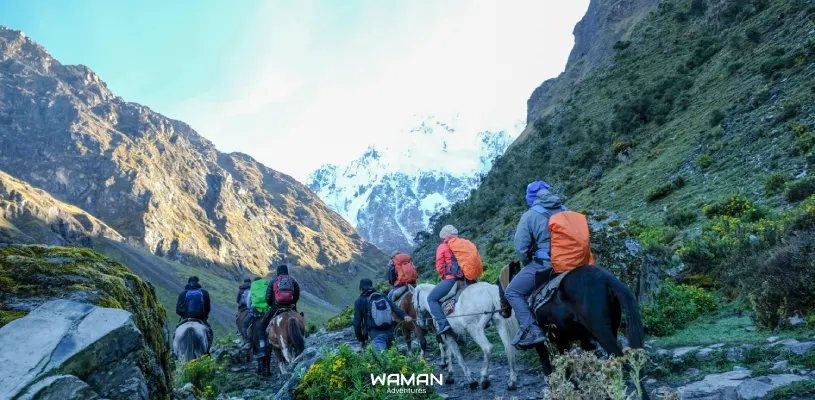
Horseback riding along the Salkantay Trek offers an alternative way to experience the high Andes, passing through valleys and mountain scenery on the route to Machu Picchu.
Offerings to Apu Salkantay
Today, different offerings are still made to Apu Salkantay for various reasons, including protection against hailstorms and crop diseases, the hope of increasing agricultural yields and herd growth, and general protection.
The Apus do not speak directly to humans. Instead, people address them through invocations, offerings, rituals, and prayers, asking for protection.
Apachetas
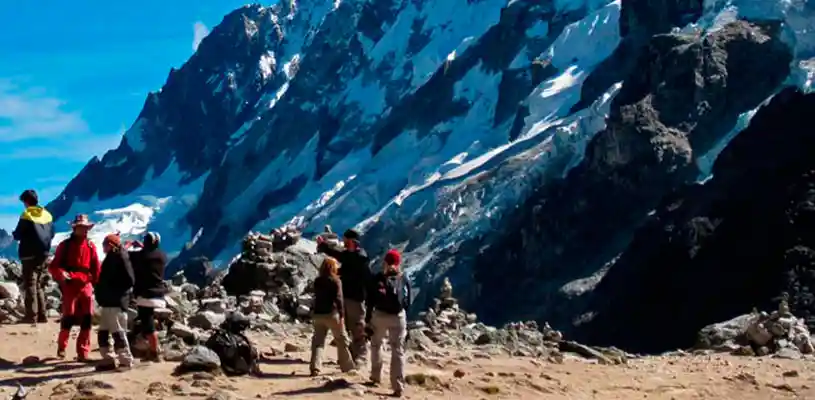
One detail you will notice on the slopes of Salkantay Mountain, especially near the Salkantay Pass, is the presence of apachetas. These stone piles are built collectively as a way to ask Pachamama for permission and protection, and to express gratitude for the landscape and nature.
Today, travelers often add stones to existing apachetas or create new ones. They are usually built at the base of Apus or at mountain passes, symbolizing respect for the path traveled and the journeys yet to come.
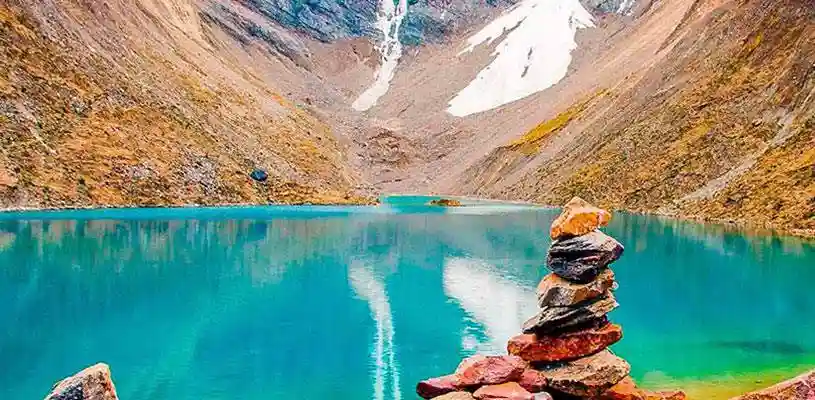
An apacheta is a traditional Andean stone offering, often seen at Humantay Lake on the Salkantay Trek route near Cusco
History and current presence
Salkantay Mountain stands out not only for its size, but also as a mountain that requires proper mountaineering techniques to climb. Today, you can experience and admire it without reaching the summit.
Mountaineering
The first documented ascent of Salkantay Peak took place on August 4, 1952, by a French-American expedition. Since then, its reputation as an “untamed mountain” has been well earned. Even the standard route via the northeast ridge is a technical glacier, snow, and ice climb rated AD (somewhat difficult) on the French scale. Access is also challenging, with a long high-altitude approach, avalanche risk in certain sections, and cloud cover that can quickly reduce visibility due to the proximity of cloud forests.
A lesser-known fact is that Salkantay has two summits (east and west). According to the American Alpine Journal, part of the peak collapsed in the 1970s, affecting comparative height measurements between the two.
Did you know?
In 2013, the American Alpine Journal documented the ascent of a team led by Nathan Heald, which included Luis Crispin, identified as the first Peruvian to reach the summiton that climb.
How to get to Salkantay Mountain?
If your goal is to see Salkantay Mountain up close, capture great photos, and feel its presence, these are the most direct experiences:
Humantay Lake: This day trip is the most popular way to see the massif in a single day. The lake sits at 13,780 ft (4,200 m) and is accessed from Soraypampa, where you can already catch a first view of the glacier-covered slopes of this sacred mountain.

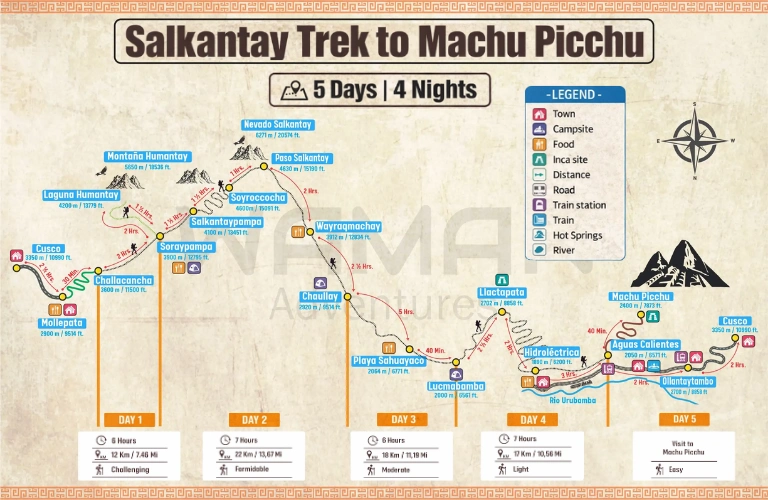
Salkantay Trekking: Along this route, several sections pass very close to the glacier, offering direct views of the mountain. Whether you choose the classic 4- or 5-day trek or the extended 7-day version that connects with the Inca Trail, you typically cross the Salkantay Pass at 15,190 ft (4,630 m), a natural viewpoint overlooking the mountain. For travelers continuing south, including those researching where to stay on the Choquequirao trek, this corridor provides valuable context for high-altitude Andean travel.
Frequently asked questions
What exactly is Salkantay, and why do so many people seek it out?
Which months offer the best chance of clear views of Salkantay?
What time of day is best to see the mountain without clouds?
Can you see Salkantay Mountain without doing the full Salkantay Trek?
Are Salkantay and Humantay Lake in the same area?
What is the practical difference between a one-day Humantay visit and the Salkantay Trek?
What fitness level do you need to enjoy Salkantay without struggling the entire way?
How long does it take to reach the main access points of the Salkantay corridor from Cusco?

Share:



Related tours you might be interested in
Enjoy unique experiences in Cusco and Machu Picchu with the peace of mind that comes from working with a local travel agency
Rural and Agritourism Experience in Chichubamba
TRADITIONAL LIFE IN THE HEART OF THE SACRED VALLEY Let yourself be immersed in the mystique and...

Birdwatching Experience at Chacán Dam & Ensifera Camp
BIRD WATCHING IN CUSCO: CHACÁN & ENSIFERA CAMP Cusco is far more than history and dramatic...

Cusco Soccer Game Experience
EXPERIENCE CUSCO SOCCER LIKE A LOCAL Immerse yourself in one of Cusco’s most intense cultural...
Huacarpay Birdwatching Experience
HUACARPAY: ANDEAN BIRD SANCTUARY Discover the natural richness of Huacarpay, a high-Andean wetland...
If you liked this article and the information you found, give us 5 stars!
Table of Contents
Related blogs
Salkantay vs Mexico Mountains and Which Adventure to Choose
18 min of reading