The Intihuatana at Machu Picchu: Sacred Stone, Solar Clock, or Something More?
Ultima actualización en 15 September, 2026 por Jhon Quispe
Last Updated on 15 September, 2026 by Jhon Quispe
What was the Intihuatana Stone at Machu Picchu used for?
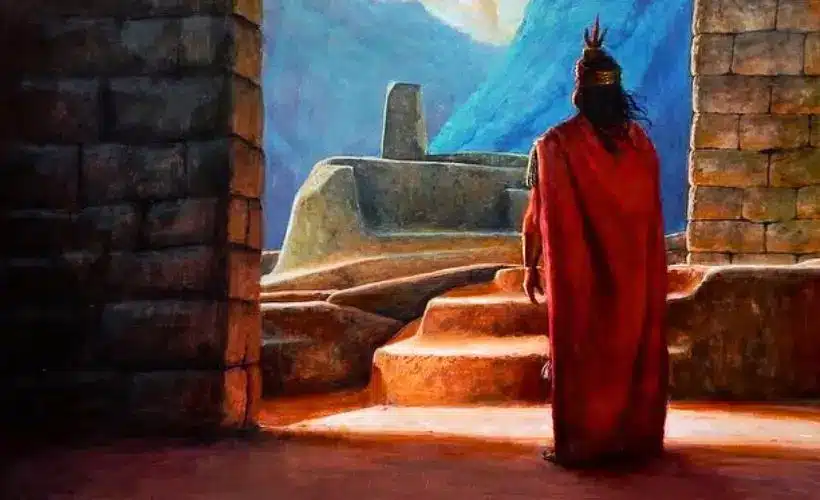
The Intihuatana is a carved ritual stone on a stepped platform in Machu Picchu. Its Quechua name is commonly interpreted as “place where the sun is tied.” Archaeologists associate it with ceremonial practices and observation of the sun, but its exact function remains debated, so describing it simply as a precise sundial or calendar overstates the evidence. Today, official Route 2-A and 2-B maps identify the Intiwatana Pyramid sector, although conservation restrictions can affect how closely visitors approach it.
- Intihuatana Stone at a glance
- What does Intihuatana mean?
- What was the primary purpose of the Intihuatana Stone?
- Intihuatana in the Inca worldview
- How the Intihuatana Stone was constructed
- Design and location of the Intihuatana
- Current access and conservation at the Intihuatana
- Other Intihuatanas in Peru
- Claims about the Intihuatana and what the evidence supports
- Plan your Machu Picchu visit around the places you want to see
- Frequently asked questions about the Intihuatana Stone
The Intihuatana is important not because archaeologists have one simple explanation for it, but because its location, carved form and relationship with the surrounding landscape support several connected interpretations. Understanding the monument means separating what can be observed directly from later theories about astronomy, ritual and Inca beliefs.
Intihuatana Stone at a glance
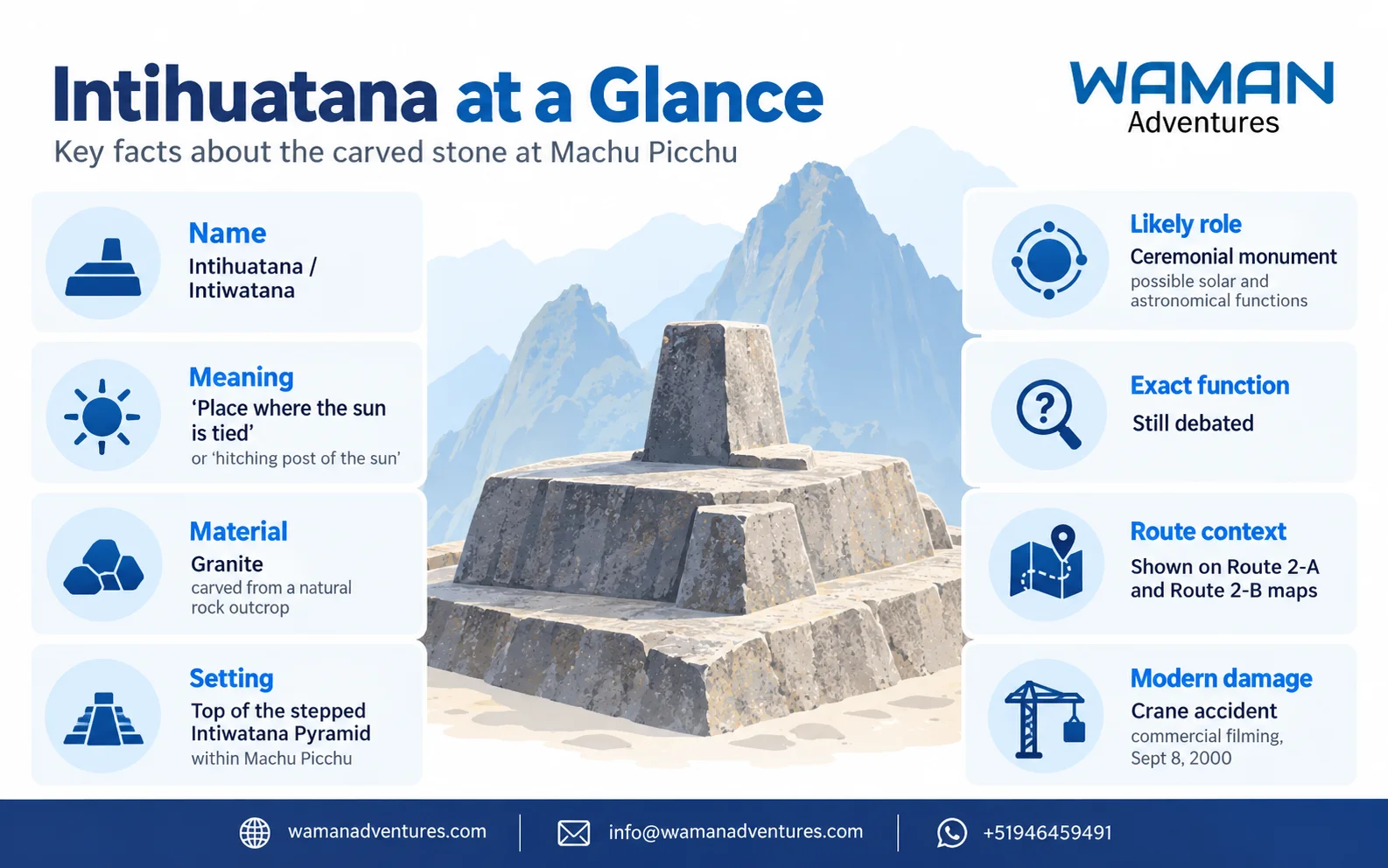
The infographic summarizes key facts about the Intihuatana, a granite structure carved from natural rock whose exact function remains debated, along with its location at Machu Picchu and its connection to Routes 2-A and 2-B.
What does Intihuatana mean?
The name is commonly connected with the Quechua words inti, meaning “sun,” and watana, associated with tying or fastening.
For that reason, Intihuatana is commonly translated as “place where the sun is tied” or “hitching post of the sun.”
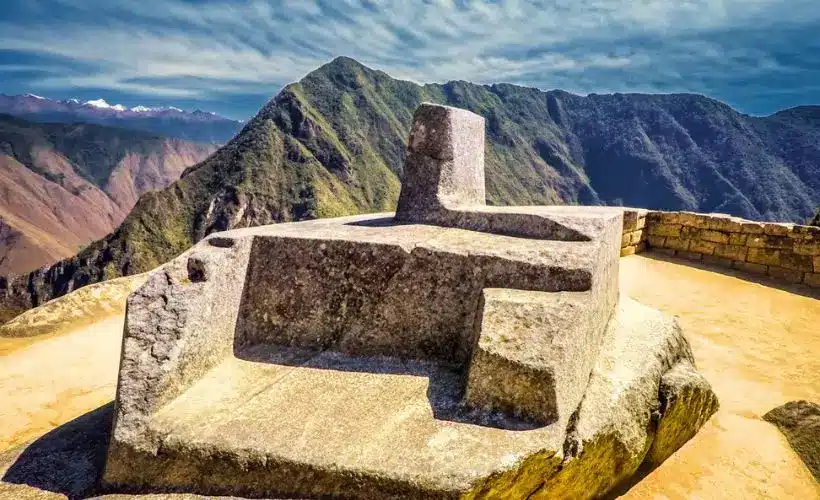
The translation is useful for understanding why the monument became strongly associated with solar interpretations, but the name alone does not prove that the stone functioned as a precise astronomical instrument.
You may also see the monument written as Intiwatana or Inti Watana. These spellings refer to the same monument at Machu Picchu.
Did you know…?
The name Intihuatana has been applied to several carved stones and archaeological places in Peru. Researchers therefore avoid assuming that every site given this name necessarily had exactly the same purpose.
What was the primary purpose of the Intihuatana Stone?
There is no universally accepted single-purpose explanation for the Intihuatana.
The strongest interpretations connect it with ceremonial activity, sacred landscape and observation of the sun. These functions may have overlapped rather than existing as separate uses.
Ceremonial and sacred-landscape interpretation
The official Machu Picchu visitor information describes the Intiwatana Pyramid as a terraced natural rock formation crowned by the monolithic sculpture and associates the sector with ceremonies honoring the sacred mountains surrounding Machu Picchu.
That interpretation fits a broader Andean worldview in which mountains, the sun, water, agriculture and sacred places were interconnected.
The elevated setting therefore matters as much as the carved stone itself. The monument was positioned within a landscape already charged with religious and political meaning.
Official information about the archaeological sectors can be reviewed through the Machu Picchu visitor guide.
Solar and astronomical interpretation
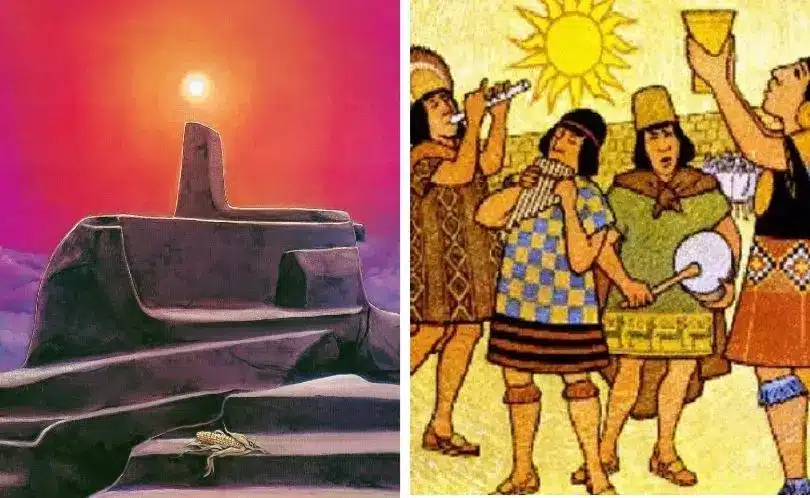
The Intihuatana has also long been connected with observations of the sun.
Its carved planes, orientation and changing shadows have led researchers to propose that it may have helped recognize significant moments in the solar cycle or reinforce ceremonies connected with seasonal change.
That does not necessarily mean Inca observers used the monument in isolation. Solar observations at Machu Picchu would have existed within a wider relationship between architecture, horizon features, mountains and ritual practice.
Was the Intihuatana an Inca sundial?
Calling the Intihuatana a sundial or Inca solar clock is a useful shorthand, but it can be misleading if taken literally.
The monument may have been associated with observing solar movement and seasonal changes, yet there is no strong basis for describing it as a clock that measured hours in the same way as a calibrated modern timekeeping device.
A more accurate description is a ceremonial stone with probable astronomical associations whose exact function remains debated.
Intihuatana in the Inca worldview
Modern explanations often separate religion, astronomy, agriculture and politics into different categories. The Inca world did not necessarily operate with those same divisions.
Observation of the sun could have helped structure agricultural seasons while also carrying ceremonial and political meaning. Sacred mountains could simultaneously function as visible features of the landscape, sources of water and powerful religious entities.
The Intihuatana is therefore easier to understand as part of a wider sacred landscape than as a single-purpose scientific instrument.
How the Intihuatana Stone was constructed
One of the clearest facts about the monument is how it relates physically to the mountain.
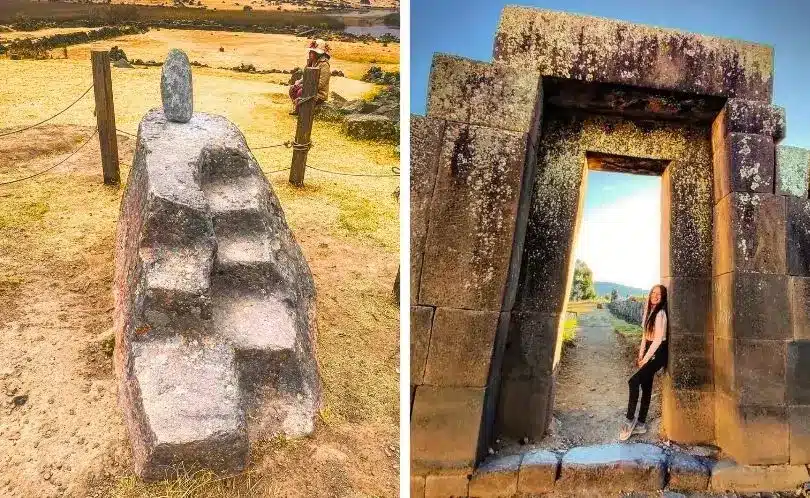
The Intihuatana was not carved elsewhere and then placed on top of its platform. Inca stoneworkers shaped it directly from an existing granite outcrop, leaving the central sculpture physically connected to the rock beneath it.
UNESCO conservation documentation describes the monument as sculpted in one piece from tapering granite.
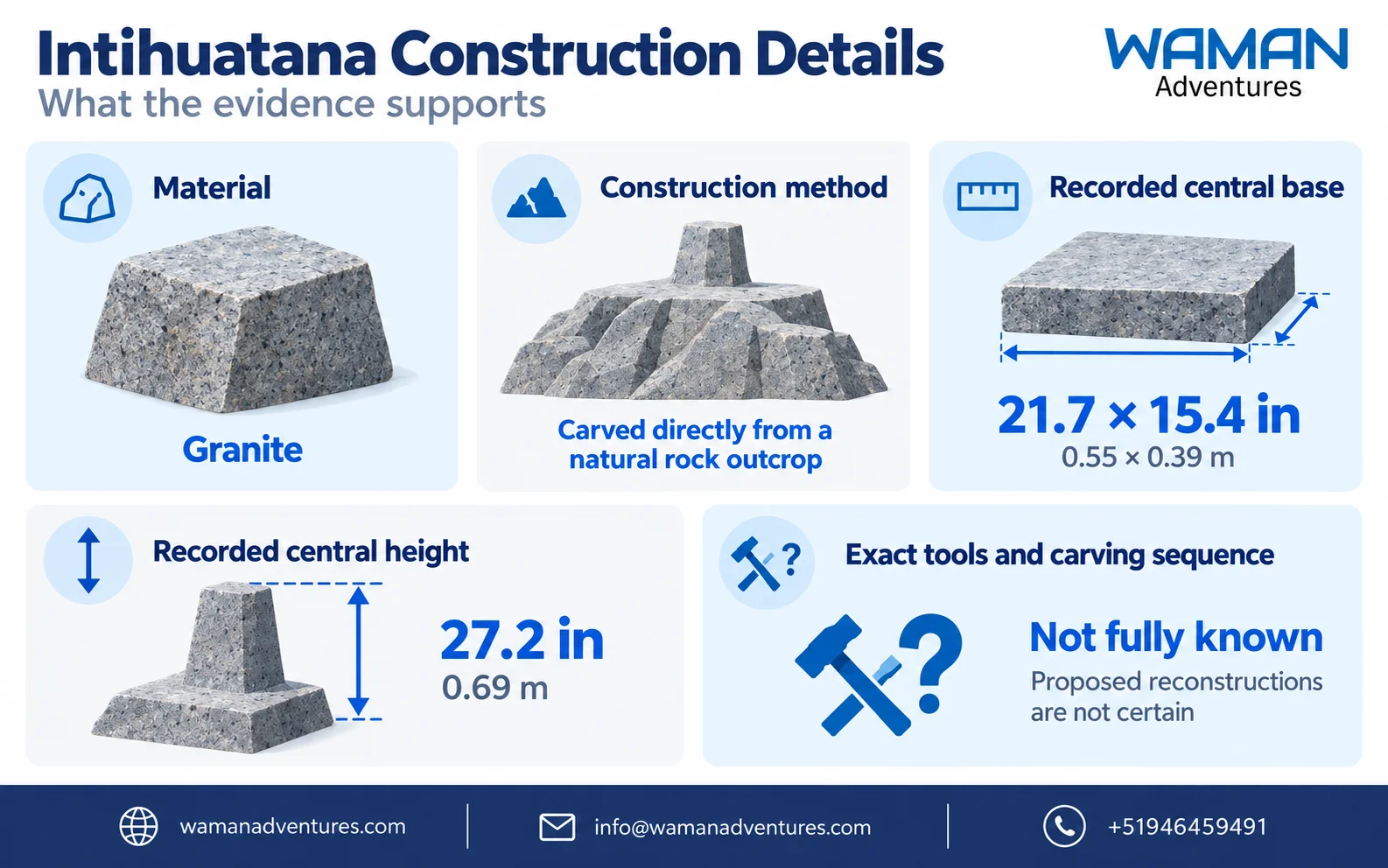
The infographic summarizes material evidence for the Intihuatana, a granite structure carved directly from a natural rock outcrop, while distinguishing its recorded dimensions from the still-uncertain tools and exact carving sequence.
The surviving stonework demonstrates controlled shaping of the granite, but claims about one exact sequence of tools, labor or astronomical calibration go beyond what the monument alone can prove.
Design and location of the Intihuatana
The carved granite form
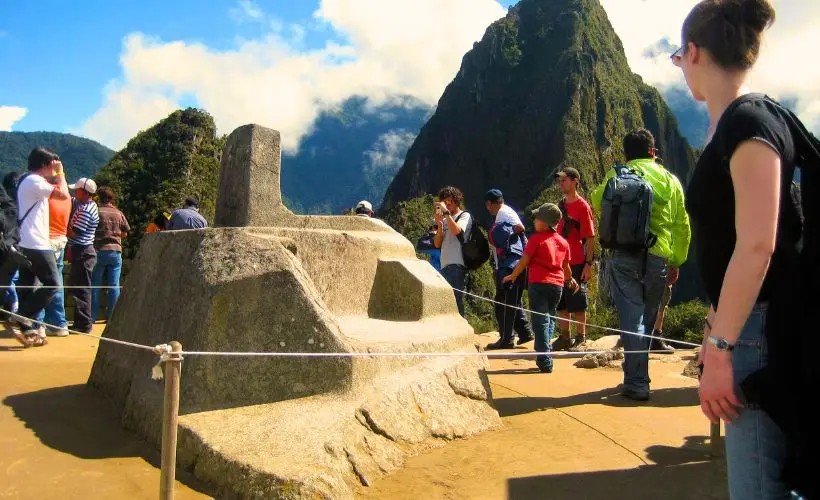
The monument has a geometric appearance created by worked planes, a rectangular lower section and a prominent upright element.
Its design is striking because carved geometry remains physically integrated with the irregular natural rock beneath it. The transition between architecture and landscape is therefore part of the monument itself.
Location on the Intiwatana Pyramid
The stone stands at the top of the archaeological sector traditionally known as the Intiwatana Pyramid, an elevated terraced formation within Machu Picchu’s urban area.
Its position creates visual relationships with the surrounding mountains and helps explain why interpretations of the monument often involve sacred landscape as well as solar observation.
The Intihuatana should not be assigned the much higher elevations sometimes repeated in older travel articles. It lies within Machu Picchu itself rather than hundreds of meters above the archaeological city.
Did you know…?
This archaeological stone allowed priests and astronomers to measure time and study seasonal changes. Besides its spiritual meaning, it was closely linked to sun worship, as Inti, the sun, was the principal deity.
Current access and conservation at the Intihuatana
Official maps for Circuit 2 Route 2-A and Circuit 2 Route 2-B identify the Pirámide del Intiwatana within the route context.
However, seeing the sector on an official map does not mean visitors should assume unrestricted close access to the carved monument.
The Intiwatana hill has been subject to continued conservation work and geodynamic monitoring. Peru’s Ministry of Culture has reported preventive interventions around the eastern terraces and continued technical evaluation of the sector during 2025 and 2026.
Important note:
Official Circuit 2 maps identify the Intiwatana Pyramid, but conservation restrictions can affect how closely visitors approach the sector. Check your current ticket route and official conditions instead of relying on older access schedules.
For that reason, access conditions should be treated as operational information rather than a permanent guarantee.
- You can review the current visitor-route structure on the official Machu Picchu circuits and routes page.
- For prices, admission rules and the full comparison of current routes, use the Machu Picchu entrance ticket guide.

Other Intihuatanas in Peru
Machu Picchu’s Intihuatana is the most internationally recognized example, but the name is also associated with other carved stones and archaeological places in Peru.
Their existence shows that the term is not exclusive to Machu Picchu. It does not prove that every monument called Intihuatana performed exactly the same astronomical or ritual function.
Pisac
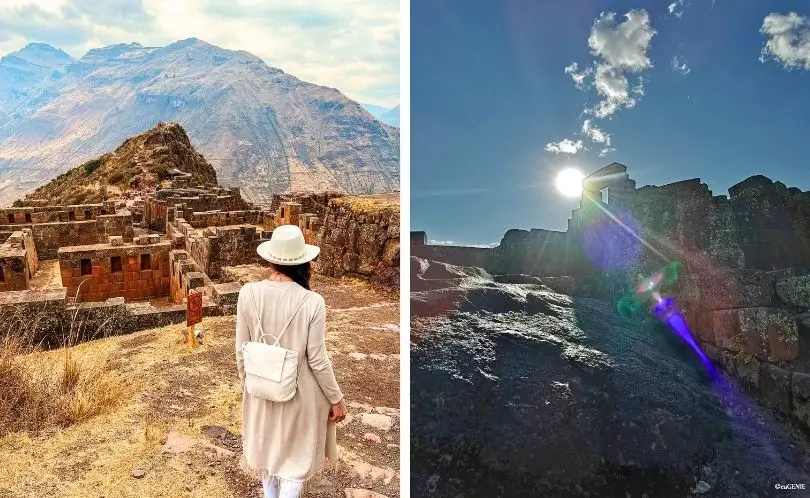
Pisac in the Sacred Valley contains a carved stone traditionally identified as an Intihuatana within an elevated ceremonial complex.
Its architecture and landscape setting have also encouraged ritual and astronomical interpretations, but it should be studied within Pisac’s own archaeological context rather than treated as an exact copy of Machu Picchu’s monument.
Intihuatana in Ayacucho
Ayacucho has a separate archaeological complex officially known as Intihuatana in Vischongo, Vilcashuamán.
Its name demonstrates how broadly the term can appear in Peruvian archaeological contexts, but the site should not be used as proof that every Intihuatana shared one standardized purpose.
Claims about the Intihuatana and what the evidence supports
Popular descriptions of Machu Picchu sometimes turn interpretations into facts. Several claims deserve more careful wording.
- “It was a precise Inca clock”: solar observation is a plausible interpretation, but precise hour-by-hour timekeeping has not been established.
- “It was only a sundial”: this is too narrow because ritual, sacred landscape and solar functions may have overlapped.
- “It was a human-sacrifice altar”: there is no solid evidence demonstrating that the Machu Picchu Intihuatana served as a human-sacrifice altar.
- “It predicted the weather”: observing seasonal solar cycles is not the same as forecasting day-to-day weather.
- “It is an archaeological energy vortex”: visitors may hold personal or spiritual interpretations, but an energy vortex is not an established archaeological function.
- “Its exact function is known”: researchers continue to debate how ceremonial, astronomical and symbolic roles may have interacted.
This distinction does not make the Intihuatana less important. It makes the monument more historically credible by separating physical evidence from claims that cannot currently be demonstrated.
Plan your Machu Picchu visit around the places you want to see
If the Intihuatana and Machu Picchu’s main ceremonial sectors are important to your visit, choose your admission route based on the archaeological experience you want rather than assuming every ticket follows the same path.
You can plan your Machu Picchu itinerary with Waman Adventures and coordinate the ticket, route and wider Peru itinerary around the places that matter most to you.
Frequently asked questions about the Intihuatana Stone
What does Intihuatana mean?
What was the primary purpose of the Intihuatana Stone?
Was the Intihuatana an Inca sundial or clock?
How was the Intihuatana Stone constructed?
Can visitors access the Intihuatana today?
How was the Intihuatana damaged?
Are there other Intihuatanas in Peru?

Share:



Related tours you might be interested in
Enjoy unique experiences in Cusco and Machu Picchu with the peace of mind that comes from working with a local travel agency

02 DAY «EXPLORING» THE SACRED VALLEY AND MACHU PICCHU
CHINCHERO, MARAS AND MORAY WILL ENVELOP YOU IN THE MAGIC OF THE SACRED VALLEY. EACH EXPERIENCE WILL...

Full Day – «Exploring» Machu Picchu
MACHU PICCHU EPIC ADVENTURE TOUR FROM CUSCO This full-day option is an excellent opportunity to...

04 DAY CUSCO – SACRED VALLEY – MACHU PICCHU
DISCOVER THE MAGIC OF CUSCO, THE SERENITY OF THE SACRED VALLEY AND THE GRANDEUR OF MACHU PICCHU On...

10 Days Andean Dreamscapes – Lima, Ica, Cusco & Puno with Local Flights
YOUR NEXT DESTINATION IS PERU, THE LAND OF FASCINATING STORIES AND OUTSTANDING LANDSCAPES! With our...
If you liked this article and the information you found, give us 5 stars!
Table of Contents
Related blogs
Mexican Peso to Peruvian Sol in Cusco: Safe and Easy Exchange Guide
10 min of reading
OUR DEFINITIVE GUIDE TO CONQUER THE SALKANTAY TREK
26 min of reading