Sacsayhuamán (Saqsaywaman) Cusco: History, Walls and Tips
Ultima actualización en 24 November, 2026 por Jhon Quispe
Last Updated on 24 November, 2026 by Jhon Quispe
What is Sacsayhuamán?
Sacsayhuamán (also spelled Saqsaywaman) is a monumental Inca complex on a hill just above Cusco, Peru, at about 12,140 ft (3,700 m). Built mainly in the 15th century under Pachacútec, it is famous for its three zigzag terraces of giant, perfectly fitted stones, some estimated at well over 100 tons. Often called a fortress, it was also a ceremonial center, and today it hosts the Inti Raymi festival every June 24. It is a 30–40 minute walk from the main square, and entry is included in the Cusco Tourist Ticket.
Few places show the power of the Inca Empire as clearly as Sacsayhuamán. Standing in front of its walls, you understand why the Spanish thought they were built by giants or demons. This guide explains what Sacsayhuamán was, what to see inside the archaeological park, how to get there from Cusco and how to plan your visit.
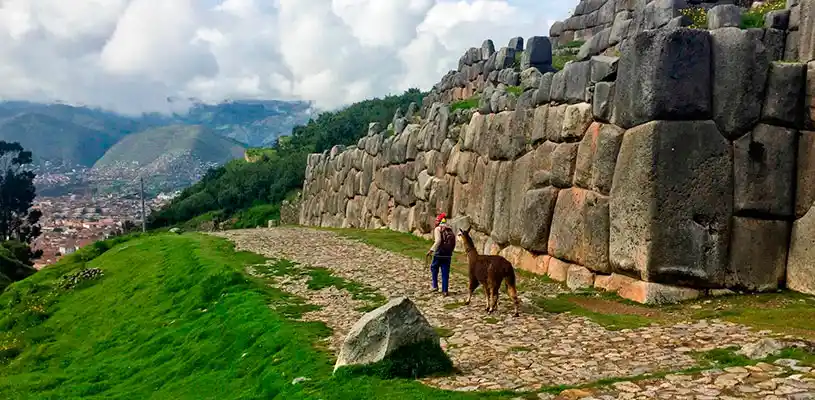
Cusco seen from the Sacsayhuamán hill
Sacsayhuamán at a glance
| Detail | Information |
| Other spellings | Saqsaywaman, Saksaywaman |
| Location | About 1.2 mi (2 km) north of Cusco’s main square |
| Altitude | About 12,140 ft (3,700 m) |
| Built | Mainly in the 15th century, under Pachacútec and his successors |
| Highlights | Zigzag walls, towers of Muyucmarca, Rodadero, chinkanas |
| Entry | Cusco Tourist Ticket (Boleto Turístico del Cusco) |
| Time needed | About 1.5 to 2 hours |
| Best known for | Megalithic stonework and the Inti Raymi festival |
What does Sacsayhuamán mean?
The name comes from Quechua. The most common translation is “place where the falcon is satisfied,” from saqsay (to be satisfied or full) and waman (falcon or hawk). Some scholars read it as “speckled head,” linked to the idea that Cusco was laid out in the shape of a puma, with Sacsayhuamán as its head.
History of Sacsayhuamán
Construction is generally attributed to Pachacútec, the ruler who transformed Cusco into an imperial capital in the 15th century, and work continued under later Incas such as Huayna Cápac. Colonial chroniclers wrote that thousands of workers labored on it for decades.
Although the Spanish called it a fortress, most researchers see Sacsayhuamán as a ceremonial and administrative complex dedicated to the Sun, with storehouses, water channels and towers, which could also be defended in times of war.
In 1536, during the great rebellion of Manco Inca, Inca forces occupied Sacsayhuamán and besieged the Spanish in Cusco. The Spanish eventually retook it in a bloody battle in which Juan Pizarro, brother of Francisco Pizarro, was killed. After the conquest, the complex was used as a quarry: many of its smaller stones were carried down to build colonial churches and houses in Cusco, which is why mainly the largest blocks remain.
Did you know…?
The early Spanish could not believe humans had moved such stones and attributed the walls to demons. Today some visitors repeat similar “alien” theories, but the walls are a product of Inca engineering, organized labor and enormous skill.
What to see at Sacsayhuamán
The zigzag walls
The highlight of the visit is the three tiered terraces of zigzag walls, roughly 1,300 ft (400 m) long, built with huge limestone blocks fitted together without mortar. The joints are so tight that a sheet of paper will not slip between them, and the zigzag design helped the walls resist earthquakes. The largest stone is estimated to weigh well over 100 tons.

The zigzag walls (photo: ChezShawna)
The gates
Trapezoidal doorways in the center of the walls once led up to the towers. Their traditional names are T’iopunku, Ajawanapunku and Wiracochapunku. The trapezoidal shape, wider at the base, is a classic Inca design that also helped resist earthquakes.

Trapezoidal Inca gates (photo: Jonmant, Pablito y Caro)
The towers: Muyucmarca, Sallaqmarca and Paucarmarca
At the top of the hill, above the zigzag walls, stood three towers. Today only their foundations remain, but they help you imagine the original complex:
- Muyucmarca: “round place,” a circular tower with three concentric walls, possibly linked to water and the Sun.
- Sallaqmarca (Sayaqmarca): a tower beside Muyucmarca whose name relates to rough, stony ground.
- Paucarmarca: probably square, now mostly buried; some believe it was dedicated to the stars.
You can still see remains of aqueducts and channels that carried water to the top of the hill.

Foundations of the towers (photo: Catherine Lucia)
The rooms on the hilltop
On the south side of the hill, near the towers, are long, narrow rooms joined by trapezoidal doors, with views over Cusco. Their walls use irregular stones with well-polished edges, a different style from the giant blocks below.
The Rodadero (Suchuna)
Across the esplanade from the main walls is the Rodadero, or Suchuna, a natural rock outcrop polished into smooth slopes by geological processes over millennia. Local children and many adults slide down it for fun. Carved seats nearby, sometimes called the Throne of the Inca, were probably used for ceremonies.

The Rodadero natural slides (photo: Zorka Ostojic Espinoza, Matt Brumitt)
The chinkanas
Near the Rodadero are the chinkanas, passages in the limestone tied to legends of a tunnel to the Qorikancha. The small Chinkana Chica can be crossed in a few minutes with a light, while the Chinkana Grande is closed. Read our full guide to the chinkanas of Sacsayhuamán.

The chinkanas (photo: Zorka Ostojic Espinoza, América Oyaneder)
Inti Raymi at Sacsayhuamán
Every June 24, Sacsayhuamán becomes the main stage of Inti Raymi, the Inca Festival of the Sun, revived in 1944. After ceremonies at the Qorikancha and Cusco’s main square, the central ritual takes place on the great esplanade in front of the walls, with hundreds of performers. Seats in the official stands sell out early, so book well ahead if you plan to attend.
How to visit Sacsayhuamán
How to get there from Cusco
- On foot: from the main square, walk up Calle Suecia and the steep Calle Resbalosa, turn right after the San Cristóbal church and follow the road and stone steps up to the control point. It takes about 30 to 40 minutes, and the altitude makes it tiring.
- By taxi: about 10 minutes from the center. Agree on the fare before getting in.
- On a tour: the easiest option, with transport and a guide. Most Cusco city tours include Sacsayhuamán.
Tickets: the Cusco Tourist Ticket
Sacsayhuamán has no individual ticket; entry is included in the Boleto Turístico del Cusco. For foreign adults, the full ticket costs about S/130 and is valid for 10 days, while the partial Circuit I ticket costs about S/70 for one day and covers Sacsayhuamán, Q’enqo, Puka Pukara and Tambomachay. Carry your passport, as the ticket is personal.
Opening hours and best time to visit
The park usually opens from about 7:00 a.m. to 5:30 p.m. Mornings are quieter and have the best light for photos. The dry season, May to September, brings the most stable weather, though late June is crowded around Inti Raymi.
Expert Tip:
If you have just arrived in Cusco, take the taxi or a tour up and walk back down to the city. You will enjoy the views without the steep climb at high altitude.
Nearby sites
With the same Circuit I ticket you can continue to Q’enqo, a carved rock shrine, Puka Pukara, a small checkpoint, and Tambomachay, the “Inca baths,” all along the road above Cusco. For more ideas, see our list of things to do in Cusco and our 25 Inca Empire facts.
Discover Sacsayhuamán with a local guide
Sacsayhuamán is impressive on its own, but a guide turns the stones into stories: how the walls were built, what happened in the siege of 1536 and how the site connects with the rest of Inca Cusco. Our Cusco City Tour visits Sacsayhuamán, Q’enqo, Puka Pukara, Tambomachay and the Qorikancha with transport and a professional guide.
Frequently asked questions about Sacsayhuamán
How do you pronounce Sacsayhuamán?
Was Sacsayhuamán a fortress or a temple?
How were the giant stones moved?
Can I visit Sacsayhuamán without a guide?
Is Sacsayhuamán worth visiting?
Is Sacsayhuamán included in the Machu Picchu ticket?
Share:



Related tours you might be interested in
Enjoy unique experiences in Cusco and Machu Picchu with the peace of mind that comes from working with a local travel agency
If you liked this article and the information you found, give us 5 stars!
Table of Contents
Related blogs