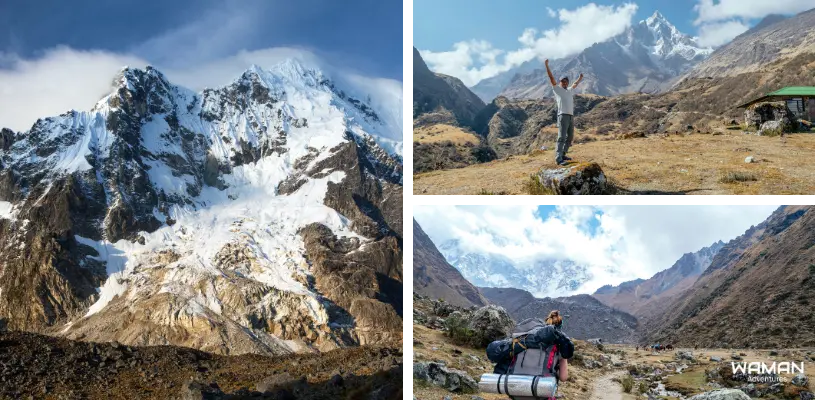
Explore Huayna Picchu like an expert: Our guide will take you gradually
Ultima actualización en 6 November, 2024 por Waman Adventures
Last Updated on 6 November, 2024 by Waman Adventures
- What is Huayna Picchu Mountain?
- What does Huayna Picchu mean?
- Where is Huayna Picchu located?
- How high is Huayna Picchu?
- History of Huayna Picchu
- General Information
- Experience of the Hike
- Logistics and Planning
-
Comparisons and Restrictions
- Huayna Picchu vs Huchuy Picchu
- Machu Picchu Mountain or Huayna Picchu
- Location
- Difficulty Level
- Slope degree
- Maximum altitude
- Permitted age
- Is Huayna Picchu Worth It?
- Are there prohibited items when climbing Machu Picchu Mountain?
- Age Restrictions for Huayna Picchu:
- Health Restrictions for Huayna Picchu:
- Huayna Picchu without a Guide:
- Is Huayna Picchu dangerous to climb?
- Are there rest stops along the way to Huayna Picchu Mountain?
- What equipment or training do I need to climb Huayna Picchu Mountain?
- Preparation
Are you passionate about history? Are you attracted to nature? Are you a born adventurer? If you answered yes to these questions, then Huayna Picchu is the perfect destination for you. This majestic mountain rises imposingly in front of the Inca citadel of Machu Picchu, holds a fascinating history within its interior, and offers its visitors an incomparable experience.
This Waman Adventures‘ blog will guide you gradually through everything you need to know and learn to plan your trip to Huayna Picchu Mountain. Read about how to obtain tickets and essential tips, including the best climbing routes and the gorgeous landscapes while feeling the adrenaline rush through your veins. Huayna Picchu is not just a peak; it’s an adventure that welcomes you to challenge your physical and mental limits.
What are you waiting for? Keep reading.
What is Huayna Picchu Mountain?
Huayna Picchu is an impressive mountain that stands out in every iconic photograph of Machu Picchu. It is also one of the most popular attractions of this historic Inca site. Also, thousands of people endeavor to climb to its highest point to enjoy an incredible view every year.
From the summit, you can witness, not only the majestic mountains surrounding the area, the magnificent citadel of Machu Picchu in all its grandeur. The experience of discovering this landscape for oneself is unforgettable and is worth it anyway.

Summit of Huayna Picchu
What does Huayna Picchu mean?
“Huayna Picchu” is a name that comes from the Quechua language, and it means “young peak.” Therefore, “Huayna Picchu” is generally translated as “Young Mountain” or “Small Mountain.” By the way, Quechua is a language spoken by indigenous tribes and cultures that lived and inhabited the Andes before the arrival of the Spaniards.
In the specific context of the archaeological site of Machu Picchu in Peru, Huayna Picchu is the mountain located northwards of the citadel of Machu Picchu.
Where is Huayna Picchu located?
The imposing mountain of Huayna Picchu, located north of the Inca citadel of Machu Picchu in the province of Urubamba, is about 80 km / 50 miles from Cusco city.
It is interesting how Machu Picchu and Huayna Picchu perch within a subtropical cloud forest and are part of the Vilcabamba Mountain Range.
How high is Huayna Picchu?
Huayna Picchu is about 2,720 m / 8,923 ft ASL, which may seem unimaginable, especially considering that the city of Cusco lies at a higher altitude, roughly at 3,350 m / 10,990 ft ASL. However, you shouldn’t worry too much about altitude sickness. We are confident you will acclimatize undoubtedly during your first days in Cusco. By the time you reach Huayna Picchu’s foothills, the altitude of this mountain will not pose any challenge to you.
History of Huayna Picchu
Huayna Picchu Mountain is in the Peruvian archaeological complex of Machu Picchu. Its name in Quechua means “Young mountain or peak.” So, this mountain is part of the iconic landscape of Machu Picchu and is one of the most popular tourist attractions for visitors in this cultural site.
The history of Huayna Picchu is closely linked to the history of Machu Picchu in general. According to chronics, Machu Picchu was built by the Incas around the 15th century atop the Peruvian Andes mountains. It is considered one of the masterpieces of Inca architecture and an important religious, political, and cultural center.
The exact function of Huayna Picchu in the context of Machu Picchu is not entirely clear, but it is believed to have had a religious or ceremonial significance for the Incas. Some studies suggest that Huayna Picchu may have been a sacred place dedicated to astronomical observation or as a point of connection with the gods.
During the Inca period, researchers say that Huayna Picchu was a religious mountain dedicated to ceremonial activities. Archaeological evidence of structures, caves, and terraces has been found at the top. Also, the mystical temple of the moon is on the other slope and has fine lithic carved rocks.
General Information
Climate of Huayna Picchu
Huayna Picchu during the Rainy Season
Huayna Picchu in November
Wheater: November marks the beginning of the rainy season in the region. Days are more humid, and rains are more frequent. Daytime temperatures may still be warm, around 20 °C / 68 °F to 25 °C / 77 °F, but nights are cooler.
- Pros: Fewer tourists compared to the high season.
- Cons: Frequent rains that may hinder outdoor activities and visibility.
Huayna Picchu in December
Wheater: December continues with the rainy season, although rainfall may increase towards the end of the month. Daytime temperatures may still be warm, around 20 °C / 68 °F to 25 °C / 77 °F, with cool nights.
- Pros: Fewer tourists than in the high season, especially towards the end of the month.
- Cons: Possible rains that may affect outdoor activities and visibility.
Huayna Picchu in January
Wheater: January marks the beginning of the rainy season in the Huayna Picchu region. Daytime temperatures usually range between 20 °C / 68 °F and 25 °C / 77 °F. Nights can be cool, with temperatures around 10 °C / 50 °F.
- Pros: Fewer tourists compared to the high season months.
- Cons: Frequent rains can make hiking conditions difficult and less predictable.
Huayna Picchu in February
Wheater: Similar to January, February is generally rainy in the region. Daytime temperatures may be similar, around 20 °C / 68 °F to 25 °C / 77 °F, but nights may be slightly cooler.
- Pros: Vegetation is at its peak due to recent rains, making the landscape lush and green.
- Cons: Continuous rains can hinder the hiking experience and visibility of the views.
Huayna Picchu in March
Wheater: March marks the end of the rainy season, although there may still be some precipitation. Daytime temperatures may rise a bit, reaching 25 °C / 77 °F or even a little higher. Nights tend to be warmer than in previous months.
- Pros: Less rain compared to previous months, improving hiking conditions.
- Cons: As the high season approaches, there may be more tourists compared to previous months. It is the beginning of the high season, so there may be more tourists and higher prices for accommodation and activities.
Huayna Picchu during the Dry Season
Huayna Picchu in May
Climate: May marks the beginning of the dry season in the region, with sunny days and pleasant temperatures. Daytime temperatures may range between 25 °C / 77 °F and 30 °C / 86 °F, while nights are cooler, around 15 °C / 59 °F.
- Pros: Excellent hiking conditions due to the dry weather and warm temperatures.
- Cons: Although not as crowded as the high season months, there may be more tourists than in previous months.
Huayna Picchu in June
Climate: June continues with dry and sunny weather. Daytime temperatures may be similar to those in May, around 25 °C / 77 °F to 30 °C / 86 °F, with cool nights around 15 °C / 59 °F.
- Pros: Perfect weather for outdoor activities and hiking.
- Cons: As July approaches, the high season begins, so there may be an increase in the number of tourists.
Huayna Picchu in July
Climate: July is one of the most popular months to visit Huayna Picchu due to the dry and sunny weather. Daytime temperatures are warm, around 25 °C / 77 °F to 30 °C / 86 °F, while nights remain cool.
- Pros: Optimal conditions for outdoor activities and enjoying panoramic views.
- Cons: High influx of tourists, which may mean longer waiting times and higher prices.
Huayna Picchu in August
Wheater: August remains a popular month to visit Huayna Picchu with dry weather and pleasant temperatures. Daytime temperatures may be similar to those in July, around 25 °C / 77 °F to 30 °C / 86 °F, while nights may be slightly cooler.
- Pros: Ideal conditions for hiking and exploration.
- Cons: Continuous influx of tourists, especially during
Huayna Picchu in September
Wheater: September marks the beginning of the transition to the rainy season. Although there may still be sunny days, rain is more frequent. Daytime temperatures may range from 20 °C / 68 °F to 25 °C / 77 °F, with cooler nights around 10 °C / 50 °F to 15 °C / 59 °F.
- Pros: Fewer tourists compared to the high season.
- Cons: Possibility of rains that may hinder views.
Huayna Picchu during the Shoulder Season
Huayna Picchu in April
Wheater: April marks the beginning of the dry season in the region. Daytime temperatures can be warm and pleasant, around 25 °C / 77 °F to 30 °C / 86 °F, while nights remain still warm, but less chilly than in previous months.
- Pros: Excellent hiking conditions due to the dry weather and pleasant temperatures.
Huayna Picchu in October
Wheater: October is a transitional month with the gradual arrival of the rainy season. Daytime temperatures may still be warm, around 20 °C / 68 °F to 25 °C / 77 °F, but rains are more frequent. Nights can be cool.
- Pros: Green and lush landscapes due to recent rains.
- Cons: Possible rains that may affect the hiking experience and visibility.
Best Time of Year to Climb Huayna Picchu
The best time of year to climb this mountain is during the dry season, which ranges from May to September. Why? These months are chosen because they offer many climatic advantages and by many travelers worldwide. Traveling during this season will spare you many unforeseen situations caused by rain and bad weather, such as road blockages and the rise of the Vilcanota River, which can affect train tracks.
If you have already planned to visit Huayna Picchu during the rainy season, don’t worry; that doesn’t mean you won’t be able to ascend this mountain or have great days in Cusco. Nonetheless, you should keep in mind that it has a steep trail and ascent, hence rain can make it very slippery and add a little touch of danger. However, the reward is guaranteed with a spectacular glimpse of the citadel of Machu Picchu and a much greener landscape with the blooming vegetation compared to the dry season.

Main entrances and check point of Machu Picchu citadel
How to Get to Huayna Picchu?
Getting to this destination is easier than you think. To guide you, let’s start from the city of Cusco. Remember that most journeys begin from the historic center of this city, and once you’re there, everything will be straightforward:
- First step: Whether you’ve booked a tour with a travel agency like Waman Adventures or prefer a pick-up service from your hotel, the meeting point is usually in the historic center or downtown area. So, choosing Waman Adventures will be more convenient for you in logistics and comfort undoubtedly.
- Second Step: At this point, transportation will take us to Ollantaytambo, where you will take a train from the train station to Aguas Calientes or Machu Picchu Town.
- Third Step: Once you make it to Aguas Calientes, you’ll need to head to the CONSETTUR bus station to board one of these buses, which will take you to the entrance gate of the Inca citadel of Machu Picchu.
- Fourth Step: Enjoy your stroll or guided tour through the citadel of Machu Picchu. Remember that when purchasing any entrance ticket, you must book the Circuit 4 + Waynapicchu in order to climb this mountain.
- Fifth Step: Walking and exploring the citadel of Machu Picchu using the Circuit 4 + Waynapicchu ticket, you must stop at the Huayna Picchu control booth. From here, you can ascend this mountain and enjoy the most incredible view of the citadel from a considerable height.
How difficult is the Huayna Picchu hike?
The difficulty of ascending this mountain and enjoying the spectacular view isn’t too tough. You might wonder what the reason is. Keep in mind that the entire route is extremely steep, with sections that have very small steps, akin to those for a child. Additionally, it requires a certain level of physical exertion to reach the summit.
How hard Is to climb Huayna Picchu?
This journey is a small test to overcome your fears, especially vertigo. If you’re someone who has a terrible fear of heights, we recommend that you refrain from doing it, as it can pose a danger to your safety. As mentioned, it features a steep path. However, if you follow the established instructions and are careful, the fear becomes secondary and almost negligible.
Experience of the Hike
Huayna Picchu Hike
The route to ascend this mountain is extremely steep, making it a bit challenging to climb. However, despite its difficulty, it is highly sought after due to its attractiveness. The trail offers a unique panoramic experience, with lush vegetation surrounding it, adding additional value to the route.
During the ascent, you’ll encounter the inevitable stairs built by the Incas, which are a testament to the engineering skill of this ancient civilization. Additionally, along the way, you’ll marvel at the impressive constructions scattered along the route, leaving you in awe of their grandeur and mystery. Due to the limitation of daily entries, it is crucial to book well in advance to secure your spot.
Don’t forget! Get in touch with our Waman Adventures team, who are ready and prepared to help you plan your trip with 100% guaranteed service.
How Long Does It Take to Climb Huayna Picchu?
The time it will take you to reach the top of Huayna Picchu will be between 2 and 3 hours, round trip. Remember that these times are approximations and not exact. Every traveler has a different walking pace and may visit certain places at different speeds. Some may walk very fast while others may do so more slowly.
Views from the Summit of Huayna Picchu
Being at the top of this mountain is a very significant achievement. Why? At this point, you will have overcome your fear of vertigo and demonstrated bravery by climbing to the summit.
What is the reward? A spectacular and privileged view of the citadel of Machu Picchu and the other mountains surrounding this Wonder of the world, as well as breathtaking views of the Vilcanota River snaking at the base of the mountains.
Traveler, don’t forget to take that classic photograph. Remember that later you can share it on social networks and be the envy of others.
Stairs of Death Huayna Picchu
What a challenge, right?! The Stairs of Death are one of the challenges that await you. They are truly steep and narrow. Many travelers comment that to overcome them, you should not look up or down, as it could increase fear. Keep your gaze forward at all times.
This step is not dangerous if you follow the instructions and respect the rules of the place. To help you, you can use the metal cables anchored to one side, as well as ropes that will be very useful for climbing and safety. Additionally, if you get tired or feel dizzy from panic, there are small flat spaces along the route where you can take a break before continuing. Also, at certain spots, you’ll find park rangers and other travelers willing to help you.

Stairs of death
Logistics and Planning
Do I need to book tickets in advance for Huayna Picchu?
Indeed, you must book in advance. How come? Keep in mind that tickets are limited, and due to the high demand for this place, it’s necessary to book at least three months ahead. Therefore, if your plan is climbing to Huayna Picchu Mountain, you must start planning right now! If you don’t do it, it is impossible to book entry tickets days before to travel.
Let us, Waman Adventures, be your travel companion; you won’t have to worry about anything. We have numerous satisfied travelers, whose experiences you can review on our TripAdvisor profile. You can also find us on our social media channels, such as Facebook, TikTok, and Instagram, as well as on the TourRadar and TripAdvisor platforms.
Daily Capacity of Huayna Picchu
Wondering how many tickets are available? The Ministry of Culture only opens 300 entries per day to ascend this mountain, which you can reserve from the Joinnus’ website. However, if you want to climb Huayna Picchu, you have to choose the Circuit 4 + Waynapicchu ticket, otherwise, it would be impossible.
Opening Hours to Climb Huayna Picchu
Travelers, it’s very important that you can’t ascend the Huayna Picchu mountain at any time. When booking your ticket on the platform, you can find 4 different schedules to choose from according to your itinerary. As Waman Adventures, we recommend booking it between 9 a.m. and 10 a.m., because this schedule is the best. Imagine you’re going during the rainy season, encountering a foggy landscape, and won’t be able to see anything, so entering about 9 a.m. will allow you to witness that spectacular view without any problems.
Here are the four schedules to climb this mountain:
First Group:
- The first group enters Machu Picchu between 7 a.m. and 8 a.m.
Second Group:
- The second group enters Machu Picchu between 8 a.m. and 9 a.m.
Third Group:
- The third group enters Machu Picchu between 9 a.m. and 10 a.m.
Fourth Group:
- The fourth group enters Machu Picchu between 10 a.m. and 11 a.m.

Joinnus website
Rates for Huayna Picchu
To ascend the Huayna Picchu mountain, it’s crucial to note that only Circuit 4 + Waynapicchu will allow you to explore this majestic mountain. Regarding prices, they vary depending on where they come from, so if you’re wondering about discounts, the answer is affirmative. Below are the details of the rates:
Foreign travelers:
- General Rate: 200.00 PEN or approximately 52.00 USD.
- Students: 125.00 PEN or approximately 33 USD.
- Minors (3 to 17 years old): 118.00 PEN or approximately 31 USD.
Travelers from CAN countries and Peruvians:
- General Rate: 112.00 PEN or approximately 30 USD.
- Students: 80.00 PEN or approximately 21 USD.
- Minors (3 to 17 years old): 80.00 PEN or approximately 21 USD.
- Important: We don’t recommend booking Circuit 4 + Waynapicchu for travelers under 11 years of age because we care about the safety and well-being of each traveler.
Cusco Local Travelers:
For locals, it’s essential to note that entry to the Machu Picchu citadel is free on Sundays. However, it’s worth noting that Circuit 4 + Waynapicchu is not available for booking in this section. It’s a common practice for residents to take advantage of this opportunity, but it’s essential to remember that certain circuit options may not be available on these days.
Don’t worry! As long as you book your ticket in advance, you’ll be able to visit it. Furthermore, the rates are listed above.
If you have difficulty booking, don’t hesitate to contact our team at Waman Adventures website.
Circuit 4 + Huayna Picchu
This is the only circuit if you plan to visit and ascend the Huayna Picchu mountain. You probably saw many travelers with a spectacular photograph of the Machu Picchu citadel in the background. Well, in this circuit, you won’t be able to take the classic photo from that viewpoint; the view you’ll have will be from Huayna Picchu.
Choosing this circuit, you can visit places such as:
- Qolqas
- Agricultural zone
- Water channel
- Dry moat
- Sun Temple complex
- Inca House complex
- Water fountains
- Sacred rock
- Huayna Picchu mountain
- Twelve niches
- Eastern Qolqas
- Mirror of the water complex
- Pisonay Square
- Archaeological Reserve

The route of the Circuit 4 + Waynapicchu in Machu Picchu
Comparisons and Restrictions
Huayna Picchu vs Huchuy Picchu
Difficulty Level:
- Huayna Picchu: Ascending this mountain is challenging, so prepare adequately and bring what’s necessary only. We assure you that the reward is enormous.
- Huchuy Picchu: Don’t worry too much! Ascending this mountain is not complicated; it has an easy difficulty level. We recommend visiting it, as every place has something special you should discover.
Mountain steepness:
- Huayna Picchu: The overall path has a 60-degree slope. Quite steep, isn’t it? If you have an intense fear of heights, we recommend avoiding it or opting for other options.
- Huchuy Picchu: This path is relatively less steep compared to Huayna Picchu and Machu Picchu mountain, so don’t worry about the journey. It’ll be easy to reach its summit.
Maximum Altitude:
- Huayna Picchu: This mountain reaches its highest point at 2,720 m / 8,923 ft ASL. Keep in mind that the Machu Picchu citadel lies at a much lower altitude, so from Huayna Picchu, you’ll have a spectacular view of it.
- Huchuy Picchu: This mountain reaches an altitude of 2,497 m / 8,192 ft ASL.
Allowed Age:
- Huayna Picchu: Everyone can enter, but we recommend older than 12 are allowed to enter. This measure is taken to ensure the well-being and safety of each traveler.
- Huchuy Picchu: Visiting this mountain doesn’t have any specific age restriction, making it an ideal destination for families or those seeking a straightforward route.
Machu Picchu Mountain or Huayna Picchu
Location
- Machu Picchu Mountain: This mountain is located south of the Machu Picchu citadel, and although it passes inconspicuously behind the citadel, it offers an impressive view you shouldn’t miss.
- Huayna Picchu: This mountain is located north of the Machu Picchu citadel. I bet if you’ve seen the classic photos of the citadel many times, this mountain appears in the background.
Difficulty Level
- Machu Picchu Mountain: Ascending this mountain has a moderate level; the path is less steep, so you won’t experience as much tension to overcome vertigo. However, the view from the top is still incredible.
- Huayna Picchu: This mountain has a challenging level of difficulty due to the steepness of the path and also poses a challenge to overcome the fear of heights.
Slope degree
- Machu Picchu Mountain: To reach this place, the journey inclines around 30 degrees and is less steep than Huayna Picchu, which facilitates proper mobilization and allows you to arrive without many setbacks.
- Huayna Picchu: The trail, in general, has an inclination of approximately 60 degrees, which is very steep and requires certain sections to have to walk with arms close to the path.
Maximum altitude
- Machu Picchu Mountain: This mountain, with its highest peak at 3,082 m / 10,111 ft ASL, offers a quieter option, especially if you do family travel. From here, you can also enjoy a spectacular view of Machu Picchu and, in the distance, of Huayna Picchu.
- Huayna Picchu: Upon reaching the top of this mountain, you will be at about 2,720 m / 8,923 ft ASL approx. Keep in mind that Machu Picchu is at 2,430 m.a.s.l. With this, you can already imagine the impressive view from this mountain.
Permitted age
- Machu Picchu Mountain: Exploring this mountain is not restricted to specific ages; children and adults can enjoy this experience.
- Huayna Picchu: When ascending this mountain, it is important to note that only travelers aged 12 and older are allowed. This measure is implemented to ensure minors’ well-being and all visitors’ safety.
Is Huayna Picchu Worth It?
Many travelers worldwide choose to visit the Machu Picchu citadel and add an extra thrill with a visit to Huayna Picchu mountain.
Absolutely, ascending Huayna Picchu mountain, reaching its summit, and traversing its paved trails to enjoy an incredible and privileged view of the Machu Picchu citadel is worth it. There’s no better way to challenge your fears than along this route.
Despite the risks involved, Huayna Picchu is definitely worth it!
Are there prohibited items when climbing Machu Picchu Mountain?
Of course, there are items that you should not bring or use. Keep in mind that for Machu Picchu Mountain there are no specific rules. So can I bring whatever I want? You won’t be able to do it, since the rules you must follow will be those established for the Machu Picchu citadel.
These prohibitions can also be found on the JOINUSS booking page, such as:
- Carrying backpacks, bags, or purses larger than 40x35x20 cm (16x14x8 inches).
- Entering with food and utensils.
- Entering with any illegal substance or under its effects.
- Entering with any type of alcoholic beverage or in an alcoholic state. Carrying canes, umbrellas, parasols, portable seats, tripods, supports, or extensions for cameras, cell phones, or any other stabilization or extension element for filming and/or photography.
- Entering with animals, except guide dogs.
- Feeding domestic and wild animals.
- Entering with any type of aerosols.
- Making any kind of graffiti.
- Entering with any type of musical instrument, megaphone, or speaker.
- Making loud or annoying noises like clapping, shouting, whistling, or singing, among others.
- Using virtual apps with cell phones or mobile devices in narrow arteries. Entering with heels or hard-soled shoes.
- Accessing with baby carriages.
- Entering with sharp objects and/or weapons of any kind.
- Entering with banners, posters, signs, clothing intended for advertising purposes, and costumes, among other objects of this type.
- Making recordings or photographs for advertising purposes.
- Causing turmoil, jumping, lying down, running, undressing, or creating disorder.
- Climbing or leaning on walls and/or structures.
- Touching, moving, or extracting lithic elements.
- Disturbing, collecting, or extracting flora or fauna.
- Doing activities that distort the sacred character of the Machupicchu Llaqta; such as fashion shows, dances, social commitments, obscene acts contrary to morals and good manners, or any type of activity that implies the impairment or deterioration of the monument, its natural environment, and/or facilities.
- Smoking, vaping, or making any kind of fire.
- Throw away any type of waste.
- Not respecting established circuits and routes.
- Street vending in the monument and surrounding areas up to the Ruinas Bridge.
- Performing overflights with paragliders, drones, or any type of small device.
Performing acts or entering with prohibited objects on this list will result in the immediate expulsion of the visitor without the right to a refund and the initiation of corresponding legal actions. The park rangers of the Ministry of Culture and the agents of the National Police are the authorities inside the monument.
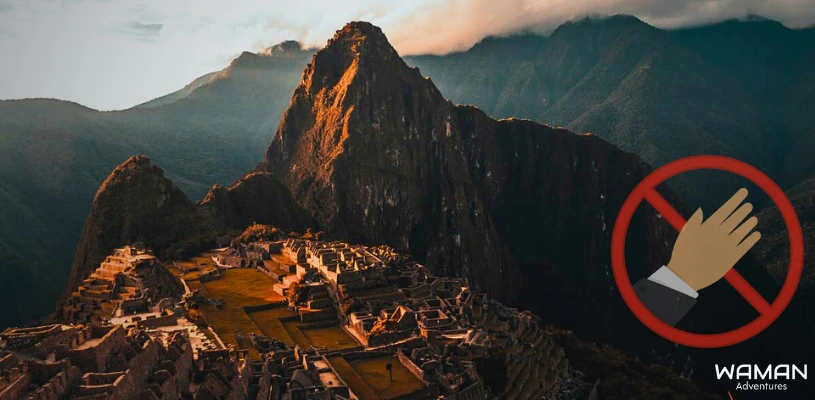
Forbidden items of Machu Picchu
Age Restrictions for Huayna Picchu:
Take note of this! Ascending this mountain is challenging, especially if you have an intense fear of heights or vertigo. Rules or instructions must be followed in the letter. Typically, travelers who ascend this mountain are at least 12 years old accompanied by their parents.
However, you may have noticed on the new Machu Picchu booking platform by JOINNUS that they offer a price for children and teenagers between 3 and 15 years old.
We recommend choosing the safest option, which ensures that each traveler is at least 12 years old. At this age, they follow instructions and have some understanding of their personal care, which would prevent setbacks when ascending this mountain.
Health Restrictions for Huayna Picchu:
While there are no specific restrictions for visiting Huayna Picchu, it’s essential to consider your well-being when exploring this destination. At Waman Adventures, we deeply care about the safety and comfort of our travelers, which is why we discourage visits from people with certain physical disabilities. The reason is clear: the path to the top is extremely steep and full of small steps, requiring considerable physical effort.
Additionally, those experiencing an intense fear of heights should think twice before ascending this mountain. This fear could trigger panic attacks, putting the traveler’s health and well-being at risk. In fact, reaching the top or descending could be very difficult and dangerous for them.
Before planning your trip, we recommend focusing on improving your physical condition to make this challenge more accessible. Although many people on social media may portray the experience as easy, it’s essential to consider the inherent difficulties of the ascent. By taking these recommendations seriously, you can enjoy your trip with greater safety and peace of mind.
Huayna Picchu without a Guide:
If you’re wondering if it’s possible to visit Huayna Picchu without the service of a guide, the answer is “yes.” However, if you ever need one, you can easily find them at the entrance to Machu Picchu and hire their services.
It’s important to establish a prior agreement with the guides to avoid misunderstandings during your possible guided tour. Waman Adventures also offers guide services with trained professionals who can help you overcome any challenges on the way and provide information about Machu Picchu and Huayna Picchu.
Don’t hesitate to contact our Waman Adventures agents. They will be delighted to provide you with all the assistance you need to make your trip an unforgettable experience.
Is Huayna Picchu dangerous to climb?
Don’t be alarmed and scared! Although this hike is challenging, it’s not dangerous, and you can succeed easily. Along the way, you’ll encounter very steep and daunting steps; however, this is part of the exciting adventure.
For your peace of mind, ropes and barriers have been installed to provide support throughout the route. Additionally, you’ll have the assistance of expert guides strategically located along the trail to offer you assistance and guidance at all times.
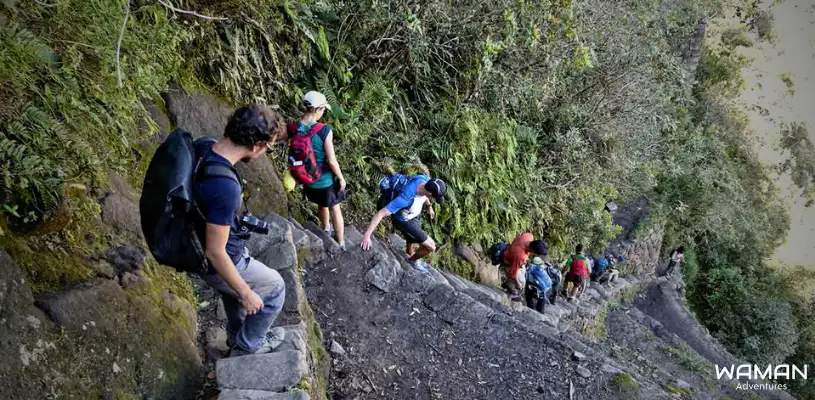
Come across with the Stairs of Death.
Are there rest stops along the way to Huayna Picchu Mountain?
It’s important to be aware that there are no established rest points on this route, although we may all feel fatigued at some point and need to take a break. So, where can I rest? You can do it at any point along the way, but it’s essential to move aside to avoid blocking the trail. This way, you can regain some of your energy and continue towards the summit of Huayna Picchu Mountain.
During these rest moments, we recommend drinking water and eating some snacks. However, remember to pack away food wrappers to keep our environment clean and preserve the natural beauty of the route.
What equipment or training do I need to climb Huayna Picchu Mountain?
Equipment
If you’ve reached this point, we’re sure you’re planning to visit Huayna Picchu Mountain, so here are some suggestions for items you should pack in a small backpack. Keep in mind that you should only bring what is necessary to avoid inconvenience or discomfort from the weight of your backpack besides the rules.
Here are some suggested items to take on your trip:
- Water Bottle: It’s important to stay hydrated, so we recommend bringing a canteen instead of disposable bottles.
- Appropriate Clothing: Wear comfortable and breathable clothing.
- Hiking Shoes or Sneakers: Very important when hiking.
- Medium or Small Backpack: Make sure your backpack is not excessively large, as it’s a one-day hike, and you’ll only need to carry the essentials.
- Sunscreen and Hat: The weather in Cusco is variable, and it’s important to protect yourself, especially on hot days.
- Snacks: You won’t find any shops, so bringing small snacks will help you avoid hunger.
- Camera: The scenic beauty during the hike will leave you amazed, so be sure to bring your camera to capture incredible images.
- Cash: Throughout the journey, before and after trekking, you may find places selling items of interest like toilets.
Preparation
Travelers, it’s essential to take care of your health and well-being, whether for this trip or any other you plan. On this particular route, you’ll need to exert yourself a bit as you ascend the mountain, so your physical condition will be crucial.
At Waman Adventures, we care about our travelers’ enjoyment while staying in Peru. Therefore, we’ll provide you with some simple and effective suggestions to consider.
- Aerobic training: Aerobic training is essential for strengthening the heart and improving breathing. You can choose between running, cycling, or swimming to reap these benefits.
- Resistance Training: A simple yet effective exercise to strengthen your muscles is to do squats. This leg-focused exercise will help improve your endurance and efficiency in your movements.
- Essential Stretches: After each workout session, it’s crucial to stretch your muscles a little bit. These cool-down stretches will help relax the muscles and improve your body’s flexibility.

Training before travelling to Peru
“A journey to Huayna Picchu will excite you: you’ll feel the adrenaline of the ascent, be amazed by the incredible Inca citadel, and feel peace within its ancient walls and silence.
Make it a reality! Follow the advice from this Waman Adventures blog, prepare yourself, and enjoy the magic at the summit. The journey is as important as the final reward. Enjoy every step that brings you closer to the top. Huayna Picchu will change you forever!
Are you ready to write your own story on these ancient paths? Tell us down below in the comments!”