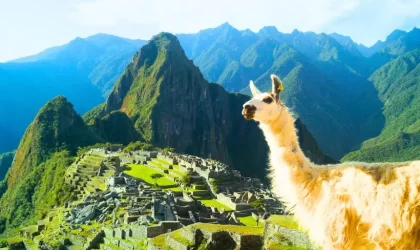
Chinchero Textile Dyeing where ancient colors come to life
Ultima actualización en 16 November, 2026 por Jhon Quispe
Last Updated on 16 November, 2026 by Jhon Quispe
What happens at a Chinchero weaving demonstration?
A Chinchero weaving demonstration introduces selected textile-making skills, which may include spinning yarn, explaining natural dyes, and using a backstrap loom. Hands-on practice is not automatically included. If you want to spin, weave, or prepare dyes yourself, choose a workshop that specifically includes those activities.
- Choose Between a Demonstration, Workshop, and Shopping Stop
- Confirm the Time, Cost, and Activities Before Booking
- How Natural Dyes Give Chinchero Textiles Their Colors
- From Raw Fiber to Finished Textile
- The Weavers and Communities Behind the Tradition
- What to Ask Before Buying a Textile
- Getting to Chinchero and Preparing for Your Visit
- Choose a Chinchero Textile Visit That Matches Your Interests
-
Frequently Asked Questions
- Will the explanation be in English?
- Do I need previous weaving experience?
- Can children join a textile workshop?
- Can I take home the piece I make?
- Does watching a demonstration mean I have to buy something?
- Can I book a private textile session?
- Can I bring natural dye ingredients back to the United States?
A Chinchero weaving demonstration can fit into a Sacred Valley itinerary, but the label alone tells you little about the visit. Time with the artisan, opportunities to practice, and time spent browsing can differ between venues. Understanding those differences helps you choose a stop that matches your interests.

| Visit format | What to expect | What to confirm |
| Weaving demonstration | Watch an artisan explain selected stages of textile production. | Demonstration time, language, any fee or contribution, and opportunities to ask questions. |
| Paid workshop | Scheduled instruction with time to practice the skills included in your booking. | Activities, instructor, materials, group size, total price, and whether you keep your work. |
| Shopping stop | Browse finished textiles; a demonstration may accompany the visit. | Whether instruction is included and who made the pieces offered for sale. |
Choose Between a Demonstration, Workshop, and Shopping Stop
The best format depends on what you want to do. Watching a skilled weaver can be worthwhile even without practical instruction, while learning to use a spindle or loom requires dedicated time.
A demonstration introduces the textile process
A demonstration suits travelers who want an introduction to Chinchero’s textile traditions during a broader day of sightseeing. An artisan may explain dye ingredients, show how yarn is spun, or demonstrate a backstrap loom.
Prepared samples help explain different stages without completing a textile while you watch. Confirm how much of the stop is reserved for the artisan’s explanation and how much is devoted to browsing.
A paid workshop gives you time to practice
A workshop is the better choice when learning a skill is a main reason for your visit. Spinning, weaving, and dyeing are different activities: a weaving lesson does not automatically include preparing natural dyes.
The booking should identify what you will do yourself, how much instruction you will receive, and whether the session welcomes beginners. Location matters, too. For example, CTTC’s published spinning and weaving workshops take place in Cusco’s historic center. Their schedules and prices do not describe a workshop in Chinchero.
A shopping stop focuses on finished textiles
A retail visit offers time to compare pieces and speak with sellers. A demonstration may be included, but seeing a technique at the venue does not establish how every item on its shelves was made.
You can ask whether a piece was made by the demonstrator, another local weaver, or a supplier elsewhere. This helps you understand what you are buying without relying only on the setting or sales description.
Pro tip: If learning a skill is your priority, request the workshop activities in writing. “Textile experience” alone does not tell you whether you will personally spin, weave, or dye.
Confirm the Time, Cost, and Activities Before Booking

There is no single price or duration that applies to every Chinchero textile visit. A brief demonstration within a tour and a separately booked lesson involve different arrangements.
Separate activity time from the rest of your itinerary
Request the time allocated specifically to the textile activity, separate from driving, meals, sightseeing, and shopping. For a practical workshop, find out how much of that time involves your own practice rather than watching an explanation.
Also confirm the center’s name and address. An itinerary that mentions Chinchero does not identify which weaving association, workshop, or store you will visit.
Check what the quoted price includes
A useful quote states the currency, whether the charge is per person or per group, and any minimum enrollment requirement. If the visit is part of a package, confirm what is already included before setting aside money for extras.
- Instruction: the activity, instructor, teaching language, and amount of guided practice.
- Materials: yarn, tools, dye ingredients, and whether you can take your work home.
- Transport: pickup location, return arrangements, and any separate transfer charge.
- Other expenses: meals, contributions, purchases, and tickets for unrelated sightseeing stops.
- Booking terms: date, starting time, group size, payment requirements, and cancellation conditions.
A useful question before booking: “Which tasks will I do myself, and how much time will I have to practice?”
How Natural Dyes Give Chinchero Textiles Their Colors
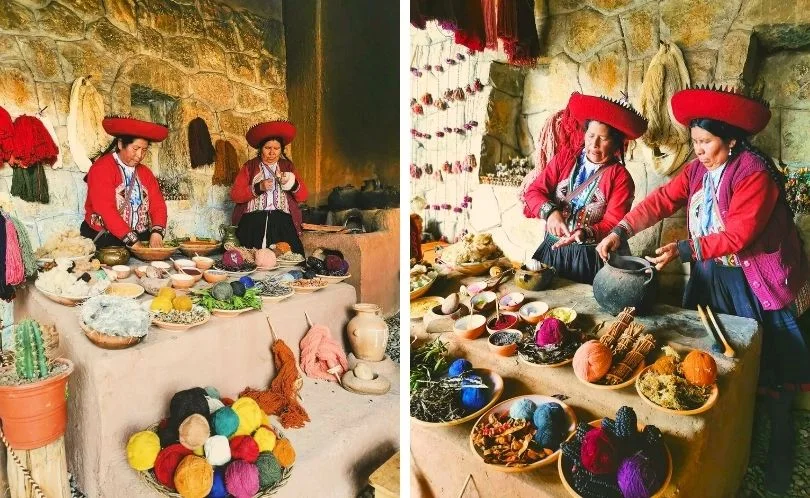
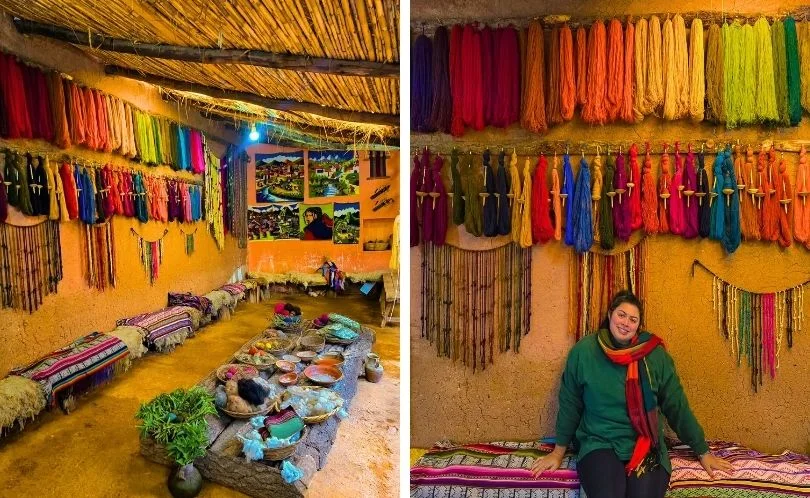
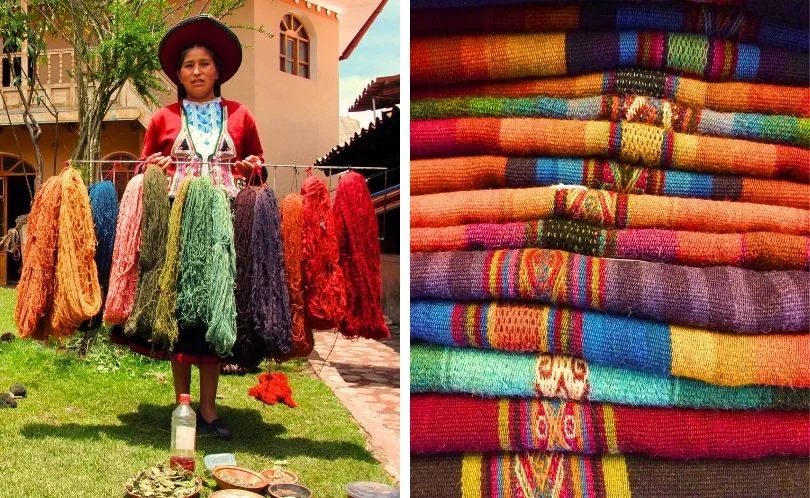
Natural dyeing combines knowledge of ingredients with careful preparation of the yarn. Plants and cochineal can produce different shades depending on the recipe and treatment used.
The examples below describe regional dye traditions. They are not a list of ingredients guaranteed to appear during every demonstration.
| Color | Source or explanation |
| Red and pink | Cochineal, an insect associated with prickly pear cacti, produces a range of red and pink shades. |
| Yellow | Q’olle flowers are one source of yellow in regional textile traditions. |
| Green | Ch’illca is used for green shades, with results depending on preparation. |
| Blue | Indigo produces blue. CTTC documents its recovery in Chinchero textiles. |
| Purple | Cochineal can also produce purple shades when the dye preparation changes. |
| Orange and coral | Chapi is one source of orange and coral shades in regional dyeing traditions. |
| Brown and black | Dark colors may come from dyeing or from the fiber’s own color. The explanation depends on the specific yarn. |
The textile organization Mosqoy explains natural dye sources used by Quechua weavers. During a demonstration, the artisan may show ingredients alongside yarn samples to explain how a particular shade was achieved.
Color alone cannot verify the dye source. Small variations do not prove that a textile was naturally dyed, and bright colors do not automatically indicate synthetic dyes.
From Raw Fiber to Finished Textile
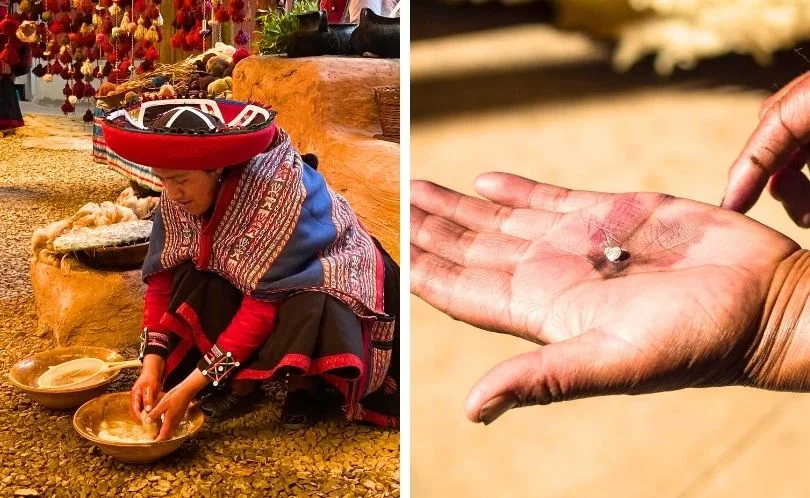
A finished textile involves several stages, each requiring its own time and skill. Demonstrations often use fiber, yarn, and partially completed pieces prepared in advance so visitors can follow the process.
| Stage | What the artisan may explain or demonstrate |
| 1. Clean and prepare the fiber | Raw fiber is cleaned before further preparation. The fiber and cleaning materials can differ between demonstrations. |
| 2. Spin the yarn | A pushka is a handheld drop spindle. The spinner twists prepared fiber into yarn; the tool is not a spinning wheel. |
| 3. Prepare the dye | The artisan selects ingredients and follows a recipe. Treatments that help color bind to fiber and ingredients that change its shade serve different purposes. |
| 4. Dye, rinse, and dry | Yarn is treated, rinsed, and dried according to the process. Prepared samples can show results that would take longer than the visit itself. |
| 5. Set up the loom | Lengthwise threads, called the warp, are arranged for weaving. A backstrap loom is one of the traditional tools used. |
| 6. Weave and finish | The weaver forms the cloth and its designs. Some pieces have woven tubular borders, including ñawi awapa, which are more than an embroidered finishing touch. |
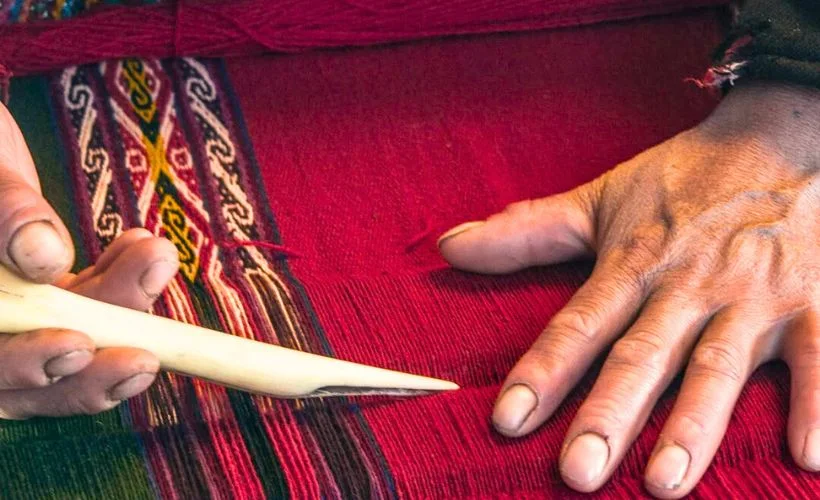
Did you know? A backstrap loom uses the weaver’s body to help control tension. Small adjustments during weaving help keep the cloth even.
The Weavers and Communities Behind the Tradition
Chinchero’s textile traditions continue through people who weave, teach younger generations, and make pieces for local use and sale. Their work includes both maintaining familiar techniques and recovering practices that became less common.
Conversations often become more meaningful when they focus on a particular textile: who made it, how the yarn was prepared, and why the weaver chose its designs. Motifs can have different meanings across communities and individual pieces, so the artisan’s explanation matters more than a universal interpretation of “Andean symbols.”
CTTC and the recovery of textile knowledge
The Centro de Textiles Tradicionales del Cusco, or CTTC, was established in 1996 by Andean weavers and their supporters. Its work combines textile preservation, education, and opportunities for weavers to share and sell their work.
CTTC describes a network of ten weaving communities in the Cusco region. Its account of Chinchero’s weaving community documents the recovery of indigo, cochineal red, and chilka green, as well as the distinctive ñawi awapa border, which is woven and sewn onto a textile at the same time.
These traditions reflect research, teaching, and renewed practice. They should not be presented as a process that has remained unchanged everywhere.
Know which association you are visiting
CTTC is a specific organization, and not every Chinchero textile center belongs to it. Its Chinchero association, Away Riqcharicheq, publishes visiting hours of 8:30 a.m. to 4:00 p.m. daily for demonstrations and its shop. Reconfirm arrangements before visiting, particularly if you want instruction beyond a demonstration.
Those hours do not apply to every center, and a Waman itinerary should not be assumed to visit that association unless the venue is confirmed.
What to Ask Before Buying a Textile
A demonstration helps you appreciate textile production, but choosing a piece also involves understanding its materials and maker. Information about one sample does not necessarily apply to every item in the shop.
Fiber content, dyes, and care
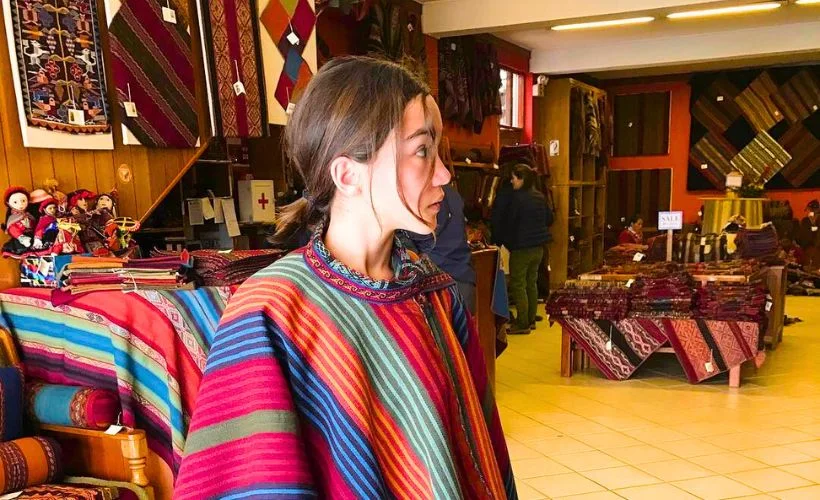
Ask whether the piece contains alpaca fiber, sheep wool, or a blend. Softness alone does not verify alpaca content. A fiber demonstration also does not establish the composition of every garment offered for sale.
For the item you choose, request fiber information, dye details where available, care instructions, and a receipt. Keep any label or maker information that accompanies the purchase.
The maker’s work and environmental claims
A backstrap loom operates without electricity, but the finished piece also involves fiber preparation, dyeing, and many hours of skilled work. Asking who made it and how the maker is paid gives you more useful information than a broad claim about supporting communities.
Likewise, “natural” does not automatically mean low environmental impact. Where the seller can explain the process, useful details include how dye ingredients are obtained, how water and fuel are used, and how leftover dye baths are handled.
Getting to Chinchero and Preparing for Your Visit
Chinchero lies approximately 19 miles (30 km) north of Cusco, on the route toward Urubamba. This is a general location reference, not a measured driving distance from your hotel. Confirm the exact venue, pickup arrangements, and return transport.
If you also want to explore the market, church, or archaeological area, allow separate time for those stops. Our Chinchero visitor guide covers the town beyond its textile experiences.
- Elevation: Chinchero is around 12,300 feet (3,750 m) above sea level. Consider its elevation when planning your arrival and the pace of your day.
- Comfort: bring drinking water, sun protection, and a warm layer. Check whether the demonstration area is sheltered.
- Access: confirm steps, walking surfaces, seating, and restroom access at the actual venue.
- Photography: ask permission before photographing people or recording instruction.
- Payments: confirm accepted payment methods and keep shopping expenses separate from the activity fee.
- Handling materials: let the artisan show you which tools, yarn, and textiles you can touch or use.
Choose a Chinchero Textile Visit That Matches Your Interests
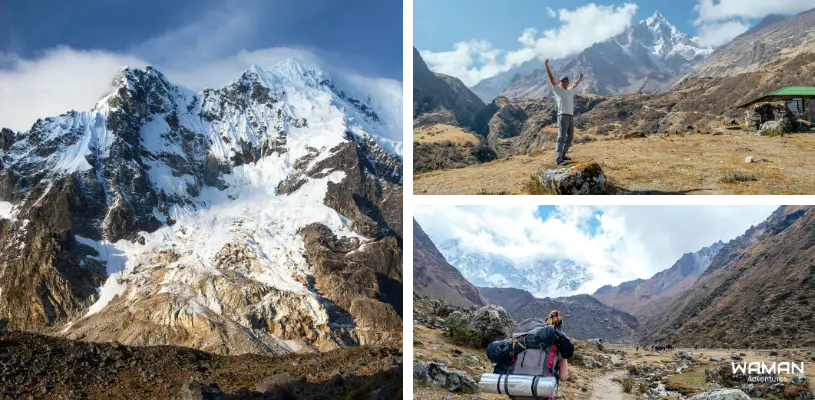
If textiles are a priority for your trip, tell Waman whether you want an introduction to the craft or dedicated time to practice. The 7-day Andean Experience itinerary includes a textile interpretation visit in Chinchero on day 5.
Before booking, confirm the venue, session length, and activities included for your departure.

Frequently Asked Questions
Will the explanation be in English?
Confirm whether the artisan explains the process in English or a guide interprets. For a practical workshop, check that interpretation covers the instruction itself, not only the introduction.
Do I need previous weaving experience?
No experience is needed to watch a demonstration. For hands-on instruction, choose a beginner session and confirm what you can reasonably learn during the time available.
Can children join a textile workshop?
Age requirements depend on the provider and activities. A demonstration and a session involving tools or heated dye baths require different supervision. Confirm suitable tasks and whether a parent must remain with the child.
Can I take home the piece I make?
That depends on the workshop terms. Your booking should clarify whether you keep a practice sample, a finished piece, or neither. If dyeing is involved, check whether the material will be dry and ready to pack.
Does watching a demonstration mean I have to buy something?
Confirm the arrangement before the visit. Ask whether there is an activity fee, an expected contribution, or any purchase condition, so you understand the cost independently of anything you choose to buy.
Can I book a private textile session?
Private instruction depends on the venue’s availability and booking terms. A private vehicle or sightseeing tour does not automatically include a private textile lesson. Confirm instructor time, group size, and the total charge.
Can I bring natural dye ingredients back to the United States?
Check USDA APHIS requirements for travelers before buying raw plants, seeds, insects, or untreated animal materials. Requirements depend on the material and its origin; a seller’s assurance does not establish that an item can enter the United States.

Share:



If you liked this article and the information you found, give us 5 stars!
Table of Contents
Related blogs

Best Things to Do in Puno: Discover the Magic of the Andean Highlands
15 min of reading
Cusco Rainy Season When It Rains and How to Plan
10 min of reading