Inca Empire Education Explained: Schools, Amautas, and Daily Learning
Ultima actualización en 28 January, 2026 por Amy Pérez
Last Updated on 28 January, 2026 by Amy Pérez
Quick answer
Inca Empire education was hands-on for everyday people and selective for the nobility. While families taught agricultural and daily skills within the community, the elite received advanced instruction in the Yachaywasi under the guidance of the amautas. This system, complemented by the training of chosen women in the Acllahuasi, helped ensure efficient state administration and upheld a moral code grounded in honesty, truth, and work.
Education in the Inca Empire stood out for its focus on practical knowledge designed to meet essential needs while strengthening the expansion of the Inca state, relying heavily on oral transmission and memory.

Inca elders instructing young boys in oral knowledge, discipline, and traditional values inside a stone-built educational space of the Inca Empire.
The Inca Empire was one of the most influential cultures in Andean history. Its territory, called Tahuantinsuyo, was organized into four major regions, or “four parts of the world.” Its origins are linked to early developments in Cusco (12th–14th centuries), but its best-known period of state expansion took shape in the 15th century and lasted into the 16th century.
Timeline of Inca education
- Origins (12th–14th centuries): Community-based training rooted in practice, memory, and family learning.
- Imperial period (15th–16th centuries): Specialized training for administration, warfare, religion, and government, with specific institutions created for the elite.
Education in the Inca Empire
| Aspect | The People (Hatunruna) | The Nobility (Elite) |
| Main goal | To learn skills for everyday life: farming, herding, construction, communal organization, and labor. | To train leaders to run the state: government, planning, justice, religion, strategy, and territorial control. |
| Type of education | Practical and community-based, built through direct experience and repetition. | Specialized and institutional, with advanced training for state roles. |
| Where learning happened | At home, in the community, in the fields, and in shared workspaces. | In institutions such as the Yachaywasi (Cusco) and training spaces connected to power. |
| Who taught | Family and community (intergenerational learning). | Amautas (wise teachers) and specialists (depending on the subject). |
| Most common subjects | Farming and herding work, production techniques, community life, and local rules; practical knowledge for living at altitude. | State history and memory, moral rules, religion, and government; technical knowledge such as record-keeping and administration (via the Quipu). |
| Ethics and values | Behavior and social order. Ama sua, ama llulla, ama qella served as a shared moral framework. | The same moral framework, reinforced as strict discipline for state service and leadership. |
| Evaluation or “tests” | Proven through performance in real tasks (daily work and responsibilities). | Rites and transition tests such as the Warachicuy (according to chronicles), linked to physical discipline and preparation. |
| Access | Broad, tied to family and community belonging. | Selective, limited to the nobility and those the state brought into positions of power. |
| Role of women’s education | Domestic and community learning (depending on social role and region). | Training in the Acllahuasi (“Houses of the Chosen”): weaving, chicha production, tradition, and state-linked functions. |
What did the Incas teach?
The Incas developed knowledge tied to science, philosophy, astronomy, geography, history, law, medicine, ethics, and literature, among other fields. Education in Inca culture emphasized strong cognitive and memory skills, which were vital for preserving key events in the empire’s history and supporting the organization of the state without a written alphabet.
In Andean tradition, educational practices (both for everyday people and for the nobility) were linked to ethical principles summed up in three widely known rules: Ama sua, Ama llulla, and Ama qella. In modern usage, these phrases are often presented as the moral code associated with the Inca world.
Education in the Inca Empire
Education in the Inca Empire was class-based: access to formal, specialized instruction was a privilege. In Tahuantinsuyo, elite education focused on training those who would plan, organize, lead, and carry out the strategic goals of the Inca state.
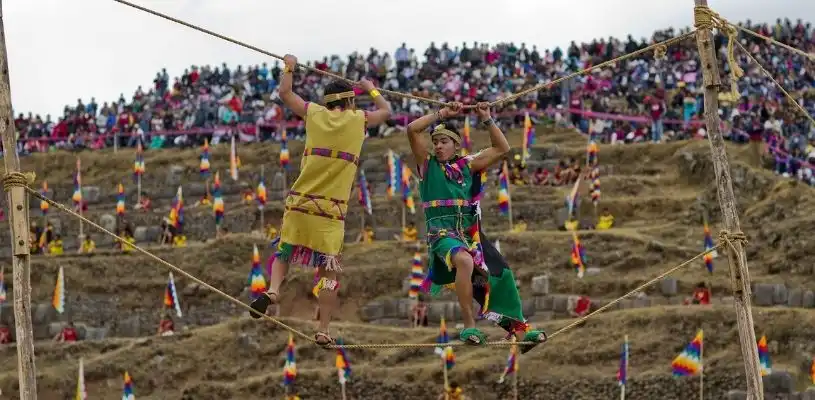
Young Inca men performing a physical endurance test during the Warachicuy ceremony, demonstrating strength, balance, and readiness for adulthood in the Andes
According to the chronicler Fray Martín de Murúa, the education of novice youth (yachakuq runa, in Quechua) began around age 13. Most Inca youth finished their formal education around age 19.
Before being recognized as adults, they went through demanding trials known as the Warachicuy. Here, they proved their physical skills and warrior abilities, building discipline, agility, focus, and endurance through forced marches. As a symbol of maturity and manhood, young men received a wara (a traditional breechcloth).
What was education like for the people?
Inca education unfolded in two main forms. One was a practical education, centered on hands-on teaching and learning for daily life: farming, mining, herding, warfare, and construction. This education was for the people, or hatunruna, and was passed down by families and the community.
Common educational processes aimed to sustain essential needs—such as food, clothing, housing, and security—while creating an environment that supported religiosity and collective work.
What were the Inca education centers?
Yachaywasi
Institutional education, according to chronicles such as those of Inca Garcilaso de la Vega, describes the “houses of knowledge,” or Yachaywasi, as training spaces strictly for the elite.
In the Yachaywasi, privileged classes received instruction led by the amautas or yachachij (teachers).
It is believed the main Yachaywasi was located in Cusco, and that Cusco’s nobility, along with elites connected to the state in different regions, had exclusive access to this type of education.
Who were the Amautas?
They were considered the most educated men in the empire: wise figures with broad knowledge, responsible for training future rulers. They taught moral and religious rules, history, and the forms of government essential to the Inca Empire.
Acllahuasi
Another institution where knowledge was taught was the Acllahuasi or “Houses of the Chosen.” Historians note that these institutions were intended for selected women, sometimes including Inca princesses. These women, chosen by the state for their skills or beauty, lived in seclusion from childhood through adolescence under strict supervision to receive advanced cultural preparation.
The main Acllahuasi of the Inca Empire was in Cusco, located where the Convent of Santa Catalina stands today. It is believed the education taught in the Cusco Acllahuasi differed in prestige from what was taught in provincial Acllahuasis.

Educators of the Inca Empire
Mamaconas
The Mamaconas, or teachers of the acllas, led instruction in the Acllahuasi. They trained young women in skills such as spinning, weaving, and making chicha (corn beer), along with Inca traditions and religious duties, though their curriculum differed from the political training of the male elite.
Haravicus
Another group of educators was the Haravicus. Responsible for teaching art, they were poets whose compositions captured themes of love, life, and the wisdom of nature. Historians note that they were known for exceptional cognitive and memorization abilities, which were useful for preserving the memory of important historical events.
Willac Umu
Another crucial educator was the Inca high priest, called the Willac Umu. He carried out religious rituals and passed down knowledge related to sacred duties, the festival calendar, fasting, sacrifices, and ceremonies with spiritual significance.
Quipucamayoc
The Quipucamayoc were the experts who made and interpreted the Quipu. They possessed deep skills in its use and a powerful memory, serving as state administrators and accountants. The Quipucamayoc were held in high regard because their mission was critical: the smooth functioning of the empire’s administrative tasks depended on their accuracy.
The Quipu and Inca education
Making and interpreting the Quipu required training and specialization to transmit statistical data and history. These colored cords and knots served as a sophisticated medium for communication and record-keeping in the absence of writing.
The work of the Quipucamayoc was complemented by the Chasquis, runners who carried information from one place to another across every corner of Tahuantinsuyo. To do this, they underwent rigorous physical and communication training to ensure messages were delivered accurately over long distances.
The Mitimaes
In Inca society, another group stood out for cultural expansion: the Mitimaes. These were groups resettled by the state to spread Inca culture among conquered peoples, consolidating Inca presence through lifestyle and the Quechua language in controlled territories.
What is the difference between Inca education and today?
Inca education was not formal in the way we understand modern schooling. It operated through a different mode of transmission, rooted in practice, oral tradition, and intergenerational learning, emphasizing the empire’s language, Runasimi (Quechua), and its cultural norms.
Education was one of the foundational pillars that supported the organization of the state and the continuity of its cultural practices.
Frequently asked questions…
What was education like in the Inca Empire, and who could study?
What was the Yachaywasi, and what was taught there?
What was the Acllahuasi, and what role did it play in women’s education?
What do “Ama sua, Ama llulla, Ama qella” mean in Inca education?
What was the Quipu for, and who used it?
Share:


If you liked this article and the information you found, give us 5 stars!
Table of Contents
Related blogs

Inca Trail packing list: simple guide to enjoy every step
9 min of reading
Machu Picchu Sunrise: Between Ancient Stones and Living Mist
9 min of reading