Best Time to Do the Inca Jungle Trek by Month and Season
Ultima actualización en 16 November, 2026 por Jhon Quispe
Last Updated on 16 November, 2026 by Jhon Quispe
What is the best time to do the Inca Jungle Trek?
The best time for the Inca Jungle Trek is generally May through September, when lower rainfall provides more predictable conditions for biking, hiking and other outdoor activities. April and October are useful transition months, while November through March brings more rain and a greater chance of activity changes.
- When is the best time to do the Inca Jungle?
- Inca Jungle weather and seasons
- Best months for the Inca Jungle Trek
- Best season for Inca Jungle adventure activities
- Machu Picchu weather and visibility
- Crowds and booking considerations by season
- Choosing the best month for your travel priorities
- What to pack for dry and rainy conditions
- Plan your Inca Jungle adventure for the right season
-
Frequently asked questions about When is the best time to do the Inca Jungle?
- What is the best month for the Inca Jungle Trek?
- Is May a good month for the Inca Jungle?
- Can you do the Inca Jungle during the rainy season?
- Is the Inca Jungle open in February?
- What is the best season for biking on the Inca Jungle?
- Does the rainy season affect rafting?
- Is April or October better for the Inca Jungle?
The Inca Jungle crosses mountain roads, hiking trails and warmer valleys, so weather affects each activity differently. A dry day can favor cycling and walking, while recent rainfall may influence river conditions and access even when the forecast looks better.

Weather conditions influence the different outdoor activities along the Inca Jungle.
When is the best time to do the Inca Jungle?
The Inca Jungle can offer different experiences throughout the year, but the period from May through September is generally the most favorable for travelers who prioritize lower rainfall and more predictable outdoor conditions.
| Travel period | Typical weather | Best suited for |
| May–September | Generally drier, with more stable conditions | Hiking, mountain biking and travelers prioritizing predictable weather |
| April | Transition from wetter to drier conditions | Green landscapes with improving weather |
| October | Transition toward increasing rainfall | Travelers seeking a balance between weather and demand |
| November–March | More frequent rain and variable conditions | Travelers comfortable with flexible plans and greener landscapes |
| January–February | Among the wetter months | Travelers who accept a greater possibility of activity changes |
Important note:
These periods describe typical seasonal patterns, not guaranteed daily weather. A dry-season trip can still experience rain, while wet-season dates may include clear periods. Current road, river and trail conditions always take priority over the calendar.
Inca Jungle weather and seasons
The Inca Jungle route crosses different elevations between the Andes and lower, warmer valleys in the Cusco region. As a result, temperatures, humidity and rainfall can change considerably between activities and locations.
Travelers should not expect the same conditions throughout the entire itinerary. A cool morning in a higher mountain section can be followed by much warmer conditions at lower elevations.
For planning purposes, the year is most useful when divided into a drier period, a wetter period and transition months between them.
Dry season from May to September
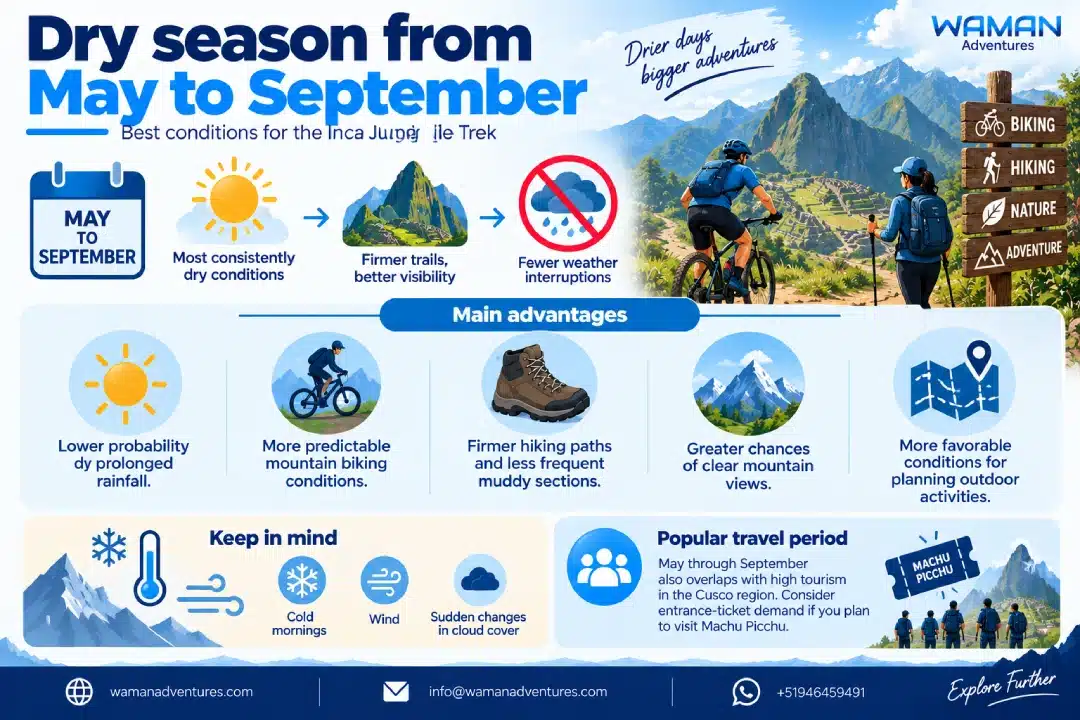
The infographic summarizes the main advantages of traveling during the dry season
Rainy season from November to March
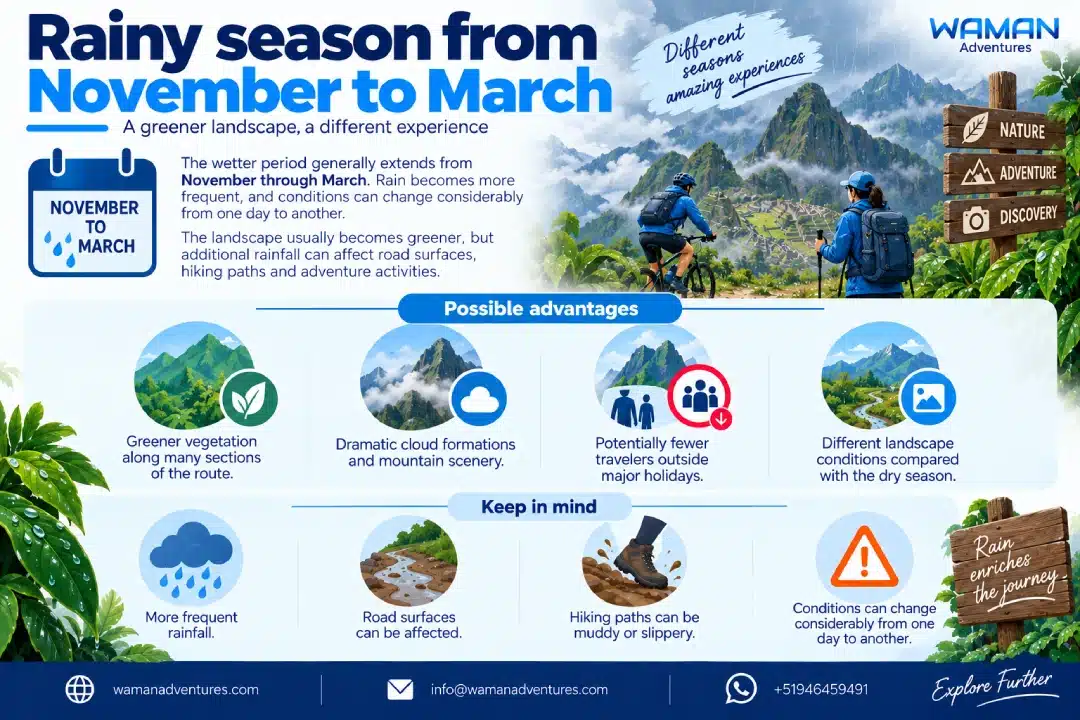
The infographic summarizes how travel conditions change during the rainy season
The rainy season does not automatically mean that every Inca Jungle departure is canceled. However, activity availability depends on actual local conditions and the operator’s safety assessment.

Rainy months bring greener scenery and more variable visibility.
Warning:
Heavy rainfall can affect mountain roads, river conditions and outdoor activities. A scheduled departure does not guarantee that every activity will operate unchanged. Follow the decisions of qualified local operators when conditions require adjustments or suspension.
Transition months in April and October
April usually marks the transition toward drier conditions. Rainfall often begins decreasing, while vegetation can remain green after the wetter months.
October generally marks the opposite transition. Many days can still offer favorable weather, but rainfall becomes more likely as the region approaches the wetter season.
Both months can appeal to travelers who prefer not to travel during the busiest part of the dry season.
Nevertheless, transition months can be variable. Travelers choosing April or October should review the forecast and local activity conditions close to their departure.
Best months for the Inca Jungle Trek
Each month offers a different balance of rainfall, scenery and travel demand. Rather than choosing a date based only on the name of the season, it helps to consider the conditions that matter most for your planned activities.
April and May
April: Rainfall generally begins decreasing after the core wet season. Landscapes can remain particularly green, although rain and muddy sections are still possible.
April is a reasonable option for travelers who want to experience the transition toward more stable weather and are comfortable with some variability.
May: May is one of the strongest months for the Inca Jungle. Rainfall usually decreases further, hiking and cycling conditions often improve, and vegetation can remain green from the previous rainy season.
For travelers seeking a balance between scenery and relatively predictable weather, May is a particularly attractive choice.
June, July and August
June: June generally brings dry conditions and many clear days across the Cusco region. Mountain biking and hiking can benefit from more predictable conditions, although mornings and higher sections may feel cold.
June also overlaps with major celebrations and stronger tourism demand around Cusco, so advance planning can be useful.
July: July is within the core dry period and generally offers favorable conditions for outdoor activities.
It is also a popular travel month, especially for visitors combining Cusco and Machu Picchu. Travelers considering July should pay particular attention to accommodation and Machu Picchu entrance arrangements.
August: August usually retains many of the dry-season advantages. Hiking paths and roads may be more predictable than during wetter months, although daytime sun exposure can be strong.
Cool mornings and evenings can still occur, particularly in higher areas.
September and October
September: September is another attractive month for the Inca Jungle. It often retains relatively dry conditions while gradually approaching a more variable part of the year.
Travelers who prefer to avoid the middle of the peak dry-season period may find September a useful alternative.
October: October can still provide favorable travel conditions, but the probability of rain generally increases.
It may suit travelers with some flexibility who want a balance between outdoor conditions and seasonal demand.
November and December
November: November usually marks a more noticeable increase in rainfall. Hiking paths may become wetter, and operators may need to adjust activities when local conditions change.
Travelers visiting in November should place greater emphasis on waterproof clothing and flexible planning.
December: December falls within the wetter period. Rainfall and cloud cover become more frequent, while vegetation generally becomes greener.
Although it is not part of the core dry season, holiday travel can still increase demand for accommodation and Machu Picchu-related services.
January and February
January: January is commonly one of the wetter months in the Cusco region. Rain can affect hiking surfaces, visibility and outdoor activity schedules.
It is better suited to travelers who are comfortable with a higher probability of rain and understand that activities may need modification.
February: February is typically among the wettest months. Heavy rainfall can affect mountain roads, trails and river conditions, making the operation of some adventure activities less predictable.
The Inca Jungle is not the same route as the regulated Classic Inca Trail. The Classic Inca Trail has an annual February closure, but that rule should not automatically be applied to every Inca Jungle itinerary.
Whether a particular Inca Jungle service operates in February depends on its route, prevailing conditions, authorized access and the operator’s current decisions.
For the separate seasonal planning and closure rules of the traditional archaeological trek, consult the best time to hike the Classic Inca Trail.
March
March generally remains part of the wetter period, although conditions may gradually begin transitioning toward drier months.
Green landscapes and humid conditions can remain prominent. Rain may still affect trail surfaces, mountain roads and activities, particularly after periods of heavy precipitation.
March is therefore more suitable for travelers who are flexible about weather and understand that activity arrangements may change.
Best season for Inca Jungle adventure activities
The best time for the Inca Jungle also depends on which activities are most important to you. Weather affects cycling, rafting, hiking and ziplining differently, so the overall seasonal recommendation cannot replace a local safety assessment.
Biking conditions
Mountain biking is one of the distinctive activities included in many Inca Jungle itineraries. Road surfaces, visibility and rainfall influence the experience.
May through September generally offers more predictable conditions because prolonged rain is less common.
During wetter months, rain can affect traction and visibility, while changing road conditions may require route or activity adjustments.
Even in the dry season, the operator must assess current conditions before the biking activity begins.

Drier conditions generally favor more predictable mountain biking experiences.
Rafting conditions
Rafting requires particular attention because river conditions can change quickly after rainfall.
Water levels, current strength and recent precipitation matter more than the name of the travel month alone.
Drier periods can provide more predictable planning conditions, but they do not guarantee that rafting will always operate.
During wetter periods, heavy rain can increase river flow and require operators to modify, postpone or suspend activities.
The final decision must depend on current river conditions and the assessment of the qualified activity provider.

Hiking conditions
For hiking, May through September generally provides more predictable conditions because prolonged rainfall is less frequent.
During wetter months, dirt trails may become muddy and some stone or steep sections can require more careful movement.
Visibility and comfort can also change with rain, cloud and elevation.
The physical challenge of the route is separate from the seasonal conditions. For fitness requirements and terrain difficulty, see the Inca Jungle difficulty guide.
Ziplining conditions
Ziplining is another outdoor activity that may be offered as part of an Inca Jungle itinerary, depending on the operator and service.
Drier weather generally makes scheduling more predictable, but current wind, rain and local operating conditions remain essential considerations.
Activities may be postponed or modified when the provider determines that conditions are unsuitable.
Travelers should also confirm whether ziplining is included in the selected package or offered as an optional activity.
Machu Picchu weather and visibility
Machu Picchu is the main destination for many travelers completing an Inca Jungle itinerary. Weather conditions at the archaeological site can therefore influence the month they choose.
During the drier months, there is generally a greater probability of clearer panoramic views. However, cloud and rain can occur throughout the year.
During the wetter months, the archaeological landscape can appear surrounded by mist and dense vegetation. Visibility may change quickly, sometimes within the same visit.
Weather is only one part of the decision. Different Machu Picchu entrance routes provide access to different archaeological sectors and viewpoints, so choosing the correct ticket is also important.
Travelers interested in a particular panoramic photograph should not assume that every entrance ticket provides the same view.
Crowds and booking considerations by season
The most favorable weather months often overlap with stronger tourism demand. This matters because an Inca Jungle itinerary usually involves several services, including transportation, activities, accommodation and admission to Machu Picchu.
| Travel period | Planning consideration |
| May–September | Generally favorable weather and stronger visitor demand; earlier planning is useful |
| April and October | Transition conditions may offer a balance between weather and demand |
| November–March | Weather uncertainty increases, although some dates may offer more flexibility |
| Major holidays | Demand can increase regardless of the usual seasonal pattern |
Higher travel demand does not mean every departure will sell out, just as quieter months do not guarantee availability.
Travelers should confirm Machu Picchu admission and the specific activities included in their itinerary before finalizing their travel dates.
Choosing the best month for your travel priorities
The most suitable travel month depends on how you balance weather, scenery, outdoor activities and visitor demand.
| Your main priority | Months to consider | Why |
| Lower rainfall and predictable outdoor conditions | May–September | The core drier period generally offers more stable conditions |
| Green scenery with improving weather | April–May | Vegetation may remain green after the rainy season |
| Generally favorable conditions outside mid-year peak months | May or September | Both can balance dry-season advantages with different demand patterns |
| Transition weather with flexible travel plans | April or October | Conditions can be favorable but variable |
| Green landscapes and tolerance for rain | November–March | Higher rainfall supports greener vegetation but increases uncertainty |
| Biking and hiking as primary activities | May–September | Lower rainfall usually improves planning predictability |
| Rafting as a main interest | Confirm current river conditions | Safe operations depend on river levels and provider assessment |
For most travelers prioritizing weather stability, May through September remains the strongest overall choice. Travelers seeking greener landscapes or different crowd patterns may find April and October particularly appealing.
What to pack for dry and rainy conditions
The basic Inca Jungle packing requirements remain similar throughout the year, but seasonal conditions change which items deserve the most attention.
During the drier months
When traveling between May and September, useful items generally include:
- Sun protection and sunglasses.
- Lightweight, breathable clothing.
- Comfortable footwear with reliable grip.
- A warm layer for cooler mornings or elevated sections.
- A waterproof jacket as a precaution.
- Water and other personal essentials required for outdoor activities.
During the wetter months
For travel between November and March, weather protection becomes especially important.
- Reliable waterproof jacket.
- Quick-drying clothing.
- Footwear with dependable traction.
- Waterproof protection for documents and electronics.
- Dry replacement socks.
- Appropriate layers for changes in elevation and temperature.
Transition months may require a combination of both approaches.
For the complete itinerary, accommodation, optional activities and general preparation, consult the complete Inca Jungle Trek guide.
Plan your Inca Jungle adventure for the right season
The best travel dates depend on how you balance weather, outdoor activities and your Machu Picchu plans. If you are deciding between dry-season and transition-month departures, talk to a travel specialist about choosing a suitable date for your Inca Jungle experience.

Frequently asked questions about When is the best time to do the Inca Jungle?
What is the best month for the Inca Jungle Trek?
Is May a good month for the Inca Jungle?
Can you do the Inca Jungle during the rainy season?
Is the Inca Jungle open in February?
What is the best season for biking on the Inca Jungle?
Does the rainy season affect rafting?
Is April or October better for the Inca Jungle?
Share:



Related tours you might be interested in
Enjoy unique experiences in Cusco and Machu Picchu with the peace of mind that comes from working with a local travel agency
6-Day Tour Cusco, Sacred Valley, Machu Picchu and Rainbow Mountain
EXPERIENCE THE MAJESTY OF THE INCAS: SACRED VALLEY, MACHU PICCHU & RAINBOW MOUNTAIN IN ONE TRIP If...
6 Day Andean Adventures Tour│With Flights from Chile
ENJOY THE BEST OF CUSCO CITY – MUST VISIT DESTINATIONS ARE WAITING FOR YOU! Want to explore Cusco...
6 Days Andean Adventure │ With Flights from Mexico
EXPERIENCE THE BEST OF CUSCO – THE MOST BREATHTAKING DESTINATIONS AWAIT Do you want to explore...
5 Day Cusco, Sacred Valley and Machu Picchu
DISCOVER THE MAJESTY OF MACHU PICCHU AND THE BEAUTY OF THE SACRED VALLEY IN ONE EPIC JOURNEY! The...
If you liked this article and the information you found, give us 5 stars!
Table of Contents
Related blogs
Is the Inca Trail worth it? Cost, Effort and Who Should Do It
13 min of reading
Lima International Airport Guide to the New Jorge Chávez Terminal
11 min of reading
Lares Trek Difficulty Altitude and How to Prepare
9 min of reading