Uyuni Salt Flats Travel Tips for Your First Visit
Ultima actualización en 16 November, 2026 por Jhon Quispe
Last Updated on 16 November, 2026 by Jhon Quispe
- Essential Tips for Uyuni Salt at a glance
- Choosing and booking a reliable Uyuni 4×4 tour
- Money, connectivity and essential documents
- What to pack for the Uyuni Salt Flats
- Protecting cameras, phones and batteries
- Altitude and physical comfort in Uyuni
- Accommodation and services on multi-day tours
- Practical advice for wet and dry salt-flat conditions
- Photography tips for the Uyuni Salt Flats
- Respecting local communities and the salt flat
- Common mistakes first-time visitors should avoid
- Final Uyuni travel checklist
- Prepare your Uyuni adventure with confidence
-
Frequently asked questions about Tips for Uyuni Salt
- Do I need cash when visiting Uyuni Salt Flats?
- Is there mobile signal on the salt flats?
- What should I confirm before booking a Uyuni 4×4 tour?
- What should I carry in my day bag?
- Do Uyuni accommodations have heating and hot water?
- Can heavy rain change an Uyuni tour itinerary?
- What should I do if my phone or camera gets exposed to salt?
- How much luggage can I bring on a shared 4×4 tour?
The biggest surprises in Uyuni often happen outside the photo stops. Long drives, limited charging opportunities, basic bathrooms and cold high-altitude nights can affect your comfort more than expected. Preparing for these details makes it easier to enjoy the salt flat without depending on services that may not be available.

Essential Tips for Uyuni Salt at a glance
Traveling through the Salar de Uyuni requires a different kind of preparation from an ordinary city excursion.
Once you leave Uyuni town and enter remote areas of the Bolivian Altiplano, access to shops, ATMs, bathrooms, electricity and mobile coverage can become limited.
These are the most important practical preparations before departure.
| What to prepare | Practical advice |
| 4×4 tour | Confirm itinerary, group size, accommodation, meals, luggage allowance and emergency procedures |
| Cash | Carry Bolivianos in small denominations and divide them between secure locations |
| Mobile coverage | Expect limited or unavailable signal in remote areas and save documents offline |
| Electronics | Protect phones and cameras from salt, water, dust and cold |
| Clothing | Pack layers for strong sunlight, cold temperatures and changing weather |
| Accommodation | Verify heating, hot water, electricity, bathrooms and room arrangements |
| Altitude | Account for Uyuni’s elevation and higher Altiplano sections |
| Weather | Prepare for possible changes in access, stops and route conditions |
| Hygiene | Bring toilet paper, hand sanitizer and essential personal supplies |
| Day bag | Keep water, medication, sunscreen, documents and warm layers accessible |
Choosing and booking a reliable Uyuni 4×4 tour
Not every excursion advertised as an Uyuni tour offers the same itinerary or level of service.
Before booking, identify the type of route, transportation arrangements, accommodation and activities included.
These details become particularly important on multi-day journeys through the remote Bolivian Altiplano.
One-day vs multi-day Uyuni tours
A one-day excursion generally focuses on the Salar de Uyuni and selected nearby attractions.
A multi-day expedition travels farther into the Altiplano and may include high-altitude lagoons, geysers, desert landscapes and overnight accommodation in remote settlements.
Some itineraries also connect Bolivia with northern Chile.
The main options include:
- One-day salt-flat tour: Focuses mainly on the Salar de Uyuni and selected nearby stops.
- Multi-day Altiplano expedition: Includes additional landscapes, longer driving sections and overnight stays.
- Cross-border itinerary: Starts or finishes in Bolivia or Chile, depending on the service.
- Private 4×4 tour: Usually provides more flexibility in group arrangements and selected services.
- Shared 4×4 tour: Travels with other passengers and follows the operator’s established program.
The duration and route influence how much time travelers spend inside the vehicle, what facilities are available and which equipment is necessary.
For detailed itineraries and attractions, consult the complete Uyuni travel guide.
Questions to ask before booking
An advertised price does not explain everything about a 4×4 excursion.
Before making a payment, confirm:
- How many passengers travel in each vehicle?
- Is the tour private or shared?
- Is the driver also responsible for guiding the group?
- What language is used during the tour?
- Which meals and drinks are included?
- Are entrance fees included or paid separately?
- Which accommodation category is provided?
- Are rooms private or shared?
- Are bathrooms private or shared?
- Will heating and hot water be available?
- Can travelers charge phones or cameras overnight?
- What is the luggage allowance per passenger?
- Which emergency and first-aid arrangements are available?
- How are changes caused by weather or road conditions handled?
- Where exactly does the tour finish?
These questions help compare services based on actual inclusions rather than headline prices.
Pro tip:
Save the itinerary, accommodation details and confirmed inclusions on your phone before departure. Mobile coverage can be unavailable in remote sections of the Altiplano.
Vehicle safety and itinerary changes
A multi-day Uyuni expedition can involve long drives across remote terrain, unpaved roads and areas with limited access to assistance.
Before booking, ask about:
- The driver’s experience operating on remote Altiplano routes.
- Vehicle condition and maintenance procedures.
- First-aid equipment.
- Emergency communication arrangements.
- How breakdowns or unexpected delays are handled.
- Procedures when rain or water levels affect access.
- Passenger capacity and luggage restrictions.
Do not assume that every vehicle carries identical emergency equipment or communication systems.
Confirm what the operator actually provides and how assistance would be arranged if necessary.
Weather, road conditions and local access restrictions can also change the planned itinerary.
A responsible operator may need to modify:
- The route across the salt flat.
- Access to specific islands or sectors.
- The order of attractions.
- Driving times.
- Overnight arrangements in exceptional circumstances.
A route change does not automatically indicate poor service. In some situations, using an alternative route is the safer decision.
Money, connectivity and essential documents
Cash, reliable access to important information and basic communication planning make travel through remote Uyuni considerably easier.
Cash and card payments
Although electronic payments may be available in Uyuni town, travelers should not assume cards will work throughout the salt flat or remote Altiplano.
Carry some cash in Bolivian Bolivianos (BOB), preferably in smaller denominations.
Possible expenses include:
- Entrance fees not included in the package.
- Small food or drink purchases.
- Bathroom fees.
- Souvenirs and handicrafts.
- Tips when appropriate.
- Purchases from local communities.
Avoid relying exclusively on large banknotes.
Dividing your cash between secure locations also reduces the risk of losing access to all your money if one item is misplaced.

Mobile signal and offline information
Mobile coverage becomes less reliable when traveling away from Uyuni town and larger settlements.
Depending on the area, travelers may have limited access to:
- Mobile data.
- Wi-Fi.
- Fast hotel internet.
- Cloud storage.
- Online payments.
- Messaging and phone calls.
Before departure, save offline copies of:
- Tour confirmation.
- Accommodation information.
- Transport reservations.
- Important contact numbers.
- Insurance information.
- Maps when useful.
- Your next accommodation address.
Tell someone you trust when you expect to reconnect after a multi-day excursion.
Travel documents and emergency contacts
Keep your passport, required travel documents and essential reservation details accessible.
For cross-border excursions, confirm the entry requirements and necessary documents before departure.
Different nationalities may have different immigration conditions, so do not assume another traveler’s requirements also apply to you.
Carry emergency contact details somewhere accessible even without mobile data.
It is also useful to keep your tour operator’s contact information and insurance details available offline.
What to pack for the Uyuni Salt Flats
The best packing approach is to carry equipment suitable for changing conditions without filling the limited space available in a shared 4×4.
Your main luggage may be stored away during the journey, so frequently used items should remain accessible.
Day bag essentials
A small day bag should contain the items you may need between stops.
Recommended essentials include:
- Water.
- Sunscreen.
- Sunglasses.
- Warm layer.
- Light rain protection.
- Personal medication.
- Passport or necessary identification.
- Cash.
- Phone or camera.
- Snacks.
- Toilet paper or tissues.
- Lip balm.
This avoids repeatedly opening larger bags during short sightseeing stops.
Clothing for cold and changing weather
Uyuni can feel warm in direct sunlight and much colder once the sun disappears.
A flexible layering system is more practical than relying only on one heavy jacket.
Consider packing:
- Comfortable base layers.
- Warm fleece or insulating mid layer.
- Wind-resistant outer layer.
- Waterproof jacket when needed.
- Warm hat or beanie.
- Gloves for colder conditions.
- Comfortable closed footwear.
- Extra socks.
Clothing requirements depend on the season and whether your itinerary includes higher Altiplano areas.
For rainfall patterns, mirror conditions and seasonal differences, consult the best time to visit Uyuni Salt Flat guide.
Sun protection and personal hygiene
The reflective salt surface and high altitude make sun protection especially important, even when the air feels cold.
Keep these items accessible:
- UV-protection sunglasses.
- High-protection sunscreen.
- Sun hat.
- Lip balm.
- Water.
Reapply sunscreen when appropriate during extended outdoor activities.
Basic hygiene supplies are also useful because remote facilities may not provide the same amenities as city hotels.
A practical kit can include:
- Toilet paper.
- Wet wipes.
- Hand sanitizer.
- Toothbrush and toothpaste.
- Personal hygiene products.
- Small towel if needed.
- Waste bags.
- Personal medication.
Do not assume every bathroom or accommodation provides towels, toilet paper or other supplies.
Protecting cameras, phones and batteries
The Salar de Uyuni can expose electronic devices to salt, dust, water and cold.
Taking simple precautions helps reduce the risk of damage and prevents equipment problems during remote excursions.
Protect devices from salt, water and dust
Dry salt and fine dust can enter bags, camera compartments and charging ports.
When parts of the salt flat are covered by water, splashes and wet surfaces create additional risks.
Useful protection includes:
- Resealable storage bags.
- Water-resistant pouches.
- Protective camera bags.
- Lens cloths.
- Phone protection.
- Rain covers when required.
Avoid placing cameras, phones or other delicate equipment directly on wet or salty ground.
After the excursion, remove salt and dust carefully according to the equipment manufacturer’s cleaning recommendations.
Prepare for limited charging opportunities
Battery performance can decline in cold conditions, particularly during early mornings, evenings and high-altitude overnight stops.
Bring:
- A charged power bank.
- Charging cables.
- A spare camera battery when photography is important.
- Offline copies of essential travel information.
Keep spare batteries protected from extreme cold when practical.
Do not assume every remote accommodation has enough electrical outlets or continuous electricity for all passengers.
Altitude and physical comfort in Uyuni
Uyuni town sits at approximately 11,995 ft (3,656 m) above sea level.
Some multi-day Altiplano itineraries travel through even higher terrain.
Travelers arriving from much lower elevations should consider how altitude may affect them before beginning a demanding excursion.
Potential altitude-related symptoms can include headache, nausea, dizziness and unusual fatigue.
If symptoms become concerning or worsen, inform your guide and seek appropriate medical attention.
Fitness does not eliminate altitude-related risks.
For detailed acclimatization advice, symptoms and elevation comparisons, consult the Uyuni Salt Flats altitude guide.
Warning:
Uyuni is already at considerable altitude, and remote itineraries may reach higher elevations. Travelers with severe or worsening symptoms should seek medical help rather than continuing strenuous activities without assessment.
Accommodation and services on multi-day tours
Multi-day Uyuni excursions may include overnight stays in basic hostels, simple guesthouses, salt hotels or other accommodations, depending on the itinerary.
Terms such as “accommodation included” do not necessarily indicate the same room standards or facilities across different tour categories.
Heating, bathrooms and electricity
Before booking, ask what the accommodation actually provides.
| What to confirm | Why it matters |
| Private or shared room | Determines privacy and comfort |
| Private or shared bathroom | Facilities vary between accommodation categories |
| Hot water | May not be available continuously |
| Heating | Important during cold high-altitude nights |
| Additional blankets | May improve comfort when temperatures drop |
| Electricity | Affects phone and camera charging |
| Wi-Fi | Can be slow, limited or unavailable |
| Towels | Not every basic accommodation supplies them |
Travelers looking specifically for accommodation built with salt should consult the Uyuni salt hotel guide.
Food, snacks and long 4×4 journeys
A multi-day Altiplano excursion can involve several hours inside a 4×4 between attractions.
Roads may be rough, facilities may be limited and shops can be widely separated.
Prepare for:
- Long driving sections.
- Uneven or unpaved roads.
- Limited bathroom stops.
- Basic overnight facilities.
- Significant temperature changes.
- Early departures.
- Long distances between attractions.
Meals are often arranged according to the selected service, but travelers should verify what is included.
Carrying a few personal snacks is useful during longer driving periods.
Choose foods that:
- Do not require refrigeration.
- Are easy to carry and eat.
- Do not melt easily.
- You already know you tolerate well.
If you have dietary restrictions or allergies, communicate them to the operator before departure.
Keep water, medication and snacks somewhere accessible rather than storing everything in your main luggage.
Practical advice for wet and dry salt-flat conditions
Conditions on the Salar de Uyuni change throughout the year.
Dry salt surfaces and flooded sections create different travel experiences and require different precautions.
The famous mirror effect depends on water covering suitable parts of the salt flat.
Its appearance is not guaranteed on a particular day, even during months associated with wetter conditions.
When the salt flat is wet:
- Use footwear appropriate for water.
- Protect electronics against splashes.
- Carry dry socks when useful.
- Expect some access routes to change.
- Do not assume every dry-season stop will be accessible.
During drier periods, fine salt and dust may create greater problems for bags, lenses and exposed equipment.
The actual route may depend on water depth, road conditions and operational restrictions.
Allow time for arrival and onward travel
Your transportation to Uyuni influences when it is practical to begin the tour.
An overnight bus, domestic flight or overland arrival from Chile can involve different schedules and possible delays.
Avoid planning a tight connection between your expected arrival and the departure of a multi-day 4×4 excursion.
The same applies to onward transportation after the tour.
Confirm the exact endpoint and allow a realistic margin before the next major reservation.
For detailed transportation options, see the how to get to Uyuni Salt Flat guide.
Photography tips for the Uyuni Salt Flats
Uyuni is famous for unusual perspectives, reflections and wide-open landscapes.
Travelers do not necessarily need professional photography equipment to enjoy the experience.
A few practical habits can make photography easier:
- Keep camera and phone lenses clean.
- Carry a power bank or spare battery.
- Protect devices against salt and water.
- Use simple objects for forced-perspective photographs.
- Leave enough storage space for photos and videos.
- Avoid placing delicate equipment directly on the salt surface.
The reflective surface can create striking photographs when suitable water conditions are present.
Dry salt patterns also provide distinctive visual opportunities.
If photography is a major reason for your journey, allow flexibility for changing light and weather.
For more specialized photographic experiences, consult the guides to sunset at Uyuni and Uyuni at night.
Respecting local communities and the salt flat
Responsible travel includes protecting the natural landscape and respecting the communities that live and work in southwestern Bolivia.
Practical actions include:
- Carry out wrappers and other waste.
- Follow the guide’s instructions in sensitive areas.
- Avoid disturbing wildlife.
- Ask permission before photographing people at close range.
- Respect local customs and private spaces.
- Support local producers when purchasing goods or services.
- Avoid damaging natural salt formations for photographs.
These measures help reduce unnecessary impacts on the environment and local communities.
Common mistakes first-time visitors should avoid
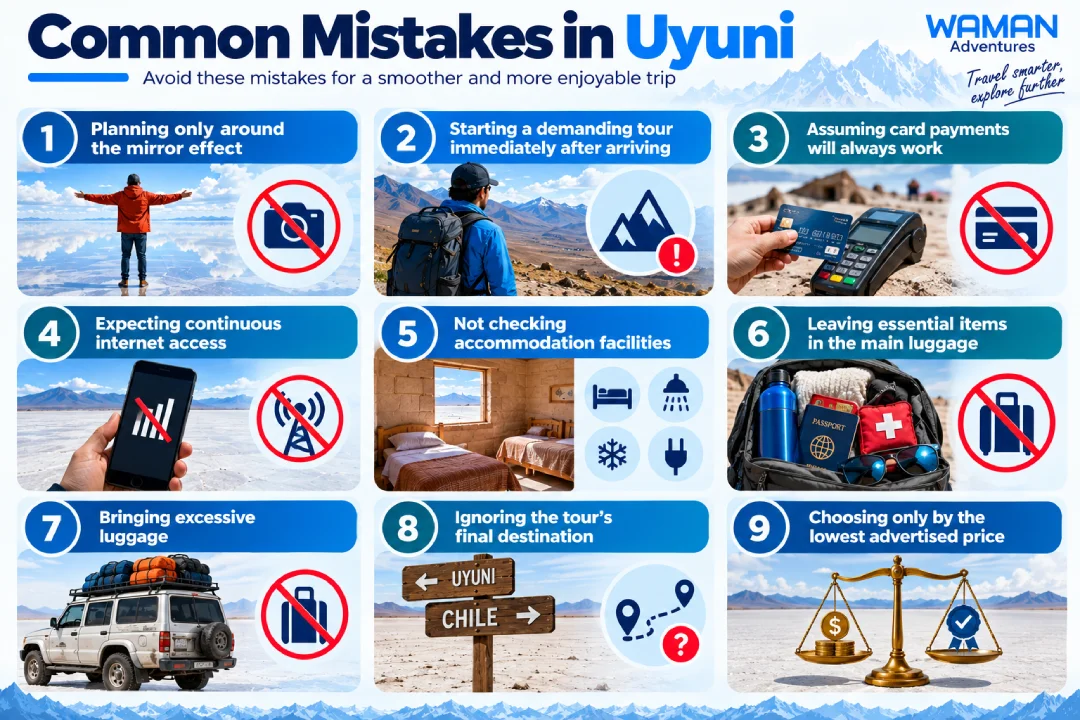
The infographic highlights nine mistakes that can complicate a Uyuni trip, including relying on mirror-season conditions, underestimating altitude, depending only on cards or choosing tours solely by price.
Final Uyuni travel checklist
Use this checklist before leaving for the salt flat or beginning a multi-day Altiplano itinerary.
| Check before departure | Done? |
| Tour itinerary saved offline | □ |
| Exact tour endpoint confirmed | □ |
| Accommodation type and facilities confirmed | □ |
| Cash divided between secure locations | □ |
| Phone and power bank fully charged | □ |
| Electronics protected from salt and water | □ |
| Warm and waterproof layers accessible | □ |
| Sunscreen, sunglasses and lip balm packed | □ |
| Personal medication accessible | □ |
| Toilet paper and hygiene basics packed | □ |
| Offline bookings and emergency contacts saved | □ |
| Next transport connection has enough time margin | □ |
| Vehicle and emergency arrangements confirmed | □ |
| Luggage allowance checked | □ |
Prepare your Uyuni adventure with confidence
A comfortable Uyuni trip starts with clear expectations about the 4×4 route, accommodation, luggage and services available outside town. Before confirming your departure, review the practical arrangements and talk to a travel specialist about choosing an itinerary that matches your travel plans.

Frequently asked questions about Tips for Uyuni Salt
Do I need cash when visiting Uyuni Salt Flats?
Is there mobile signal on the salt flats?
What should I confirm before booking a Uyuni 4×4 tour?
What should I carry in my day bag?
Do Uyuni accommodations have heating and hot water?
Can heavy rain change an Uyuni tour itinerary?
What should I do if my phone or camera gets exposed to salt?

Share:



If you liked this article and the information you found, give us 5 stars!
Table of Contents
Related blogs

Is a Machu Picchu Tour Guide Worth It? 2026 Guide
15 min of reading
Best Things to Do in Puno: Discover the Magic of the Andean Highlands
15 min of reading
Cusco Handicrafts Where to Buy Art Textiles and Jewelry
13 min of reading