Museums in Cusco: explore Inka relics, vibrant galleries, and hidden corners of history
Ultima actualización en 31 October, 2025 por Waman Adventures
Last Updated on 31 October, 2025 by Waman Adventures
- Inka Museum in Cusco: The Heart of Inca History
- Pre Columbian Art Museum (MAP): The Best Museum in Cusco for Art Lovers
- Qoricancha Site Museum: Fusion Between Inca Past and Spanish Colonization
- Regional Historical Museum: Learn About Inca Garcilaso de la Vega’s Life
- Lesser Known Museums in Cusco That Surprise Travelers
- Tips for Touring Museums in Cusco Practically
- Why Museums in Cusco Enrich Your Travel Experience
-
Frequently Asked Questions About Museums in Cusco
- What’s the best museums in Cusco if I only have time for one?
- How much does entry to museums in Cusco cost?
- Where are Cusco’s main museums?
- Is a guide needed to visit museums?
- How much time is needed to visit museums in Cusco?
- Which is the most educational museum for children or families?
- Are museums open every day?
- Can I take photos inside Cusco museums?
Museums in Cusco hold the essence of ancient civilizations, showcasing original artifacts, sacred art, and stories of cultural resilience. In this guide, you’ll find the best visiting hours, updated ticket prices, museums near the Historic Center, and practical tips to make the most of your visit. When exploring this magical city, don’t miss the chance to experience its history preserved within these walls.
Inka Museum in Cusco: The Heart of Inca History

Location
You’ll find it on Cuesta del Almirante street 103, in Cusco’s historic center.
You can also locate it easily, as it’s just one block from the city’s Plaza de Armas.
This museum operates inside Admiral’s House, a colonial mansion built in the 17th century on ancient Inca walls.
Museum History
The Inka Museum was founded in 1920 and is currently administered by National University of San Antonio Abad of Cusco (UNSAAC).
It was created with the purpose of preserving, researching, and disseminating Andean civilizations’ cultural legacy.
Here you can immerse yourself in centuries of history through authentic pieces revealing how pre Hispanic cultures lived, thought, and organized themselves.
Museum’s Featured Collections
- Pre Inca cultures: you can appreciate ceramics, utensils, and ritual objects from cultures like Chavín, Paracas, Nazca, Mochica, Wari, among many others.
- Inca culture: includes a valuable collection of finely crafted textiles, reflecting this civilization’s technical and symbolic mastery.
- Goldsmithing and lithic art: the museum exhibits metallurgy pieces and stone sculptures, many representing Andean deities, sacred animals, and elements of Inca worldview.
- Colonial and republican era: you’ll find colonial furniture, coins, documents, and religious objects showing Cusco’s transition from pre Hispanic times to viceregal and republican eras.
Tickets
| Payment is only cash at museum ticket office. | |
| Foreign Adults | $5 USD (S/ 20.00) |
| Foreign Students | $1.30 USD (S/ 5.00) |
| Peruvians | $1.30 USD (S/ 5.00) |
| Peruvian Students | $0.80 USD (S/ 3.00) |
| Children | Free |
Opening Hours
| During the Week | |
| Monday to Friday | 8:00 a.m. to 6:00 p.m. |
| Saturdays and Holidays | 9:00 a.m. to 4:00 p.m. |
| Sundays | Closed to public. |
Pre Columbian Art Museum (MAP): The Best Museum in Cusco for Art Lovers

Location
You’ll find it at Plazoleta de las Nazarenas 231, just three blocks from Cusco’s Plaza de Armas.
The museum operates in Cabrera House, a historic building that was originally a Yachaywasi (Inca house of knowledge), later converted into colonial convent and subsequently into viceregal mansion.
Museum History
The Pre Columbian Art Museum opened its doors in June 2003 as a joint project between BBVA Peru Foundation and Larco Museum in Lima.
Its approach combines pieces’ aesthetic care, deep cultural interpretation, and a pre Columbian art collection representing Peru’s ancestral cultures’ artistic legacy.
Museum’s Featured Collections
- Rooms by materials: explore pieces made in various materials like ceremonial ceramics, jewelry, wooden objects, textiles, and metals. Each reveals fundamental aspects of Andean worldview.
- Introductory audiovisual room: when starting your visit, you can watch a multimedia presentation that clearly and visually explains the Andean universe vision, its symbols, gods, and social structures.
- Handicraft shop: upon finishing your tour, you can visit a shop offering textile products, ceramics, and other objects made by local artisans, ideal for taking an authentic Cusco souvenir.
Tickets
| Costs | |
| Foreigners | $5.30 USD (S/ 20) |
| Peruvians | $2.60 USD (S/ 10) |
| Foreign Students | $2.60 USD (S/ 10) |
| Peruvian Students | $1.30 USD (S/ 5) |
Opening Hours
Open every day, including Sundays and holidays, 8:00 a.m. to 10:00 p.m., with last entry at 9:30 p.m.

Qoricancha Site Museum: Fusion Between Inca Past and Spanish Colonization

Location
It’s located at Santo Domingo Square, a few blocks from Cusco’s Plaza de Armas.
The museum is located in Santo Domingo Convent’s basement, which was built on remains of the ancient Inca Sun temple, known as Qorikancha or Coricancha.
Museum History
Qorikancha was the Inca Empire’s most sacred temple, dedicated to god Inti (the Sun). Its walls were covered with gold sheets, and inside it housed offerings, idols, and altars of precious metals.
During colonial times, Spaniards built Santo Domingo Convent on its foundations, generating an imposing combination of Inca architecture with baroque colonial structures, a tangible symbol of two worlds’ fusion (and conflict).
Museum’s Featured Collections
Five thematic rooms allowing you to learn about pre Inca, Inca, and colonial history through carefully preserved pieces.
- Ceramics and lithic fragments: you can observe original pieces used in ritual and everyday contexts by various Andean cultures.
- Textiles and musical instruments: explore development of ancestral techniques that still persist today in Cusco communities.
- Qorikancha models: visual reconstructions showing how the temple was in its splendor era before Spaniards’ arrival.
- Panels explaining the temple’s religious symbolism and sacred space’s transformation process during colonization.
Tickets
| Cost | |
| Foreign and National Adults | $4 USD (S/ 15) |
| University Students | $2.10 USD (S/ 8) |
| Children Under 10 | Free Entry |
Opening Hours
Monday to Saturday: 8:00 a.m. to 5:00 p.m.
Sundays: 2:00 p.m. to 4:00 p.m.
Did you know…?
The Museum is located in an old mansion that was chronicler Inca Garcilaso de la Vega’s residence.
Regional Historical Museum: Learn About Inca Garcilaso de la Vega’s Life

Location
You’ll find it on Heladeros street s/n, inside Inca Garcilaso de la Vega House, located at Plaza Regocijo’s south corner, in Cusco’s historic center. This colonial mansion was built on ancient Inca terraces of old Cusipata neighborhood.
Museum History
The museum was officially founded on March 1, 1967, although its origin dates back to 1946, when it functioned as Cusco’s Viceregal Museum. Since then, it has evolved to become the current Regional Historical Museum, under Cusco’s Decentralized Directorate of Culture management.
This space has special value, as it was the house where chronicler Inca Garcilaso de la Vega lived in his childhood, the first Peruvian mestizo to publish a literary work in Europe and one of the great interpreters of the Andean colonial world.
Museum’s Featured Collections
During your tour, you’ll find twelve exhibition rooms, organized on two levels narrating both Peru’s pre Hispanic history and colonial and republican era. Here are some of the most representative:
First level:
Archaeology and paleontology: original pieces from pre Inca cultures and fossil findings evidencing millenary life in the Andean region.
Second level:
- Room 7: “From Santiago Matamoros to Illapa”
A contrast between Christian warrior saint figure and Andean thunder god, showing religious fusion and resistance. - Room 8: “Ancient and New Arts”
Shows Cusco’s artistic transition from pre Columbian to viceroyalty. - Room 9: “Gastronomy and Pisco”
A look at Peruvian culinary history and pisco’s cultural importance as national drink. - Room 10: “Evangelization”
Religious representations and catechetical tools used in Andean world’s spiritual colonization. - Room 11: “Túpac Amaru”
Space dedicated to indigenous leader who led the 18th century’s greatest anticolonial rebellion. - Room 12: “Cusco Estate”
Recreates daily life of a typical Cusco house during colonial times, with furniture and domestic use objects.
Tickets
To access this museum book a Cusco tourist ticket (Circuit II)
| Cost | |
| Foreign Adults | $34 USD (S/ 130) |
| Foreign Students | $18 USD (S/ 70) |
Opening Hours
Open every day: Monday to Sunday 08:00 a.m. to 05:00 p.m. (December 24 and 31 until 1:00 p.m.).
Expert tip:
Buy the Tourist Ticket if you plan to visit several museums and archaeological sites. It will save you money and facilitates entry.
Lesser Known Museums in Cusco That Surprise Travelers
You’ll find it near Cusco’s Plaza de Armas, right in the heart of the historic center. The museum stands on ancient Inca walls, including the famous Twelve-Angle Stone, visible along Hatun Rumiyoq Street. Inside, you can admire masterpieces from the Cusco School, along with 17th and 18th-century sculptures and sacred art that reflect the city’s deep cultural legacy.
Casa Concha (Machu Picchu Museum)
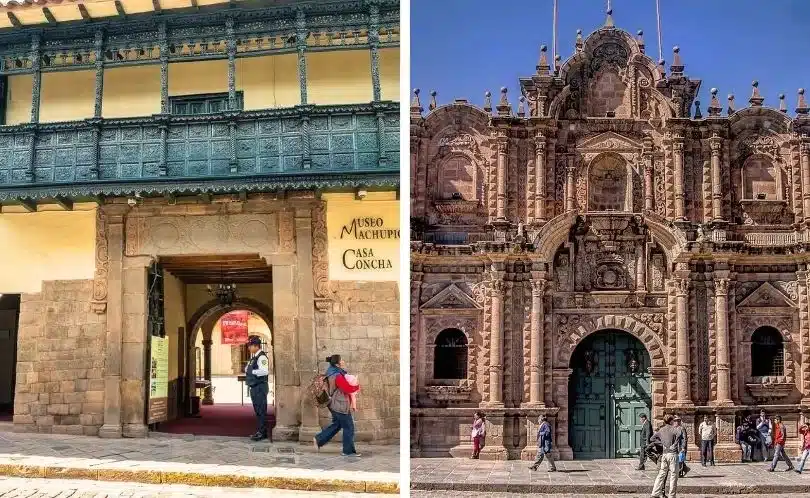
Just half a block from Plaza de Armas, this museum is located in a colonial mansion built on what was Túpac Inca Yupanqui’s palace. Here you’ll see original archaeological pieces recovered from Machu Picchu, which were at Yale University for almost a century. You’ll find ceramics, tools, bone fragments, and other objects enriching your understanding of Inca world.
Natural History Museum
You’ll locate it at UNSAAC’s University Hall, right across from Plaza de Armas. This museum offers you geological, paleontological, biological, and ethnobotanical exhibitions. Among its most striking pieces you’ll see a mastodon tusk, glyptodont remains, prehistoric American horse fossils, as well as fossil flora samples connecting you with Andes’ natural history.
Tips for Touring Museums in Cusco Practically
Take advantage of historic center’s proximity:
Most museums in Cusco are concentrated in the historic center, especially around Plaza de Armas and San Blas neighborhood. This allows you to visit them walking, without needing to use transportation.
Buy Cusco Tourist Ticket:
This ticket groups entry to several important museums and archaeological sites. Partial Tourist Ticket (Circuit II) includes Regional Historical Museum, Popular Art Museum, Qorikancha Site Museum, and Qosqo Native Art Center. It’s an excellent option if you want to save and optimize your tour.
Visit early to avoid crowds:
Many museums open from 8:00 or 9:00 a.m., so it’s advisable to start your visit in the day’s first hours to avoid crowds and enjoy the tour with greater tranquility.
Bring cash:
Some museums, like Inka Museum, aren’t included in BTC and only accept cash payments. Therefore, it’s convenient to carry coins and bills in soles to avoid inconveniences.
Prepare what’s necessary for a comfortable visit:
- Wear comfortable clothing and light jacket.
- Bring a bottle.
- Have a camera handy
Check each museum’s rules before entering:
Each museum has its own rules. Some prohibit taking photographs, entry with large backpacks, or access to certain rooms. Review indications at entrance or consult with staff to avoid setbacks.
Why Museums in Cusco Enrich Your Travel Experience
- They connect you with Inca and colonial past before visiting ruins.
- They’re ideal refuge in case of rain or to acclimatize in your first days.
- Interior rooms detail objects complementing your visit to archaeological sites and markets.
Touring museums in Cusco is traveling beyond the obvious: it’s understanding what Incas lived, what colonial times imposed, and what today keeps a people’s identity alive. Dare to know this great city. At Waman Adventures we help you organize your visit, book your tickets, and enjoy worry free. Let us accompany you on this unique cultural journey.
Frequently Asked Questions About Museums in Cusco
What’s the best museums in Cusco if I only have time for one?
If you want to deeply understand Andean culture, its worldview, customs, and social and spiritual evolution, Inka Museum is the best option.
On the other hand, if you prefer a more aesthetic experience, emphasizing visual curation and ancient art’s staging, choose Pre Columbian Art Museum (MAP).
How much does entry to museums in Cusco cost?
Inka Museum: $5 USD (S/ 20) for foreign visitors. Only accepts cash payment and is purchased on site.
Pre Columbian Art Museum (MAP): $5.30 USD (S/ 20) for foreigners, $2.60 USD (S/ 10) for Peruvians, and free entry for Cusco residents in mornings (with accrediting document).
Where are Cusco’s main museums?
Most are concentrated in Cusco’s Historic Center, within 1,640 feet (500 meters) radius around Plaza de Armas, making them easily accessible on foot.
- Inka Museum is on Cuesta del Almirante.
- MAP is at Plaza de las Nazarenas.
- Regional Historical Museum is located at Inca Garcilaso House.
- Religious Art Museum is inside Archbishop’s Palace
All are surrounded by colonial streets, churches, and craft shops.
Is a guide needed to visit museums?
It’s not mandatory, but having a guide can greatly enrich your experience:
- At MAP, you can rent a multilingual audio guide offering detailed context about each room.
- There are also informative panels in Spanish and English helping you understand what you see.
How much time is needed to visit museums in Cusco?
For large museums like MAP or Inka Museum, we recommend dedicating between 1.5 and 2 hours to tour them calmly and enjoy each room.
Which is the most educational museum for children or families?
Natural History Museum is perfect for family visits, as it presents stuffed animals, skeletons, minerals, and Andean fossils in visual and playful form.
Inka Museum can also interest older children, with its mummies, tools, and models helping imagine ancient Peruvians’ life.
Are museums open every day?
- Inka Museum: Open Monday to Saturday, 8:00 a.m. to 6:00 p.m.. Closes Sundays and major holidays.
- Pre Columbian Art Museum (MAP): Opens every day, including Sundays and holidays, 8:00 a.m. to 10:00 p.m., allowing you to visit even at night.
- Qoricancha Site Museum: Open Monday to Saturday 8:00 a.m. to 5:30 p.m.
- Regional Historical Museum: Open Monday to Sunday, 8:00 a.m. to 5:00 p.m.
Can I take photos inside Cusco museums?
It depends on the museum. In some it’s allowed to take photos without flash, while in others it’s completely forbidden. For example, at MAP you can photograph some rooms, but not specific pieces. It’s always advisable to ask at entrance or read informative signs before taking out your camera.

Share:



Related tours you might be interested in
Enjoy unique experiences in Cusco and Machu Picchu with the peace of mind that comes from working with a local travel agency

Tour to Chinchero, Maras & Moray – Private Service
Discover with us this beautiful, charming and historic places, where we will visit the enigmatic...

2-Day Trip to Machu Picchu from Cusco with Machu Picchu Mountain
LIVE A UNIQUE EXPERIENCE EXPLORING THE BREATHTAKING LANDSCAPES ON A 2-DAY JOURNEY TO MACHU PICCHU...
6-Day Tour Cusco, Sacred Valley, Machu Picchu and Rainbow Mountain
EXPERIENCE THE MAJESTY OF THE INCAS: SACRED VALLEY, MACHU PICCHU & RAINBOW MOUNTAIN IN ONE TRIP If...

6 Day Andean Adventures Tour│With Flights from Chile
ENJOY THE BEST OF CUSCO CITY – MUST VISIT DESTINATIONS ARE WAITING FOR YOU! Want to explore Cusco...
If you liked this article and the information you found, give us 5 stars!
Table of Contents
Related blogs
Discovering The Amazing History of Machu Picchu
13 min of reading