Get all the details and tips you need to conquer Machu Picchu Mountain
Ultima actualización en 1 April, 2026 por Waman Adventures
Last Updated on 1 April, 2026 by Waman Adventures
- What is Machu Picchu Mountain?
- Location
- History
- General Information
- Logistics and planning
- Hiking experience
-
Comparisons and recommendations
- Is Huayna Picchu better than Machu Picchu Mountain?
- Is it worth climbing Machu Picchu Mountain?
- Is a guide needed to climb Machu Picchu Mountain?
- Are guides available for the hike to Machu Picchu Mountain?
- Are there prohibited items when climbing Machu Picchu Mountain?
- Are there age or health restrictions to climbing Machu Picchu mountain?
- Is it dangerous to hike up Machu Picchu Mountain?
- Are there rest stops along the way to Machu Picchu Mountain?
- What equipment or training do I need to climb Machu Picchu Mountain?
Do you feel the call of adventure? So Machu Picchu Mountain awaits you. This mountain is a magical destination that will transport you to another era and perspective of the Machu Picchu archaeological site. Let yourself be enclosed by the mystical energy of its cobblestone paths, and the secrets of its architecture, and contemplate the majesty of the surrounding landscape.
This Waman Adventures’ blog will guide you on an unforgettable journey to Machu Picchu. We’ll tell you everything you need to know to plan your trip: how to get there, what permits you need, what to pack in your backpack, and much more.
Additionally, we’ll share our experiences and tips with you so you can make the most of your visit. We’ll recommend the best routes, the most photogenic spots, and exciting activities.
What is Machu Picchu Mountain?
Machu Picchu Mountain, one of the mountains surrounding the citadel of the same name, stands out as one of the highest in the area, surpassing the famous Huayna Picchu Mountain.
Machu Picchu has a specific meaning in Quechua: “Old Mountain.” Nowadays, it’s the second most famous mountain after Huayna Picchu, so it gets high demand from visitors, and it’s essential to book in advance as spots are limited.
Waman Adventures can help you plan your trip according to your preferences and ensure you enjoy your experience to the fullest in this magical ancient place.

A great view from the summit.
Location
Machu Picchu Mountain stands south of the Inca citadel of Machu Picchu, in the province of Urubamba, in the Cusco region. If you’re wondering how far it is from Cusco, it’s approximately 80 km or 49 miles.
This mountain is an imposing presence that can be seen from afar, although it may sometimes go unnoticed because classic photographs often focus northward, with Huayna Picchu in the background. However, if you stop and turn 180 degrees, you’ll come out facing the majesty of this towering mountain rising behind you.
History
The history of Machu Picchu Mountain is connected to the history of the Inca city of Machu Picchu. There are theories that the families that dwelled in these territories before the Incas and the subsequent construction of this Inca city revered this mountain around 1450 AD. Later, the Inca Pachacútec ordered the construction of temples, paths, terraces, and enclosures of the Inca city to be his personal residence, control post, and religious site. Furthermore, the construction of this Inca jewel passed to the next Inca, Túpac Yupanqui. In Machu Picchu Mountain, almost at the summit, there is evidence of enclosures and terraces that were left incomplete.
Machu Picchu Mountain also served as a lookout post against the threat of invasion. Due to its high altitude, religious ceremonies to the Inca’s gods like the sun, moon, and stars would have been carried out there. Ceremonies to pay homage to the earth’s ‘Pachamama’ would also have taken place on the same mountain. When the Spaniards arrived in Cusco in 1535, the mountain and the Inca city were gradually abandoned. Most of its structures were covered by dense vegetation as time passed.
General Information
Machu Picchu Mountain Climate
Machu Picchu Mountain during the Rainy Season
Machu Picchu Mountain in November
- Weather: November marks the beginning of the rainy season in the region. Days are more humid, and rainfall is more frequent. Daytime temperatures can still be warm, around 20 °C / 68 °F to 25 °C / 77 °F, but nights are cooler.
- Pros: Fewer tourists compared to the high season.
- Cons: Frequent rains that can hinder outdoor activities and visibility.
Machu Picchu Mountain in December
- Weather: December continues with the rainy season, although rainfall may decrease towards the end of the month. Daytime temperatures can still be warm, around 20 °C / 68 °F to 25 °C / 77 °F, with cool nights.
- Pros: Fewer tourists than in the high season, especially towards the end of the month.
- Cons: Possible rains that can affect outdoor activities and visibility.
Machu Picchu Mountain in January
- Weather: The rainy season begins in January. Daytime temperatures typically range between 20 °C / 68 °F and 25 °C / 77 °F. Nights can be cool, with temperatures around 10 °C / 50 °F.
- Pros: Fewer tourists compared to the high season.
- Cons: Frequent rains can make hiking conditions difficult and less predictable.
Machu Picchu Mountain in February
- Weather: Similar to January, February is generally rainy in the region. Daytime temperatures can be similar, around 20 °C / 68 °F to 25 °C / 77 °F, but nights may be slightly cooler.
- Pros: Vegetation is at its peak due to recent rains, making the landscape lush and green.
- Cons: Continuous rains can hinder the hiking experience and visibility of views.
Machu Picchu Mountain in March
- Weather: March marks the end of the rainy season, although there may still be some precipitation. Daytime temperatures may rise a bit, reaching 25 °C / 77 °F or even a bit higher. Nights tend to be warmer than in previous months.
- Pros: Less rain compared to previous months, improving hiking conditions.
- Cons: As the high season approaches, there may be more tourists compared to previous months.
- Cons: It’s the beginning of the high season, so there may be more tourists and higher prices for accommodation and activities.
Machu Picchu Mountain during the dry season
Machu Picchu Mountain in May
- Weather: May marks the beginning of the dry season in the region, with sunny days and pleasant temperatures. Daytime temperatures can range between 25 °C / 77 °F and 30 °C / 86 °F, while nights are cooler, around 15 °C / 59 °F.
- Pros: Excellent hiking conditions due to dry weather and warm temperatures.
- Cons: Although not as crowded as in the high season, there may be more tourists than in previous months.
Machu Picchu Mountain in June
- Weather: June continues with dry and sunny weather. Daytime temperatures may be similar to those in May, around 25 °C / 77 °F to 30 °C / 86 °F, with cool nights around 15 °C / 59 °F.
- Pros: Perfect weather for outdoor activities and hiking.
- Cons: As July approaches, the high season begins, so there may be an increase in the number of tourists.
Machu Picchu Mountain in July
- Weather: July is one of the most popular months to visit Machu Picchu Mountain due to dry and sunny weather. Daytime temperatures are warm, around 25 °C / 77 °F to 30 °C / 86 °F, while nights remain cool.
- Pros: Optimal conditions for outdoor activities and enjoying panoramic views.
- Cons: High influx of tourists, which may mean longer waiting times and higher prices.
Machu Picchu Mountain in August
- Weather: August remains a popular month to visit Machu Picchu Mountain with dry weather and pleasant temperatures. Daytime temperatures may be similar to those in July, around 25 °C / 77 °F to 30 °C / 86 °F, while nights may be slightly cooler.
- Pros: Ideal conditions for hiking and exploration.
- Cons: Continued influx of tourists, especially during the first half of the month.
Machu Picchu Mountain in September
- Weather: September marks the beginning of the transition to the rainy season. Although there may still be sunny days, rainfall is more frequent. Daytime temperatures can range from 20 °C / 68 °F to 25 °C / 77 °F, with cooler nights around 10 °C / 50 °F to 15 °C / 59 °F.
- Pros: Fewer tourists compared to the high season.
- Cons: Possibility of rain that may hinder outdoor activities.
Machu Picchu Mountain during the shoulder season
Machu Picchu Mountain in April and October
- Weather: April marks the beginning of the dry season in the region. Daytime temperatures can be warm and pleasant, around 25 °C / 77 °F to 30 °C / 86 °F, while nights remain cool but less chilly than in previous months. October is a transitional month with the gradual arrival
- Pros: Excellent hiking conditions due to dry weather and pleasant temperatures.
What is the best season for hiking up to Machu Picchu Mountain?
The best time to visit Machu Picchu Mountain is during the dry season, which ranges from May to September. Remember that this period is preferred by many travelers due to its weather and so on, resulting in a considerable increase in demand.
However, if you have already planned or booked your trip for the rainy season with an agency like Waman Adventures, don’t worry. It doesn’t mean you can’t visit Machu Picchu Mountain. It is important to pack your gear properly or choose the dry season to avoid setbacks caused by rain and fog, which may hinder the incredible views. In return, you will be able to enjoy a much greener and more attractive landscape than the dry season.

Main entrance of Machu Picchu
How to get to Machu Picchu Mountain?
Getting to this destination is easier than you think. To guide you, let’s start with the city of Cusco. Remember that most trips begin from the historic center of this city, from this point, everything will be straightforward:
- First step: Whether you have hired the service of a travel agency like Waman Adventures or prefer a pick-up service from your hotel, the meeting point is usually in the historic center. The latter will be more convenient for you in terms of logistics and comfort.
- Second Step: At this point, transportation will take us to Ollantaytambo. There is the train station, where you will board a train to Machu Picchu Town, also known as Aguas Calientes.
- Third Step: Once in Aguas Calientes, you should head to the CONSETTUR bus station to board one of these units, which will take you to the entrance gate of the Inca citadel of Machu Picchu.
- Fourth Step: Enjoy your stroll through the citadel of Machu Picchu. Keep in mind that when purchasing any entry ticket, part of it is your mandatory visit to any circuit of the citadel. Each of these circuits adds a destination to your visit.
- Fifth Step: Now that you have visited the citadel of Machu Picchu, before leaving, you must go to the control post of Machu Picchu Mountain. From here, you can ascend this mountain and enjoy the most incredible view of the citadel from a considerably higher altitude than Huayna Picchu Mountain.
How high is Machu Picchu Mountain?
Machu Picchu Mountain stands out at 3,082 m / 10,111 ft. Being relatively high, it is important to note that Cusco is at a higher altitude. We always recommend acclimatizing, which will help you enjoy your trips without any mishaps.
Is Machu Picchu the highest mountain in Peru?
Machu Picchu Mountain is not the highest in the country; that title belongs to the Huascarán snow-capped peak, located in the Cordillera Blanca, with an altitude of 6,768 m / 22,204 ft.
If you are concerned about altitude sickness during your travels, we have good news for you! Tourist operations usually start in the city of Cusco, located roughly at 3,350 m / 10,941 ft. There, you will have at least one day to acclimate. Additionally, since Machu Picchu Mountain is at a lower altitude, it is unlikely that you will experience altitude sickness during your visit.
In which mountain range is Machu Picchu Mountain located?
This incredible mountain is located in the Vilcabamba Mountain Range exactly. On a broader scale, Machu Picchu lies within the Andes mountain range, famous for its vast expanse and high altitude, which crosses the countries of Argentina, Chile, Bolivia, Colombia, Ecuador, Peru, and part of Venezuela.
Logistics and planning
How difficult is the way up to Machu Picchu Mountain?
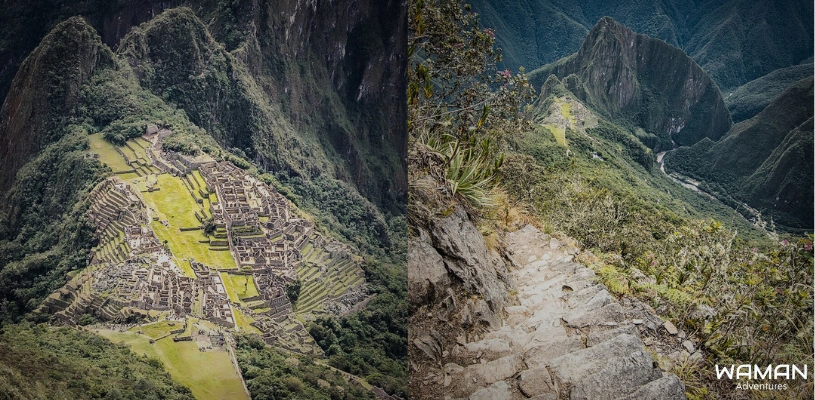
The difficulty of climbing this majestic mountain is considered moderate. Don’t worry; this is an extremely enjoyable route. Imagine the feeling of walking on ancient trails surrounded by lush vegetation that gives a special touch to the adventure. In the end, the reward will be an incredible view that you can only appreciate if you dare to live this experience.
Why is it considered a moderate route?
Part of the route has an ascent with a slope of approximately 30 degrees, and as you ascend, you will reach its highest point, which is over 3,000 m / 9,842 ft ASL.

The summit of Machu Picchu Mountain
How many people can climb Machu Picchu Mountain daily?
We understand your keen interest in being well-informed. Typically, Machu Picchu Mountain receives the visit of around 300 tourists daily, coinciding with ticket availability. However, you might wonder why the total entries for Machu Picchu are higher.
The Machu Picchu citadel is split into 4 different circuits, each with a specific number of tickets available for visitation. It’s important to note this detail: if you’re planning to visit Machu Picchu Mountain, you’ll need to reserve Circuit 3. Don’t forget this crucial detail for your visit!
Is it necessary to book in advance the tickets for Machu Picchu Mountain?
You must book in advance. Keep in mind that Machu Picchu, as such, has a high demand, and is every traveler’s dream to visit this incredible place. Now that you know Machu Picchu Mountain has limited availability, we recommend booking it at least 3 months in advance. Booking in advance will greatly help ensure your trip goes smoothly. Book it as soon as possible! If you don’t do that, it’s highly unlikely or almost impossible to find a ticket overnight.
Dear traveler, if you need assistance or help, allow us to be your travel companions. Feel free to contact our Waman Adventures agents, who will support you at all times. You can also find us on platforms like Facebook, Instagram, TikTok, TripAdvisor, and TourRadar, where you can see reviews from many of our satisfied clients who were pleased with our services.

What are the schedules for visiting Machu Picchu Mountain?
Take note, it’s crucial to know that if you want to climb Machu Picchu Mountain, you can’t do it at any time of the day. Remember that when you book your entrance ticket, you’ll only see two available schedules as options.
Traveler, if you’re planning to travel during the rainy season, we recommend booking your ticket in the second or second group. Why? This action will help you avoid the fog that may appear that day and hinder the incredible view offered by Machu Picchu Mountain, but you never know.
Here are the two schedules for entering this mountain.
- First group
The first group enters Machu Picchu from 7 a.m. to 8 a.m.
- Second group
The second group enters Machu Picchu from 9 a.m. to 10:00 a.m.

Book your ticket on Joinnus’ website.
Prices of Machu Picchu Mountain’s tickets
For you, traveler, it’s very important to consider this: only the Machu Picchu Mountain + Circuit 3 route will allow you to access this mountain. Regarding the prices, these vary depending on your nationality and age, so you can take advantage of discounts during the booking process that will surely catch your attention. Below, we provide you with the details of the prices:
Foreign travelers:
- General Price: 200 PEN / 52 USD.
- Students: 125 PEN / 33 USD.
- Children (3 to 17 years old): 118 PEN / 31 USD.
Travelers from CAN countries and Peruvians:
- General Fare: 112 PEN / 29 USD.
- Students: 80 PEN / 21 USD.
- Children (3 to 17 years old): 80 PEN / 21 USD.
Local (Cusco) travelers:
For travelers from Cusco, this route is not available. We know that on Sundays, entry is free for Cusco residents, but only on circuits 1 and 2; keep in mind that only these routes are available, not Circuit 3. However, don’t worry, this doesn’t mean you won’t be able to visit.
When making your reservation, select the option for travelers from countries of the Andean Community of Nations (CAN) and Peruvians to purchase a ticket to climb Machu Picchu Mountain. We mentioned the prices above so you can plan your trip.
Machu Picchu Mountain + Circuit 3 Ticket
You should book this ticket if you plan to ascend Machu Picchu Mountain. Keep in mind that you won’t be able to take the classic photo on the route, but you’ll have a similar and much more panoramic view of the Inca citadel of Machu Picchu.
Within this circuit, you can visit places such as:
- Qolqas Agricultural Zone.
- Water Canal.
- Dry Moat.
- Temple of the Sun.
- Complex Inca House.
- Complex Water sources.
- Water Mirror Complex.
- Pisonay Square.
- Archaeological Reserve.

Circuit 3 route in Machu Picchu
Hiking experience
What tour can I take to walk through Machu Picchu Mountain?
Do you want to make your visit unforgettable and unique different from any other traveler’s? If your answer is “yes,” Waman Adventures gives you the incredible opportunity to complement your travel itinerary with a visit to Machu Picchu Mountain through our travel packages and individual tours.
Whether you’re passionate about trekking, a natural-born adventurer, or prefer to experience Machu Picchu quickly with a full-day tour, Waman Adventure will orchestrate it for you. We have options for all tastes:
What kind of views can I witness from Machu Picchu Mountain?
We mentioned that this is one of the highest mountains near the Machu Picchu citadel, so the views it offers are some of the most privileged you could enjoy if you plan to climb Machu Picchu Mountain.
Part of this view includes:
- The mountains surrounding the Historic Sanctuary.
- Huayna Picchu Mountain.
- Huchuy Picchu Mountain.
- The Machu Picchu citadel.
All of them offer a spectacular panoramic perspective. The view is incredible, so don’t forget to bring your camera. Climbing to Machu Pichu mountain will be one of the most life-unique moments you will experience.

Other mountains you can contemplate at Machu Picchu Mountain’s summit
Can I see Machu Picchu from Machu Picchu Mountain?
Of course, you can see the Inca citadel of Machu Picchu from the summit. This natural mountain viewpoint, located south of the citadel, will allow you to enjoy a unique and incomparable panoramic view. Although you may not have heard of it, rest assured that it has always been there, waiting for you to discover it.
Don’t forget to bring your camera to capture those moments at the top. Your photos will be the envy of all your friends and family, and they will forever remember you and the incredible experience of having visited Machu Picchu from a different perspective.
How long does this hike last?
The hike to Machu Picchu Mountain takes approximately between 3 and 4 hours in total, round trip. The route is less demanding than the ascent to Huayna Picchu Mountain, as the slope is much gentler.
Keep in mind that the hiking hours are approximate. Each person has their own pace, and the time may vary. Plan your trip, as ticket availability is limited and demand is high.

The summit stands as one of the highest in the area.
Comparisons and recommendations
Is Huayna Picchu better than Machu Picchu Mountain?
Location
- Machu Picchu Mountain: This mountain is located south of the Machu Picchu citadel, and although it passes inconspicuously behind the citadel, it offers an impressive view you shouldn’t miss.
- Huayna Picchu: This mountain is located north of the Machu Picchu citadel. I bet if you’ve seen the classic photos of the citadel many times, this mountain appears in the background.
Difficulty Level
- Machu Picchu Mountain: Ascending this mountain has a moderate level; the path is less steep, so you won’t experience as much tension to overcome vertigo. However, the view from the top is still incredible.
- Huayna Picchu: This mountain has a challenging level of difficulty due to the steepness of the path and also poses a challenge to overcome the fear of heights.
Slope degree
- Machu Picchu Mountain: To reach this place, the journey inclines around 30 degrees and is less steep than Huayna Picchu, which facilitates proper mobilization and allows you to arrive without many setbacks.
- Huayna Picchu: The trail, in general, has an inclination of approximately 60 degrees, which is very steep and requires certain sections to have to walk with arms close to the path.
Maximum altitude
- Machu Picchu Mountain: This mountain, with its highest peak at 3,082 m / 10,111 ft ASL, offers a quieter option, especially if you do family travel. From here, you can also enjoy a spectacular view of Machu Picchu and, in the distance, of Huayna Picchu.
- Huayna Picchu: Upon reaching the top of this mountain, you will be at about 2,720 m / 8,923 ft ASL approx. Keep in mind that Machu Picchu is at 2,430 m.a.s.l. With this, you can already imagine the impressive view from this mountain.
Permitted age
- Machu Picchu Mountain: Exploring this mountain is not restricted to specific ages; children and adults can enjoy this experience.
- Huayna Picchu: When ascending this mountain, it is important to note that only travelers aged 12 and older are allowed. This measure is implemented to ensure minors’ well-being and all visitors’ safety.
You have learned about the characteristics of both alternatives and now comes the crucial moment: Which one would you choose?
Both options will surprise you with incredible views and a unique route; however, the final decision will depend on your preferences. Don’t forget to share your opinion with us. Leave your comment in the corresponding section and tell us which option has conquered you.
Is it worth climbing Machu Picchu Mountain?
Is it worth it? Absolutely yes! Remember that this place is beside the Machu Picchu citadel, one of the most famous places in the world and one that every traveler dreams of visiting at least once in their life. Travelers, let us be your travel companions. Waman Adventures is your best choice for your trips. Let us help you plan everything. We have a large professional team at your disposal.
Remember not to forget your camera. As we are conscious you will want to share your photos on social media. Your memories will be uploaded to them.
Is a guide needed to climb Machu Picchu Mountain?
To enter the mountain and the Machu Picchu citadel, it is not mandatory to have a guide, but it would be great if you could have one. Your visit could be much better, and besides, you would have someone who would support you throughout the route, from the beginning to the end of your journey. Finally, you will hear and learn about stories you never imagined about this incredible place.
Are guides available for the hike to Machu Picchu Mountain?
Of course, they are. If, for some reason, you forgot to hire one, you can find guides offering their services at the entrance to Machu Picchu. Don’t forget to agree on a price to avoid problems later. Waman Adventures also has a wide range of guides, don’t hesitate to contact us; we guarantee a truly unique experience.
Are there prohibited items when climbing Machu Picchu Mountain?
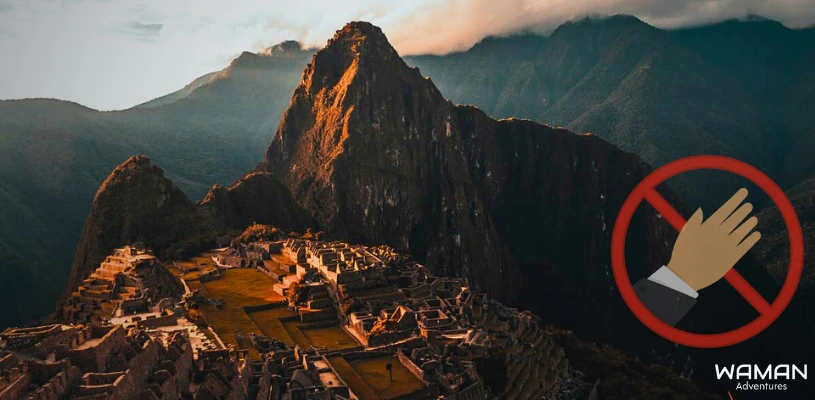
Of course, there are items that you should not bring or use. Keep in mind that for Machu Picchu Mountain there are no specific rules. So can I bring whatever I want? You won’t be able to do it, since the rules you must follow will be those established for the Machu Picchu citadel.
These prohibitions can also be found on the JOINUSS booking page, such as:
- Carrying backpacks, bags, or purses larger than 40x35x20 cm (16x14x8 inches).
- Entering with food and utensils.
- Entering with any illegal substance or under its effects.
- Entering with any type of alcoholic beverage or in an alcoholic state. Carrying canes, umbrellas, parasols, portable seats, tripods, supports, or extensions for cameras, cell phones, or any other stabilization or extension element for filming and/or photography.
- Entering with animals, except guide dogs.
- Feeding domestic and wild animals.
- Entering with any type of aerosols.
- Making any kind of graffiti.
- Entering with any type of musical instrument, megaphone, or speaker.
- Making loud or annoying noises like clapping, shouting, whistling, or singing, among others.
- Using virtual apps with cell phones or mobile devices in narrow arteries. Entering with heels or hard-soled shoes.
- Accessing with baby carriages.
- Entering with sharp objects and/or weapons of any kind.
- Entering with banners, posters, signs, clothing intended for advertising purposes, and costumes, among other objects of this type.
- Making recordings or photographs for advertising purposes.
- Causing turmoil, jumping, lying down, running, undressing, or creating disorder.
- Climbing or leaning on walls and/or structures.
- Touching, moving, or extracting lithic elements.
- Disturbing, collecting, or extracting flora or fauna.
- Doing activities that distort the sacred character of the Machupicchu Llaqta; such as fashion shows, dances, social commitments, obscene acts contrary to morals and good manners, or any type of activity that implies the impairment or deterioration of the monument, its natural environment, and/or facilities.
- Smoking, vaping, or making any kind of fire.
- Throw away any type of waste.
- Not respecting established circuits and routes.
- Street vending in the monument and surrounding areas up to the Ruinas Bridge.
- Performing overflights with paragliders, drones, or any type of small device.
- Performing acts or entering with prohibited objects on this list will result in the immediate expulsion of the visitor without the right to a refund and the initiation of corresponding legal actions. The park rangers of the Ministry of Culture and the agents of the National Police are the authorities inside the monument.
Are there age or health restrictions to climbing Machu Picchu mountain?
Age Restrictions
There are no age restrictions as such for visiting Machu Picchu Mountain, making it ideal for an unforgettable family trip.
The new booking platform JOINUSS facilitates the planning of your trip. Minors, aged 3 to 17, have special rates. Additionally, you can find offers and discounts that fit your budget.
So, what are you waiting for? Pack your bags, travel, and discover Machu Picchu Mountain. We are sure that you will greatly enjoy this destination.
Health restrictions
While there are no specific restrictions for visiting Machu Picchu Mountain, it is very important to consider your well-being and that of your companions when making this trip.
Waman Adventures deeply cares about our travelers’ safety and comfort, so we discourage visits from people with certain motor disabilities. The reason is simple: the path to Machu Picchu has a large number of steps that require considerable physical effort and a certain degree of mobility.
Before planning your trip, we recommend focusing on improving your physical condition. This will help you enjoy the experience to the fullest and avoid possible difficulties during the journey. Take into account our recommendations, as they will help you have a safe trip and a unique and unforgettable experience.

Group of people of different ages in Machu Picchu
Is it dangerous to hike up Machu Picchu Mountain?
This route does not present any danger and is much easier than the Huayna Picchu hike. However, always remember to follow the rules of the archaeological park and follow your guide’s instructions.
Thanks to its ease, it is an ideal route for families to enjoy, as there is no age limit. Additionally, park rangers are working at various points along the trail, they ensure travelers’ safety. In case of an emergency, they will be the first to assist you and request help from a specialized team.
Are there rest stops along the way to Machu Picchu Mountain?
It’s important to be aware that there are no established rest points on this route, although we may all feel fatigued at some point and need to take a break. So, where can I rest? You can do it at any point along the way, but it’s essential to move aside to avoid blocking the trail. This way, you can regain some of your energy and continue towards the summit of Machu Picchu Mountain.
During these rest moments, we recommend drinking water and eating some snacks. However, remember to pack away food wrappers to keep our environment clean and preserve the natural beauty of the route leaving no trace.
What equipment or training do I need to climb Machu Picchu Mountain?
Equipment
If you’ve reached this point, we’re sure you’re planning to visit Machu Picchu Mountain, so here are some suggestions for items you should pack in a small backpack. Keep in mind that you should only bring what is necessary to avoid inconvenience or discomfort from the weight of your backpack besides the rules.
Here are some suggested items to take on your trip:
- Water Bottle: It’s important to stay hydrated, so we recommend bringing a canteen instead of disposable bottles.
- Appropriate Clothing: Wear comfortable and breathable clothing.
- Hiking Shoes or Sneakers: Very important when hiking.
- Medium or Small Backpack: Make sure your backpack is not excessively large, as it’s a one-day hike, and you’ll only need to carry the essentials.
- Sunscreen and Hat: The weather in Cusco is variable, and it’s important to protect yourself, especially on hot days.
- Snacks: You won’t find any shops, so bringing small snacks will help you avoid hunger.
- Camera: The scenic beauty during the hike will leave you amazed, so be sure to bring your camera to capture incredible images.
- Cash: Throughout the journey, before and after trekking, you may find places selling items of interest like toilets.
Training
Travellers, it’s essential to take care of your health and well-being, whether for this trip or any other you plan. On this particular route, you’ll need to exert yourself a bit as you ascend the mountain, so your physical condition will be crucial.
At Waman Adventures, we care about our travelers’ enjoyment while staying in Peru. Therefore, we’ll provide you with some simple and effective suggestions to consider.
- Aerobic training: Aerobic training is essential for strengthening the heart and improving breathing. You can choose between running, cycling, or swimming to reap these benefits.
- Resistance Training: A simple yet effective exercise to strengthen your muscles is to do squats. This leg-focused exercise will help improve your endurance and efficiency in your movements.
- Essential Stretches: After each workout session, it’s crucial to stretch your muscles a little bit. These cool-down stretches will help relax the muscles and improve your body’s flexibility.

Training before traveling to the Andes
You’ve reached the end of this guide! Follow the advice on this Waman Adventures blog, prepare yourself, and live an experience you’ll never forget.
Plan for the perfect trip. Purchase your ticket in advance, choose your route, and make sure you’re in shape for the hike. Don’t forget to pack comfortable clothing, sunscreen, and insect repellent.
You’re more than ready to conquer Machu Picchu Mountain! Get ready to have a unique experience you’ll never forget.
Share:



Related tours you might be interested in
Enjoy unique experiences in Cusco and Machu Picchu with the peace of mind that comes from working with a local travel agency

02 DAY «EXPLORING» THE SACRED VALLEY AND MACHU PICCHU
CHINCHERO, MARAS AND MORAY WILL ENVELOP YOU IN THE MAGIC OF THE SACRED VALLEY. EACH EXPERIENCE WILL...

Full Day – «Exploring» Machu Picchu
MACHU PICCHU EPIC ADVENTURE TOUR FROM CUSCO This full-day option is an excellent opportunity to...

04 DAY CUSCO – SACRED VALLEY – MACHU PICCHU
DISCOVER THE MAGIC OF CUSCO, THE SERENITY OF THE SACRED VALLEY AND THE GRANDEUR OF MACHU PICCHU On...

10 Days Andean Dreamscapes – Lima, Ica, Cusco & Puno with Local Flights
YOUR NEXT DESTINATION IS PERU, THE LAND OF FASCINATING STORIES AND OUTSTANDING LANDSCAPES! With our...
If you liked this article and the information you found, give us 5 stars!
Table of Contents
Related blogs
Best Things to Do in Puno: Discover the Magic of the Andean Highlands
13 min of reading